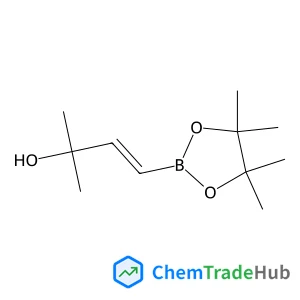
(E)-2-methyl-4-(4,4,5,5-tetramethyl-1,3,2-dioxaborolan-2-yl)but-3-en-2-ol
CAS Number:
581802-26-8
Molecular Formula:
C11H21BO3
Xiaoyong Zhao, Yan Liu, Kirk S. Schanze
A new fluorescence turn-on sensor consisting of PPE-CO2–/Cu2+ shows high selectivity for pyrophosphate over other anions and is used to develop a real-time assay for alkaline phosphatase.
Xi Zhao, Chunzhen Wang, Haijiao Zheng, Zean Tian, Lina Hu
DOI: 10.1039/C7CP02111A
DOI: 10.1039/C7CP01103B
DOI: 10.1039/C7CP01864A
Zhengfei Zhang, Liping Sheng, Lu Chen, Ze Zhang, Yong Wang
DOI: 10.1039/C7CP03071A
Liangshuai Zhong, Xiaofang Chen, Jingshan Qi
DOI: 10.1039/C7CP00964J
Zhen Jiang, Konstantin Klyukin
DOI: 10.1039/C7CP02350B
Julin Joseph, Aji A. Anappara
DOI: 10.1039/C7CP02731A
Liang Liu, Alain Walcarius
DOI: 10.1039/C7CP01775H
S. Güryel, M. Walker, P. Geerlings, F. De Proft, M. R. Wilson
DOI: 10.1039/C7CP01552F
Josep M. Anglada, Ramon Crehuet, Marilia Martins-Costa, Joseph S. Francisco, Manuel Ruiz-López
DOI: 10.1039/C7CP01976A
When considering alternatives to 1-(4-Chlorophenyl)-N-hydroxymethanimine (CAS: 3...
This compound should be stored in a cool, dry place away from direct sunlight. I...
3-(4-Bromophenyl)-5-(2-fluorophenyl)-1,2,4-oxadiazole is synthesized through a m...
5-Chloro-2-(4-chlorophenyl)-4-methyl-6-[3-(1-piperidinyl)propoxy]pyrimidine (CAS...
2-Chloro-4-(difluoromethoxy)pyridine is used in the pharmaceutical industry for ...
3-Chloro-6-methylpyridazine (CAS: 1121-79-5) is classified under the Globally Ha...
Several alternatives can be used in the synthesis of Methyl 4,5-dimethyl-2-nitro...
Alternatives to (2E,2'E)-3,3'-(1,4-Phenylene)bisacrylaldehyde include other acry...
3-Amino-5-chloropyridin-2-ol hydrochloride is an organic compound with the CAS n...
When handling 6,7-Difluoro-2,3-dihydro-4H-chromen-4-one, it is essential to wear...

ChemComm publishes urgent research which is of outstanding significance and interest to experts in the field, while also appealing to the journal’s broad chemistry readership. Our communication format is ideally suited to short, urgent studies that are of such importance that they require accelerated publication. Our scope covers all topics in chemistry, and research at the interface of chemistry and other disciplines (such as materials science, nanoscience, physics, engineering and biology) where there is a significant novelty in the chemistry aspects. Major topic areas covered include: Analytical Chemistry Catalysis Chemical Biology and medicinal chemistry Computational Chemistry and Machine Learning Energy and sustainable chemistry Environmental Chemistry Green Chemistry Inorganic Chemistry Materials Chemistry Nanoscience Organic Chemistry Physical Chemistry Polymer Chemistry Supramolecular Chemistry