












Comparison of high pressure and nanoscale confinement effects on crystallization of the molecular glass-forming liquid, dimethyl phthalate
Literature Information
Publication Date
2017-05-05
DOI
10.1039/C7CP01864A
Impact Factor
3.676
Authors
View Original
Abstract
High pressure and nanoscopic confinement are two different strategies commonly employed to modify the physicochemical properties of various materials. Both strategies act mostly by changing the molecular packing. In this work, we performed a comparative study on the effect of compression and confined geometry on crystallization of a molecular liquid. Dielectric spectroscopy was employed to investigate the crystallization of the van der Waals liquid, dimethyl phthalate, in nanoporous alumina of different pore sizes as well as on increased pressure (up to 200 MPa). The analysis of the crystallization kinetics under varying thermodynamic conditions revealed that both strategies affect the crystallization behavior of the sample in very distinct ways. Compression shifts the maximum crystallization rate towards a higher temperature and broadens it. As a result, it is more challenging to avoid crystallization upon cooling the liquid at high pressure. In contrast, when the same material is incorporated into nanopores, crystallization significantly slows down and the maximum rate shifts towards a lower temperature with decreasing pore size. Finally, we show that crystallization in nanoporous alumina is accompanied by pre-crystallization effects upon which a shift of the α-relaxation peak is observed. An equilibration process prior to the initiation of crystallization was detected for the confined material both above and below the glass transition temperature of the interfacial layer, while not in the bulk.
Recommended Journals
Related Literature
The investigation of photo-induced chemiluminescence on Co2+-doped TiO2nanoparticles and its analytical application
Guixin Li, Hongyan Nan, Xingwang Zheng
2009-03-25
Paper
DOI: 10.1039/B816226C
Multiple sized europium(III) chelate-dyed polystyrene particles as donors in FRET – an application for sensitive protein quantification utilizing competitive adsorption
Antti Valanne, Jouko Peltonen, Tero Soukka, Pekka Hänninen, Harri Härmä
2009-03-02
Paper
DOI: 10.1039/B821210D
Microchip-based integration of cell immobilization, electrophoresis, post-column derivatization, and fluorescence detection for monitoring the release of dopamine from PC 12 cells
Michelle W. Li, R. Scott Martin
2008-07-08
Paper
DOI: 10.1039/B807093H
Sol–gel derived nano-structured zinc oxide film for sexually transmitted disease sensor
Anees A. Ansari, Renu Singh, G. Sumana, B. D. Malhotra
2009-03-06
Paper
DOI: 10.1039/B817562D
Gold nanoparticle-based immunoassay by using non-stripping chemiluminescence detection
Chun-Feng Duan, Yu-Qi Yu, Hua Cui
2008-07-28
Paper
DOI: 10.1039/B807163B
Optofluidic ring resonator sensors for rapid DNT vapor detection
Yuze Sun, Jing Liu, Greg Frye-Mason, Shiou-jyh Ja, Aaron K. Thompson, Xudong Fan
2009-03-20
Paper
DOI: 10.1039/B900050J
Wide range ammonia concentration analyzer utilizing a new principle of photoelectrochemical reaction at a nanoporous TiO2 photoanode
Takashi Suzuki, Hirohito Ueno, Junichi Nemoto, Yuki Fujii, Mikio Hoshino, Masao Kaneko
2009-05-28
Communication
DOI: 10.1039/B822512E
Visualization of local electrochemical activity and local nickel ion release on laser-welded NiTi/steel joints using combined alternating current mode and stripping mode SECM
D. Ruhlig, H. Gugel, A. Schulte, W. Theisen, W. Schuhmann
2008-09-23
Paper
DOI: 10.1039/B804718A
You might also like
Compound Q&A
Are there alternatives to 1-(4-Chlorophenyl)-N-hydroxymethanimine (CAS: 3848-36-0) in synthesis?
When considering alternatives to 1-(4-Chlorophenyl)-N-hydroxymethanimine (CAS: 3...
3848-36-01-(4-Chlorophenyl)-N...
Compound Q&A
How should (1R,9S,10S,12S,14E,16S,19R,20R,21S,22R)-3,9,21-Trihydroxy-5,10,12,14,16,20,22-heptamethyl-23,24-dioxatetracyclo[17.3.1.1~6,9~.0~2,7~]tetracosa-2,5,7,14-tetraen-4-one (CAS: 183202-73-5) be stored?
This compound should be stored in a cool, dry place away from direct sunlight. I...
183202-73-5(1R,9S,10S,12S,14E,1...
Compound Q&A
How is 3-(4-Bromophenyl)-5-(2-fluorophenyl)-1,2,4-oxadiazole (CAS: 419553-16-5) typically synthesized?
3-(4-Bromophenyl)-5-(2-fluorophenyl)-1,2,4-oxadiazole is synthesized through a m...
419553-16-53-(4-Bromophenyl)-5-...
Compound Q&A
How is 5-Chloro-2-(4-chlorophenyl)-4-methyl-6-[3-(1-piperidinyl)propoxy]pyrimidine (CAS: 1639220-19-1) typically synthesized?
5-Chloro-2-(4-chlorophenyl)-4-methyl-6-[3-(1-piperidinyl)propoxy]pyrimidine (CAS...
1639220-19-15-Chloro-2-(4-chloro...
Compound Q&A
What industries use 2-Chloro-4-(difluoromethoxy)pyridine (CAS: 1206978-15-5)?
2-Chloro-4-(difluoromethoxy)pyridine is used in the pharmaceutical industry for ...
1206978-15-52-Chloro-4-(difluoro...
Compound Q&A
What regulatory guidelines apply to 3-Chloro-6-methylpyridazine (CAS: 1121-79-5)?
3-Chloro-6-methylpyridazine (CAS: 1121-79-5) is classified under the Globally Ha...
1121-79-53-Chloro-6-methylpyr...
Compound Q&A
Are there alternatives to Methyl 4,5-dimethyl-2-nitrobenzoate in synthesis?
Several alternatives can be used in the synthesis of Methyl 4,5-dimethyl-2-nitro...
90922-74-0Methyl 4,5-dimethyl-...
Compound Q&A
Are there alternatives to (2E,2'E)-3,3'-(1,4-Phenylene)bisacrylaldehyde in synthesis?
Alternatives to (2E,2'E)-3,3'-(1,4-Phenylene)bisacrylaldehyde include other acry...
63405-68-5(2E,2'E)-3,3'-(1,4-P...
Compound Q&A
What is 3-Amino-5-chloropyridin-2-ol hydrochloride (CAS: 1261906-29-9)?
3-Amino-5-chloropyridin-2-ol hydrochloride is an organic compound with the CAS n...
1261906-29-93-Amino-5-chloropyri...
Compound Q&A
What precautions should be taken when handling 6,7-Difluoro-2,3-dihydro-4H-chromen-4-one (CAS: 1092349-93-3)?
When handling 6,7-Difluoro-2,3-dihydro-4H-chromen-4-one, it is essential to wear...
1092349-93-36,7-Difluoro-2,3-dih...
Source Journal
Physical Chemistry Chemical Physics

CiteScore:
5.5
Self-citation Rate:
10.3%
Articles per Year:
3036
Physical Chemistry Chemical Physics (PCCP) is an international journal co-owned by 19 physical chemistry and physics societies from around the world. This journal publishes original, cutting-edge research in physical chemistry, chemical physics and biophysical chemistry. To be suitable for publication in PCCP, articles must include significant innovation and/or insight into physical chemistry; this is the most important criterion that reviewers and Editors will judge against when evaluating submissions. The journal has a broad scope and welcomes contributions spanning experiment, theory, computation and data science. Topical coverage includes spectroscopy, dynamics, kinetics, statistical mechanics, thermodynamics, electrochemistry, catalysis, surface science, quantum mechanics, quantum computing and machine learning. Interdisciplinary research areas such as polymers and soft matter, materials, nanoscience, energy, surfaces/interfaces, and biophysical chemistry are welcomed if they demonstrate significant innovation and/or insight into physical chemistry. Joined experimental/theoretical studies are particularly appreciated when complementary and based on up-to-date approaches.
Recommended Compounds
![2-{[(1R,2S)-2-Aminocyclohexyl]amino}-4-{[3-(2H-1,2,3-triazol-2-yl)phenyl]amino}-5-pyrimidinecarboxamide structure](https://static.chemtradehub.com/structs/137/1370261-96-3-40df.webp "2-{[(1R,2S)-2-Aminocyclohexyl]amino}-4-{[3-(2H-1,2,3-triazol-2-yl)phenyl]amino}-5-pyrimidinecarboxamide structure")
2-{[(1R,2S)-2-Aminocyclohexyl]amino}-4-{[3-(2H-1,2,3-triazol-2-yl)phenyl]amino}-5-pyrimidinecarboxamide
CAS Number:
1370261-96-3
Molecular Formula:
C19H23N9O
![6-Bromo-2,3-dihydro-1H-pyrido[2,3-b][1,4]oxazine structure](https://static.chemtradehub.com/structs/120/1203499-17-5-b4d1.webp "6-Bromo-2,3-dihydro-1H-pyrido[2,3-b][1,4]oxazine structure")
6-Bromo-2,3-dihydro-1H-pyrido[2,3-b][1,4]oxazine
CAS Number:
1203499-17-5
Molecular Formula:
C7H7BrN2O
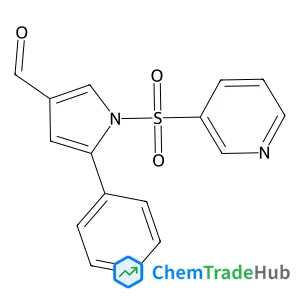
5-Phenyl-1-(pyridin-3-ylsulfonyl)-1H-pyrrole-3-carbaldehyde
CAS Number:
881676-90-0
Molecular Formula:
C16H12N2O3S
Recommended Suppliers






Disclaimer
This page provides academic journal information for reference and research purposes only. We are not affiliated with any journal publishers and do not handle publication submissions. For publication-related inquiries, please contact the respective journal publishers directly.
If you notice any inaccuracies in the information displayed, please contact us at support@chemtradehub.com. We will promptly review and address your concerns.