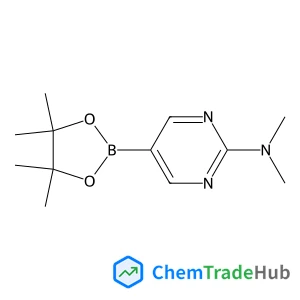
N,N-Dimethyl-5-(4,4,5,5-tetramethyl-1,3,2-dioxaborolan-2-yl)-2-pyrimidinamine
CAS Number:
1032759-30-0
Molecular Formula:
C12H20BN3O2
Josep M. Anglada, Ramon Crehuet, Marilia Martins-Costa, Joseph S. Francisco, Manuel Ruiz-López
The atmospheric oxidation of methyl hydroperoxide by the hydroxyl radical has been investigated employing high level theoretical methods. This reaction is important in the chemistry of the troposphere because these species contribute to the oxidizing capacity of the atmosphere and therefore we have studied the bare reaction and the effect of the relative humidity as well. In both cases the reaction can proceed either by abstraction of the terminal hydrogen atom of the OH group, producing CH3O2 + H2O, or by abstraction of one hydrogen atom of the CH3 group, forming H2CO + OH + H2O. We have employed BH&HLYP, QCISD and CCSD(T) theoretical methods along with 6-311+G(2df,2p), aug-cc-pVTZ, aug-cc-pVQZ and CBS basis sets to investigate the reaction mechanism, and conventional and variational transition state theory to study the kinetics of the reaction. For the bare reaction we have computed at room temperature, a rate constant of 3.59 × 10⁻¹² cm3 molecule−1 s−1 for the formation of CH3O2 + H2O and of 1.68 × 10⁻¹² cm3 molecule−1 s−1 for the production of H2CO + OH + H2O, with branching ratios of 68% and 32% respectively. Water vapor enhances the rate constant for the formation of CH3O2 + H2O between 2 and 19%, depending on the temperature and relative humidity, whereas the rate constant for the production of H2CO + OH + H2O is enhanced between 0.3 and 5% by the effect of water vapor under the same conditions, which means that the branching ratio for the formation of CH3O2 + H2O is increased up to 2.5%.
Abeer A. Alzahrani, Annette H. Erbse, Christopher N. Bowman
DOI: 10.1039/C3PY01064C
Xiaoyu Wu, Songmei Li, Bo Wang, Jianhua Liu, Mei Yu
DOI: 10.1039/C7CP00509A
Weijun Zhang, Kunxi Zhang, Shifeng Yan, Jie Wu, Jingbo Yin
DOI: 10.1039/C8TB01981A
Yiyin Mao, Wei Cao, Junwei Li, Yu Liu, Yulong Ying, Luwei Sun
DOI: 10.1039/C3TA12402A
B. P. Vinayan, Rupali Nagar, S. Ramaprabhu
DOI: 10.1039/C3TA12016C
Alexandre Simula, Fernando Ruipérez, Nicholas Ballard, José R. Leiza, José M. Asua
DOI: 10.1039/C8PY00900G
Yonghang Xu, Min Xiao, Shuanjin Wang, Mei Pan, Yuezhong Meng
DOI: 10.1039/C4PY00008K
Huayu Tian, Jianxun Ding, Jie Chen, Xuesi Chen
DOI: 10.1039/C3PY01781H
Sabrina Aufar Salma, Dong Woo Kim, Cuong Minh Quoc Le, Byung-Hyun Ahn, Gun-Do Kim, Kwon Taek Lim
DOI: 10.1039/C8PY00961A
Xiaoyun Li, Yi-Chen Li, Mingjie Chen, Qingshan Shi, Runcang Sun, Xiaoying Wang
DOI: 10.1039/C8TB01085D
When considering alternatives to 1-(4-Chlorophenyl)-N-hydroxymethanimine (CAS: 3...
This compound should be stored in a cool, dry place away from direct sunlight. I...
3-(4-Bromophenyl)-5-(2-fluorophenyl)-1,2,4-oxadiazole is synthesized through a m...
5-Chloro-2-(4-chlorophenyl)-4-methyl-6-[3-(1-piperidinyl)propoxy]pyrimidine (CAS...
2-Chloro-4-(difluoromethoxy)pyridine is used in the pharmaceutical industry for ...
3-Chloro-6-methylpyridazine (CAS: 1121-79-5) is classified under the Globally Ha...
Several alternatives can be used in the synthesis of Methyl 4,5-dimethyl-2-nitro...
Alternatives to (2E,2'E)-3,3'-(1,4-Phenylene)bisacrylaldehyde include other acry...
3-Amino-5-chloropyridin-2-ol hydrochloride is an organic compound with the CAS n...
When handling 6,7-Difluoro-2,3-dihydro-4H-chromen-4-one, it is essential to wear...

Physical Chemistry Chemical Physics (PCCP) is an international journal co-owned by 19 physical chemistry and physics societies from around the world. This journal publishes original, cutting-edge research in physical chemistry, chemical physics and biophysical chemistry. To be suitable for publication in PCCP, articles must include significant innovation and/or insight into physical chemistry; this is the most important criterion that reviewers and Editors will judge against when evaluating submissions. The journal has a broad scope and welcomes contributions spanning experiment, theory, computation and data science. Topical coverage includes spectroscopy, dynamics, kinetics, statistical mechanics, thermodynamics, electrochemistry, catalysis, surface science, quantum mechanics, quantum computing and machine learning. Interdisciplinary research areas such as polymers and soft matter, materials, nanoscience, energy, surfaces/interfaces, and biophysical chemistry are welcomed if they demonstrate significant innovation and/or insight into physical chemistry. Joined experimental/theoretical studies are particularly appreciated when complementary and based on up-to-date approaches.
![2-{[(1R,2S)-2-Aminocyclohexyl]amino}-4-{[3-(2H-1,2,3-triazol-2-yl)phenyl]amino}-5-pyrimidinecarboxamide structure](https://static.chemtradehub.com/structs/137/1370261-96-3-40df.webp "2-{[(1R,2S)-2-Aminocyclohexyl]amino}-4-{[3-(2H-1,2,3-triazol-2-yl)phenyl]amino}-5-pyrimidinecarboxamide structure")
![[4-(Isobutyrylamino)phenyl]boronic acid structure](https://static.chemtradehub.com/structs/874/874219-50-8-6ab5.webp "[4-(Isobutyrylamino)phenyl]boronic acid structure")