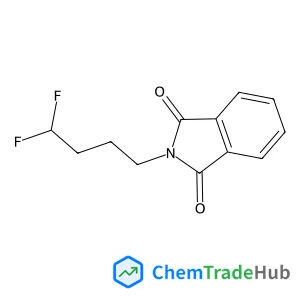
2-(4,4-Difluorobutyl)-1H-isoindole-1,3(2H)-dione
CAS Number:
1265341-14-7
Molecular Formula:
C12H11F2NO2
Wanan Cai, Zhicheng Wang, Zhaohui Shu, Wenbin Liu, Jun Wang, Jian Qiu
Fully bio-based benzoxazines are attractive thermosetting resins, but the limited variety of raw materials is a serious challenge for their further development. Herein, a new sustainable hyperbranched benzoxazine (HB), namely HB-Ra, was first designed and synthesized via the A2 + B3 method using resveratrol, paraformaldehyde and 5,5′-methylenedifurfurylamine (DFDA) derived from furfurylamine. The weight-average molecular weight (Mw) and polydispersity (PDI) of HB-Ra with good solubility were 17 000 Da and 2.26, respectively. Poly(HB-Ra) exhibited good thermal stability at high temperature at a 5% weight loss (T5) of 374 °C and a glass transition temperature (Tg) of 348 °C. Remarkably, the ultralow coefficient of thermal expansion (CTE) for poly(HB-Ra) was only 8.4 ppm °C−1. The low total heat release (THR) of 7.4 kJ g−1 and heat release capacity (HRC) of 39.6 J g−1 K−1 suggest that poly(HB-Ra) can be used as a potential nonignitable material. Moreover, poly(HB-Ra) exhibited low dielectric constants (k) varying from 2.38 to 2.42 in the range of 2–18 GHz, which may meet the needs of high-frequency microelectronic devices. These good results indicate that this technically simple synthetic strategy is a nice choice to prepare other fully bio-based HBs.
Fabrício Augusto de Lima, Cyril Gobinet, Ganesh Sockalingum, Sérgio Britto Garcia, Michel Manfait, Valérie Untereiner, Olivier Piot, Luciano Bachmann
DOI: 10.1039/C6AN01975G
Borja Cantero-Tubilla, Larry P. Walker
DOI: 10.1039/C8AN01137K
Arthur Schönhals, Hans Tholl, Mathias Glasmacher, Niels Kröger-Lui, Annemarie Pucci, Wolfgang Petrich
DOI: 10.1039/C6AN01757F
Zheng Cheng, Zhenyuan Bai, Yu Dai, Longbo Luo, Xiangyang Liu
DOI: 10.1039/C8AN01484A
Takao Ono, Takanori Ichiki
DOI: 10.1039/C8AN01152D
Gerardo Gutiérrez-Juárez, David Cywiak, Rafael Pérez-Solano, Gary A. Baker
DOI: 10.1039/C6AN02662A
Kawarpal Singh, Bernhard Blümich
DOI: 10.1039/C7AN00020K
Sofia Moriam, Muhammad Umer, Nam-Trung Nguyen
DOI: 10.1039/C8AN01348A
N-(4-Methoxybenzyl)-2-pyridinamine (CAS: 52818-63-0) is increasingly being used ...
When handling Ethyl 4-(2-chlorophenyl)-1,3-thiazole-2-carboxylate, appropriate p...
Diethyldiselane (CAS: 628-39-7) is classified under the Globally Harmonized Syst...
The market for oxocopper (CAS: 12053-18-8) is primarily driven by its use in cat...
The market for 5-{[(2-Methyl-2-propanyl)oxy]carbonyl}-5-azaspiro[2.4]heptane-7-c...
2-(1-Pyrrolidinyl)-4-pyridinamine is a chemical compound with the CAS number 359...
2-(3-Pyridinyl)-1-azabicyclo[2.2.2]octane (CAS: 91556-75-1) is a crystalline sol...
(S)-Alpha-allyl-proline hydrochloride is usually synthesized via a Wittig reacti...
3-Methyl-1,2-oxazole-5-carboxylic acid (CAS: 4857-42-5) is an organic compound w...
Lys-SMCC-DM1 is synthesized via a multi-step process involving the coupling of S...

Polymer Chemistry welcomes submissions in all areas of polymer science that have a strong focus on macromolecular chemistry. Manuscripts may cover a broad range of fields, yet no direct application focus is required.