












Contents
Literature Information
Publication Date
DOI
10.1039/B607311P
Impact Factor
6.222
Authors
View Original
Abstract
The first page of this article is displayed as the abstract.
Related Literature
Unexpected cleavage of tetrahydrofuran by catalytic reductive lithiation
Stéphane Streiff, Nigel Ribeiro, Laurent Désaubry
2004-01-13
Communication
DOI: 10.1039/B312972A
Significant and differential acceleration of dephosphorylation of the insecticides, paraoxon and parathion, caused by alkali metal ethoxides
Ik-Hwan Um, Sang-Eun Jeon, Mi-Hwa Baek, Hye-Ran Park
2003-11-07
Communication
DOI: 10.1039/B310055C
Generation of strong, homochiral bases by electrochemical reduction of phenazine derivatives
A. Mateo Alonso, Roberto Horcajada, Helen J. Groombridge, Reshma Mandalia, Majid Motevalli, James H. P. Utley, Peter B. Wyatt
2004-01-20
Communication
DOI: 10.1039/B313995F
Synthesis of new thermotropic liquid crystalline polyurethanes containing biphenyl mesogens using a novel AB-type self-polycondensation
T. Ranganathan, C. Ramesh, Anil Kumar
2003-11-24
Communication
DOI: 10.1039/B312826A
The synthesis of a di-N-heterocyclic carbene-amido complex of palladium(ii)
Richard E. Douthwaite, Jennifer Houghton, Benson M. Kariuki
2004-02-13
Communication
DOI: 10.1039/B314814A
A novel azulene synthesis from the Ramirez ylide involving two different modes of its reaction with activated alkynes
Lee J. Higham, P. Gabriel Kelly, David M. Corr, Helge Müller-Bunz, Brian J. Walker, Declan G. Gilheany
2004-02-11
Communication
DOI: 10.1039/B316759C
The first general method for α-trifluoromethylation of carboxylic acids using BrF3
Aviv Hagooly, Shlomo Rozen
2004-02-09
Communication
DOI: 10.1039/B315705A
Preparation and electrochemical behaviour of hydrophobic vitamin B12 covalently immobilized onto platinum electrode
Hisashi Shimakoshi, Mami Tokunaga, Keita Kuroiwa, Nobuo Kimizuka, Yoshio Hisaeda
2003-12-02
Communication
DOI: 10.1039/B309457J
Nucleic acid binding properties of thyminyl and adeninyl pyrrolidine-amideoligonucleotide mimics (POM)
T. H. Samuel Tan, David T. Hickman, Jordi Morral, Ian G. Beadham, Jason Micklefield
2004-01-28
Communication
DOI: 10.1039/B315768G
Novel cofacial oxidative coupling reaction of phosphinine in the presence of Cu(i) and ClO4−
Takahiko Kojima, Yoshitaka Ishioka, Yoshihisa Matsuda
2004-01-16
Communication
DOI: 10.1039/B308892H
You might also like
Compound Q&A
How should waste containing 2-Ethyl-4-Methyl-1H-Imidazole-5-Carbaldehyde (CAS: 88634-80-4) be handled?
Waste containing 2-Ethyl-4-Methyl-1H-Imidazole-5-Carbaldehyde (CAS: 88634-80-4) ...
88634-80-42-Ethyl-4-Methyl-1H-...
Compound Q&A
What industries use Triethoxy(octyl)silane (CAS: 1385031-14-0)?
Triethoxy(octyl)silane (CAS: 1385031-14-0) is widely used in the pharmaceuticals...
1385031-14-0Triethoxy(octyl)sila...
Compound Q&A
Are there alternatives to 3-iodo-7-nitro-1H-indazole (CAS: 864724-64-1) in synthesis?
Several alternatives to 3-iodo-7-nitro-1H-indazole (CAS: 864724-64-1) exist in t...
864724-64-13-iodo-7-nitro-1H-in...
Compound Q&A
Are there alternatives to Benzene, bis[(trimethoxysilyl)ethyl] (CAS: 266317-71-9) in synthesis?
Yes, there are alternatives to Benzene, bis[(trimethoxysilyl)ethyl] (CAS: 266317...
266317-71-9Benzene, bis[(trimet...
Compound Q&A
Is Isothiazole-3-carbonitrile (CAS: 1452-17-1) safe?
Isothiazole-3-carbonitrile (CAS: 1452-17-1) is generally considered safe when us...
1452-17-1Isothiazole-3-carbon...
Compound Q&A
Is (3-Chlorophenyl)methanol (CAS: 873-63-2) safe?
(3-Chlorophenyl)methanol (CAS: 873-63-2) is considered low to moderately toxic. ...
873-63-2(3-Chlorophenyl)meth...
Compound Q&A
How is (2S,3S)-2-Hydroxy-3-({[(2-methyl-2-propanyl)oxy]carbonyl}amino)-3-(2-naphthyl)propanoic acid (CAS: 959583-98-3) typically synthesized?
(2S,3S)-2-Hydroxy-3-({[(2-methyl-2-propanyl)oxy]carbonyl}amino)-3-(2-naphthyl)pr...
959583-98-3(2S,3S)-2-Hydroxy-3-...
Compound Q&A
What precautions should be taken when handling Methyl 2-(bromomethyl)-5-methoxybenzoate (CAS: 788081-99-2)?
Proper handling of methyl 2-(bromomethyl)-5-methoxybenzoate requires the use of ...
788081-99-2Methyl 2-(bromomethy...
Compound Q&A
What is 6,8-Dibromoimidazo[1,2-a]pyridine-2-carboxylic acid (CAS: 904805-36-3)?
6,8-Dibromoimidazo[1,2-a]pyridine-2-carboxylic acid (CAS: 904805-36-3) is an aro...
904805-36-36,8-Dibromoimidazo[1...
Compound Q&A
Is 3-Amino-5-bromo-2-pyridinecarbonitrile (CAS: 573675-27-1) safe?
3-Amino-5-bromo-2-pyridinecarbonitrile is considered safe when handled under pro...
573675-27-13-Amino-5-bromo-2-py...
Source Journal
Chemical Communications

CiteScore:
8.6
Self-citation Rate:
4.7%
Articles per Year:
2458
ChemComm publishes urgent research which is of outstanding significance and interest to experts in the field, while also appealing to the journal’s broad chemistry readership. Our communication format is ideally suited to short, urgent studies that are of such importance that they require accelerated publication. Our scope covers all topics in chemistry, and research at the interface of chemistry and other disciplines (such as materials science, nanoscience, physics, engineering and biology) where there is a significant novelty in the chemistry aspects. Major topic areas covered include: Analytical Chemistry Catalysis Chemical Biology and medicinal chemistry Computational Chemistry and Machine Learning Energy and sustainable chemistry Environmental Chemistry Green Chemistry Inorganic Chemistry Materials Chemistry Nanoscience Organic Chemistry Physical Chemistry Polymer Chemistry Supramolecular Chemistry
Recommended Compounds
![4,4'-[2,5-Biphenyldiylbis(oxy)]dianiline structure](https://static.chemtradehub.com/structs/941/94148-67-1-24c6.webp "4,4'-[2,5-Biphenyldiylbis(oxy)]dianiline structure")
methanone structure](https://static.chemtradehub.com/structs/814/81449-01-6-786d.webp "[4-(Hydroxymethyl)phenyl](phenyl)methanone structure")
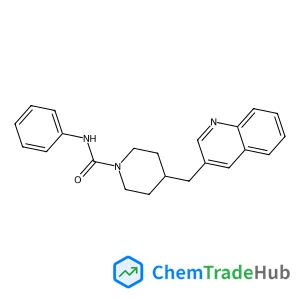
N-phenyl-4-(quinolin-3-ylmethyl)piperidine-1-carboxamide
CAS Number:
959151-50-9
Molecular Formula:
C22H23N3O
Recommended Suppliers





Disclaimer
This page provides academic journal information for reference and research purposes only. We are not affiliated with any journal publishers and do not handle publication submissions. For publication-related inquiries, please contact the respective journal publishers directly.
If you notice any inaccuracies in the information displayed, please contact us at support@chemtradehub.com. We will promptly review and address your concerns.