












Generation of strong, homochiral bases by electrochemical reduction of phenazine derivatives
Literature Information
Publication Date
2004-01-20
DOI
10.1039/B313995F
Impact Factor
6.222
Authors
A. Mateo Alonso, Roberto Horcajada, Helen J. Groombridge, Reshma Mandalia, Majid Motevalli, James H. P. Utley, Peter B. Wyatt
View Original
Abstract
Electrochemical reduction of enantiomerically pure amino- and alkoxy-phenazine derivatives forms strongly basic radical anions which give asymmetric induction in the conversion of 3,4-epoxytetrahydrothiophene-1,1-dioxide 7 into the allylic ester 9 with facile regeneration of the phenazine.
Related Literature
Cationic polythiophenes as responsive DNA-binding polymers
Webster L. Santos, John B. Matson, Regina C. So
2013-09-23
Communication
DOI: 10.1039/C3PY01069D
Direct synthesis of poly(p-phenyleneethynylene)s from calcium carbide
Nopparat Thavornsin, Mongkol Sukwattanasinitt, Sumrit Wacharasindhu
2013-08-12
Communication
DOI: 10.1039/C3PY01068F
Use of a switchable hydrophobic associative polymer to create an aqueous solution of CO2-switchable viscosity
Xin Su, Philip G. Jessop
2013-10-08
Paper
DOI: 10.1039/C3PY01382K
The relationship between the degree of branching and glass transition temperature of branched polyethylene: experiment and simulation
Xiang Luo, Shijie Xie, Jun Liu, Haibin Hu, Jing Jiang, Wei Huang, Haiyang Gao, Dongshan Zhou, Zhongyuan Lü, Deyue Yan
2013-10-23
Paper
DOI: 10.1039/C3PY00896G
Synthesis of well-defined amphiphilic branched polyethylene-graft-poly (N-isopropylacrylamide) copolymers by coordination copolymerization in tandem with RAFT polymerization and their self-assembled vesicles
Ye Zhao, Haiyang Gao, Guodong Liang, Fangming Zhu, Qing Wu
2013-09-27
Paper
DOI: 10.1039/C3PY01289A
Facile synthesis of chain end functionalized polyethylenes via epoxide ring-opening and thiol–ene addition click chemistry
Huayi Li, Jin-Yong Dong, Youliang Hu
2013-07-19
Paper
DOI: 10.1039/C3PY00727H
Poly(methacrylic acid) complexation of amphotericin B to treat neglected diseases
Ji-won Choi, Denis Martin, Vanessa Yardley, Keith Powell, Antony Godwin
2013-10-08
Paper
DOI: 10.1039/C3PY01051A
Precise synthesis of a rod-coil type miktoarm star copolymer containing poly(n-hexyl isocyanate) and aliphatic polyester
Toshifumi Satoh, Naoki Nishikawa, Daisuke Kawato, Daichi Suemasa, Sungmin Jung, Young Yong Kim, Moonhor Ree, Toyoji Kakuchi
2013-09-04
Paper
DOI: 10.1039/C3PY00985H
Porphyrin-containing hyperbranched supramolecular polymers: enhancing 1O2-generation efficiency by supramolecular polymerization
Yiliu Liu, Zehuan Huang, Kai Liu, Hans Kelgtermans, Wim Dehaen, Zhiqiang Wang, Xi Zhang
2013-08-22
Communication
DOI: 10.1039/C3PY01036H
You might also like
Compound Q&A
What are the main uses of 1H-Indazole-6-carbonitrile (CAS: 141290-59-7)?
1H-Indazole-6-carbonitrile finds applications in pharmaceuticals, where it serve...
141290-59-71H-Indazole-6-carbon...
Compound Q&A
How should waste containing Dioctyl (2E)-2-butenedioate (CAS: 2997-85-5) be handled?
Waste containing Dioctyl (2E)-2-butenedioate (CAS: 2997-85-5) should be collecte...
2997-85-5Dioctyl (2E)-2-buten...
Compound Q&A
What industries use Sodium [(1,2-benzoxazol-3-ylmethyl)sulfonyl]azanide (CAS: 68291-98-5)?
Sodium [(1,2-benzoxazol-3-ylmethyl)sulfonyl]azanide is primarily used in pharmac...
68291-98-5Sodium [(1,2-benzoxa...
Compound Q&A
Are there alternatives to Dimethyl 4-(4,4,5,5-tetramethyl-1,3,2-dioxaborolan-2-yl)-2,6-pyridinedicarboxylate (CAS: 741709-66-0) in synthesis?
Dimethyl 4-(4,4,5,5-tetramethyl-1,3,2-dioxaborolan-2-yl)-2,6-pyridinedicarboxyla...
741709-66-0Dimethyl 4-(4,4,5,5-...
Compound Q&A
How should waste containing 2-Fluoro-6-hydrazinopyridine (CAS: 80714-39-2) be handled?
Waste containing 2-Fluoro-6-hydrazinopyridine (CAS: 80714-39-2) should be manage...
80714-39-22-Fluoro-6-hydrazino...
Compound Q&A
What is 6-Formyl-2-pyridinecarboxylic acid (CAS: 499214-11-8)?
6-Formyl-2-pyridinecarboxylic acid is an organic compound with the molecular for...
499214-11-86-Formyl-2-pyridinec...
Compound Q&A
What is the market or research trend for 3-(3,4-dimethoxyphenyl)-2,5-dimethyl-N-(2-morpholin-4-ylethyl)pyrazolo[1,5-a]pyrimidin-7-amine (CAS: 900874-91-1)?
Research trends for this compound indicate a focus on its potential applications...
900874-91-13-(3,4-dimethoxyphen...
Compound Q&A
How is 9H-Tribenzo[b,d,f]azepine (CAS: 29875-73-8) typically synthesized?
9H-Tribenzo[b,d,f]azepine is typically synthesized via a multi-step process invo...
29875-73-89H-Tribenzo[b,d,f]az...
Compound Q&A
How is 1-Cyclopropyl-7-ethoxy-6-fluoro-8-methoxy-4-oxo-1,4-dihydro-3-quinolinecarboxylic acid (CAS: 1797982-51-4) typically synthesized?
1-Cyclopropyl-7-ethoxy-6-fluoro-8-methoxy-4-oxo-1,4-dihydro-3-quinolinecarboxyli...
1797982-51-41-Cyclopropyl-7-etho...
Compound Q&A
How should waste containing Methyl 3-oxo-1,2,3,4-tetrahydro-6-quinoxalinecarboxylate (CAS: 671820-52-3) be handled?
Waste containing Methyl 3-oxo-1,2,3,4-tetrahydro-6-quinoxalinecarboxylate (CAS: ...
671820-52-3Methyl 3-oxo-1,2,3,4...
Source Journal
Chemical Communications

CiteScore:
8.6
Self-citation Rate:
4.7%
Articles per Year:
2458
ChemComm publishes urgent research which is of outstanding significance and interest to experts in the field, while also appealing to the journal’s broad chemistry readership. Our communication format is ideally suited to short, urgent studies that are of such importance that they require accelerated publication. Our scope covers all topics in chemistry, and research at the interface of chemistry and other disciplines (such as materials science, nanoscience, physics, engineering and biology) where there is a significant novelty in the chemistry aspects. Major topic areas covered include: Analytical Chemistry Catalysis Chemical Biology and medicinal chemistry Computational Chemistry and Machine Learning Energy and sustainable chemistry Environmental Chemistry Green Chemistry Inorganic Chemistry Materials Chemistry Nanoscience Organic Chemistry Physical Chemistry Polymer Chemistry Supramolecular Chemistry
Recommended Compounds
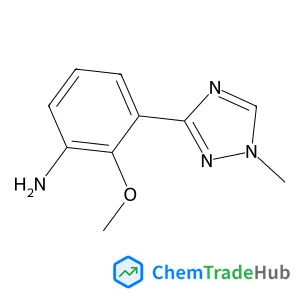
2-Methoxy-3-(1-methyl-1H-1,2,4-triazol-3-yl)aniline
CAS Number:
1609394-10-6
Molecular Formula:
C10H12N4O

Recommended Suppliers



Disclaimer
This page provides academic journal information for reference and research purposes only. We are not affiliated with any journal publishers and do not handle publication submissions. For publication-related inquiries, please contact the respective journal publishers directly.
If you notice any inaccuracies in the information displayed, please contact us at support@chemtradehub.com. We will promptly review and address your concerns.