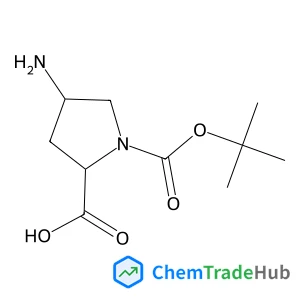
(2R,4R)-1-Boc-4-Aminopyrrolidine-2-carboxylic acid
CAS Number:
132622-98-1
Molecular Formula:
C10H18N2O4
Yinghua Jin, Robert M. Coates
Enolate anions generated from norterpenyl bromides bearing oxazolidinone chiral auxiliaries at the chain termini underwent efficient, stereo-biased cyclizations to form 6- and 14-membered rings in novel synthetic routes to α-terpineol and nephthenol enantiomers.
José Antonio Morales-Serna, Ericka Sánchez, Ricardo Velázquez, Jorge Bernal, Eréndira García-Ríos, Rubén Gaviño, Guillermo Negrón-Silva, Jorge Cárdenas
DOI: 10.1039/C0OB00161A
Richard J. Hopkinson, Philippa S. Barlow, Christopher J. Schofield, Timothy D. W. Claridge
DOI: 10.1039/C0OB00208A
Karina Mondragón-Vásquez, Hugo Morales-Rojas
DOI: 10.1039/B913315A
Atsushi Ohtaka, Takuto Teratani, Ryohei Fujii, Kanako Ikeshita, Osamu Shimomura
DOI: 10.1039/B915039K
Zhao-Bo Li, Shu-Ping Luo, Yi Guo, Ai-Bao Xia, Dan-Qian Xu
DOI: 10.1039/C002197K
Kazuhito Tanabe, Eiji Matsumoto, Takeo Ito, Sei-ichi Nishimoto
DOI: 10.1039/C0OB00275E
Yasuteru Urano, Hirotatsu Kojima, Takuya Terai, Kenjiro Hanaoka
DOI: 10.1039/B917209B
Christopher D. Gabbutt, B. Mark Heron, Colin Kilner, Suresh B. Kolla
DOI: 10.1039/C0OB00141D
Volker M. Arlt, David H. Phillips, Jóhannes Reynisson
DOI: 10.1039/C1OB05570D
(1R,3S)-1,3-Cyclopentanediol finds applications in various industries. In the ph...
When handling N'-[4-(Dimethylamino)phenyl]-N,N-dimethyl-1,4-benzenediamine, it i...
There are several alternatives to 5-(2,4-Difluorophenyl)-2-methoxypyrimidine in ...
1-(3-Methoxyphenoxy)propan-2-ol (CAS: 382141-68-6) must comply with the Globally...
Tetrodotoxin Citrate is extremely dangerous and should be handled with extreme c...
2-Methyl-2-propanyl [(1R,3S)-3-hydroxycyclopentyl]carbamate (CAS: 225641-84-9) i...
Waste containing 4-(2-Hydroxyhexafluoroisopropyl)Benzoic Acid (CAS: 16261-80-6) ...
2-Methyl-2-proanyl {(2S)-1-[(benzyloxy)amino]-3-hydroxy-3-methyl-1-oxo-2-butanyl...
Benzeneethanamine, α-ethyl-, hydrochloride (1:1) is an organic compound with the...
In the synthesis of compounds similar to 3-{(E)-[4-(Dimethylamino)phenyl]diazeny...

ChemComm publishes urgent research which is of outstanding significance and interest to experts in the field, while also appealing to the journal’s broad chemistry readership. Our communication format is ideally suited to short, urgent studies that are of such importance that they require accelerated publication. Our scope covers all topics in chemistry, and research at the interface of chemistry and other disciplines (such as materials science, nanoscience, physics, engineering and biology) where there is a significant novelty in the chemistry aspects. Major topic areas covered include: Analytical Chemistry Catalysis Chemical Biology and medicinal chemistry Computational Chemistry and Machine Learning Energy and sustainable chemistry Environmental Chemistry Green Chemistry Inorganic Chemistry Materials Chemistry Nanoscience Organic Chemistry Physical Chemistry Polymer Chemistry Supramolecular Chemistry
![4-[(3-Chloro-2-fluorophenyl)amino]-7-methoxy-6-quinazolinyl acetate structure](https://static.chemtradehub.com/structs/740/740081-22-5-f58f.webp "4-[(3-Chloro-2-fluorophenyl)amino]-7-methoxy-6-quinazolinyl acetate structure")