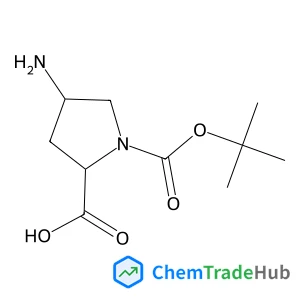
(2R,4R)-1-Boc-4-Aminopyrrolidine-2-carboxylic acid
CAS Number:
132622-98-1
Molecular Formula:
C10H18N2O4
José Antonio Morales-Serna, Ericka Sánchez, Ricardo Velázquez, Jorge Bernal, Eréndira García-Ríos, Rubén Gaviño, Guillermo Negrón-Silva, Jorge Cárdenas
A facile and mild macrolactonization reaction of ω-hydroxy acids was developed based on the transesterification of benzotriazole esters. Treatment of ω-hydroxy acids with 1-ethyl-3-(3-dimethylaminopropyl) carbodiimide (EDC) and 1-hydroxy benzotriazole (HOBT) in chloroform provided macrolactones in excellent yields. The reactions were performed under basic, neutral and acidic conditions using N,N-dimethylaminopyridine (DMAP), tetrabutylammonium tetrafluoroborate (TBABF4) and BF3·Et2O, respectively. A calcined hydrotalcite was also used instead of DMAP. Finally, to test the scope of the protocol in the synthesis of biologically relevant macrolactones, the total synthesis of Sansalvamide A was carried out.
Fernanda dos Santos Depoi, Tiago Charão de Oliveira, Diogo Pompéu de Moraes, Dirce Pozebon
DOI: 10.1039/C1AY05246B
Govardhana Babu Bodedla, Geliang Tang, Jianzhang Zhao, Xunjin Zhu
DOI: 10.1039/D0SE00356E
Yibin Yang, Xun Cui, Di Gao, Huichao He, Yingqing Ou, Ming Zhou, Qingxin Lai, Xijun Wei, Peng Xiao, Yunhuai Zhang
DOI: 10.1039/D0SE00659A
Hongmei Yu, Wei Song, Zhigang Shao
DOI: 10.1039/D0SE00103A
Hassan A. Alabdrabalameer, Juho Kauppinen, Toni Pikkarainen
DOI: 10.1039/D0SE00155D
Cecilia Solís, María Balaguer, Julio Garcia-Fayos, Elena Palafox, José M. Serra
DOI: 10.1039/D0SE00324G
(1R,3S)-1,3-Cyclopentanediol finds applications in various industries. In the ph...
When handling N'-[4-(Dimethylamino)phenyl]-N,N-dimethyl-1,4-benzenediamine, it i...
There are several alternatives to 5-(2,4-Difluorophenyl)-2-methoxypyrimidine in ...
1-(3-Methoxyphenoxy)propan-2-ol (CAS: 382141-68-6) must comply with the Globally...
Tetrodotoxin Citrate is extremely dangerous and should be handled with extreme c...
2-Methyl-2-propanyl [(1R,3S)-3-hydroxycyclopentyl]carbamate (CAS: 225641-84-9) i...
Waste containing 4-(2-Hydroxyhexafluoroisopropyl)Benzoic Acid (CAS: 16261-80-6) ...
2-Methyl-2-proanyl {(2S)-1-[(benzyloxy)amino]-3-hydroxy-3-methyl-1-oxo-2-butanyl...
Benzeneethanamine, α-ethyl-, hydrochloride (1:1) is an organic compound with the...
In the synthesis of compounds similar to 3-{(E)-[4-(Dimethylamino)phenyl]diazeny...

Organic & Biomolecular Chemistry (OBC) publishes original and high impact research and reviews in organic chemistry. We welcome research that shows new or significantly improved protocols or methodologies in total synthesis, synthetic methodology or physical and theoretical organic chemistry as well as research that shows a significant advance in the organic chemistry or molecular design aspects of chemical biology, catalysis, supramolecular and macromolecular chemistry, theoretical chemistry, mechanism-oriented physical organic chemistry, medicinal chemistry or natural products. Articles published in the journal should report new work which makes a highly-significant impact in the field. Routine and incremental work is generally not suitable for publication in the journal. More details about key areas of our scope are below. In all cases authors should include in their article clear rationale for why their research has been carried out.