


The influence of a 1,1-diarylvinyl moiety on the photochromism of naphthopyrans
Literature Information
Publication Date
2010-08-16
DOI
10.1039/C0OB00141D
Impact Factor
3.876
Authors
Christopher D. Gabbutt, B. Mark Heron, Colin Kilner, Suresh B. Kolla
View Original
Abstract
1,1,3-Triarylpent-4-en-1-yn-3-ols, efficiently obtained in two steps from 1,1,3-triarylprop-2-yn-1-ols by a Meyer-Schuster rearrangement and subsequent addition of lithium trimethylsilylacetylide, react with either a 1- or 2- naphthol to afford photochromic 1,1-diarylvinyl substituted naphtho[1,2-b]- or naphtho[2,1-b]-pyrans respectively. Irradiation of solutions of these naphthopyrans results in reversible electrocyclic ring-opening to afford photomerocyanines which possess an extended conjugated system and show a bathochromically-shifted λmax relative to the non-vinyl substituted analogues.
Recommended Journals

Journal of Catalysis

Journal of Organometallic Chemistry

Science Progress

Israel Journal of Chemistry

Kinetics and Catalysis

Helvetica Chimica Acta

Organic Preparations and Procedures International

Proceedings of the National Academy of Sciences of the United States of America

Journal of Medicinal Chemistry

European Journal of Wood and Wood Products
Related Literature
Near-infrared-driven water splitting for hydrogen evolution using a Cu2ZnSnS4-based photocathode by the application of upconversion nanoparticles
Kuang Feng, Zhiwang Cai, Dingwang Huang, Lintao Li, Kang Wang, Yan Li, Chenyang Wang, Jie Song, Wei Wei, Feng Jiang
2020-03-30
Communication
DOI: 10.1039/D0SE00152J
Photosensitizing ruthenium(ii)–dye multilayers: photoinduced charge separation and back electron transfer suppression
Nobutaka Yoshimura, Atsushi Kobayashi, Wataru Genno, Takashi Okubo, Masaki Yoshida, Masako Kato
2020-04-23
Paper
DOI: 10.1039/D0SE00151A
Morphology oriented CuS nanostructures: superior K-ion storage using surface enhanced pseudocapacitive effects
Chandrasekaran Nithya, Gowtham Thiyagaraj
2020-04-28
Paper
DOI: 10.1039/D0SE00469C
Plasma-reduced Co(OH)2 with activated hydrogen evolution and overall water splitting performance
Junxiang Jiang, Yuanhao Tang, Lin Dong, Wenhao Zhang, Haobin Wu
2020-03-30
Communication
DOI: 10.1039/D0SE00381F
Three-dimensional flower-like nickel phyllosilicates for CO2 methanation: enhanced catalytic activity and high stability
Tengfei Zhang, Zhiwei Tian, Qing Liu
2020-04-16
Paper
DOI: 10.1039/D0SE00360C
Novel Ru nanoparticle catalysts for the catalytic transfer hydrogenation of biomass-derived furanic compounds
Nishita Lucas
2020-05-04
Paper
DOI: 10.1039/D0SE00361A
You might also like
Compound Q&A
What industries use (1R,3S)-1,3-Cyclopentanediol (CAS: 16326-97-9)?
(1R,3S)-1,3-Cyclopentanediol finds applications in various industries. In the ph...
16326-97-9(1R,3S)-1,3-Cyclopen...
Compound Q&A
What precautions should be taken when handling N'-[4-(Dimethylamino)phenyl]-N,N-dimethyl-1,4-benzenediamine (CAS: 637-31-0)?
When handling N'-[4-(Dimethylamino)phenyl]-N,N-dimethyl-1,4-benzenediamine, it i...
637-31-0N'-[4-(Dimethylamino...
Compound Q&A
Are there alternatives to 5-(2,4-Difluorophenyl)-2-methoxypyrimidine (CAS: 1352318-16-1) in synthesis?
There are several alternatives to 5-(2,4-Difluorophenyl)-2-methoxypyrimidine in ...
1352318-16-15-(2,4-Difluoropheny...
Compound Q&A
What regulatory guidelines apply to 1-(3-Methoxyphenoxy)propan-2-ol (CAS: 382141-68-6)?
1-(3-Methoxyphenoxy)propan-2-ol (CAS: 382141-68-6) must comply with the Globally...
382141-68-61-(3-Methoxyphenoxy)...
Compound Q&A
Is Tetrodotoxin Citrate (CAS: 18660-81-6) safe?
Tetrodotoxin Citrate is extremely dangerous and should be handled with extreme c...
18660-81-6Tetrodotoxin Citrate
Compound Q&A
What are the main uses of 2-Methyl-2-propanyl [(1R,3S)-3-hydroxycyclopentyl]carbamate (CAS: 225641-84-9)?
2-Methyl-2-propanyl [(1R,3S)-3-hydroxycyclopentyl]carbamate (CAS: 225641-84-9) i...
225641-84-92-Methyl-2-propanyl ...
Compound Q&A
How should waste containing 4-(2-Hydroxyhexafluoroisopropyl)Benzoic Acid (CAS: 16261-80-6) be handled?
Waste containing 4-(2-Hydroxyhexafluoroisopropyl)Benzoic Acid (CAS: 16261-80-6) ...
16261-80-64-(2-Hydroxyhexafluo...
Compound Q&A
How is 2-Methyl-2-proanyl {(2S)-1-[(benzyloxy)amino]-3-hydroxy-3-methyl-1-oxo-2-butanyl}carbamate (CAS: 102507-19-7) typically synthesized?
2-Methyl-2-proanyl {(2S)-1-[(benzyloxy)amino]-3-hydroxy-3-methyl-1-oxo-2-butanyl...
102507-19-72-Methyl-2-propanyl ...
Compound Q&A
What is Benzeneethanamine, α-ethyl-, hydrochloride (1:1) (CAS: 20735-15-3)?
Benzeneethanamine, α-ethyl-, hydrochloride (1:1) is an organic compound with the...
20735-15-3Benzeneethanamine, α...
Compound Q&A
Are there alternatives to 3-{(E)-[4-(Dimethylamino)phenyl]diazenyl}benzoic acid (CAS: 20691-84-3) in synthesis?
In the synthesis of compounds similar to 3-{(E)-[4-(Dimethylamino)phenyl]diazeny...
20691-84-33-{(E)-[4-(Dimethyla...
Source Journal
Organic & Biomolecular Chemistry

CiteScore:
3.4
Self-citation Rate:
10.3%
Articles per Year:
1041
Organic & Biomolecular Chemistry (OBC) publishes original and high impact research and reviews in organic chemistry. We welcome research that shows new or significantly improved protocols or methodologies in total synthesis, synthetic methodology or physical and theoretical organic chemistry as well as research that shows a significant advance in the organic chemistry or molecular design aspects of chemical biology, catalysis, supramolecular and macromolecular chemistry, theoretical chemistry, mechanism-oriented physical organic chemistry, medicinal chemistry or natural products. Articles published in the journal should report new work which makes a highly-significant impact in the field. Routine and incremental work is generally not suitable for publication in the journal. More details about key areas of our scope are below. In all cases authors should include in their article clear rationale for why their research has been carried out.
Recommended Compounds
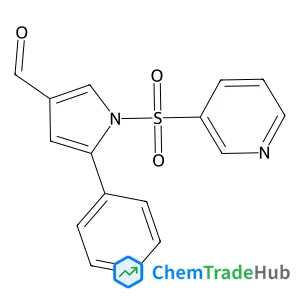
5-Phenyl-1-(pyridin-3-ylsulfonyl)-1H-pyrrole-3-carbaldehyde
CAS Number:
881676-90-0
Molecular Formula:
C16H12N2O3S
Recommended Suppliers



Disclaimer
This page provides academic journal information for reference and research purposes only. We are not affiliated with any journal publishers and do not handle publication submissions. For publication-related inquiries, please contact the respective journal publishers directly.
If you notice any inaccuracies in the information displayed, please contact us at support@chemtradehub.com. We will promptly review and address your concerns.