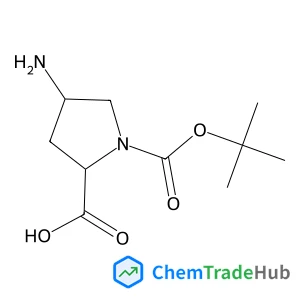
(2R,4R)-1-Boc-4-Aminopyrrolidine-2-carboxylic acid
CAS Number:
132622-98-1
Molecular Formula:
C10H18N2O4
Richard J. Hopkinson, Philippa S. Barlow, Christopher J. Schofield, Timothy D. W. Claridge
Within cells it is proposed that a major mechanism for the metabolism of formaldehyde is via its reaction with glutathione (GSH) to form S-hydroxymethylglutathione (HMG), which undergoes subsequent oxidation. In addition to HMG and the previously reported (5R,10S)-5-(carboxymethylcarbamoyl)-7-oxo-3-thia-1,6-diazabicyclo[4.4.1]undecane-10-carboxylic acid (BiGF2), NMR studies on the reaction of GSH with formaldehyde reveal two previously unassigned monocyclic structures. The results imply that the biologically relevant reactions between aldehydes and peptides/proteins may be more complex than presently perceived.
Andreas Eschenbacher, Alireza Saraeian, Brent H. Shanks, Peter Arendt Jensen, Ulrik Birk Henriksen, Jesper Ahrenfeldt, Anker Degn Jensen
DOI: 10.1039/D0SE00303D
Minjin Kim, Tae Kyung Lee, In Woo Choi, Hye Won Choi, Yimhyun Jo, Jiyun Lee, Gi-Hwan Kim, Sang Kyu Kwak, Dong Suk Kim
DOI: 10.1039/D0SE00382D
Hongmei Yu, Wei Song, Zhigang Shao
DOI: 10.1039/D0SE00103A
M. V. Balarama Krishna, A. C. Sahayam, D. Karunasagar
DOI: 10.1039/C1AY05624G
Junxiang Jiang, Yuanhao Tang, Lin Dong, Wenhao Zhang, Haobin Wu
DOI: 10.1039/D0SE00381F
Dattaprasad D. Narulkar, Anil Kumar U., Sunder N. Dhuri, Anil Kumar Vardhaman
DOI: 10.1039/D0SE00232A
Ping Zhou, Bo Liu, Mingming Luan, Na Li, Bo Tang
DOI: 10.1039/D1BM00619C
(1R,3S)-1,3-Cyclopentanediol finds applications in various industries. In the ph...
When handling N'-[4-(Dimethylamino)phenyl]-N,N-dimethyl-1,4-benzenediamine, it i...
There are several alternatives to 5-(2,4-Difluorophenyl)-2-methoxypyrimidine in ...
1-(3-Methoxyphenoxy)propan-2-ol (CAS: 382141-68-6) must comply with the Globally...
Tetrodotoxin Citrate is extremely dangerous and should be handled with extreme c...
2-Methyl-2-propanyl [(1R,3S)-3-hydroxycyclopentyl]carbamate (CAS: 225641-84-9) i...
Waste containing 4-(2-Hydroxyhexafluoroisopropyl)Benzoic Acid (CAS: 16261-80-6) ...
2-Methyl-2-proanyl {(2S)-1-[(benzyloxy)amino]-3-hydroxy-3-methyl-1-oxo-2-butanyl...
Benzeneethanamine, α-ethyl-, hydrochloride (1:1) is an organic compound with the...
In the synthesis of compounds similar to 3-{(E)-[4-(Dimethylamino)phenyl]diazeny...

Organic & Biomolecular Chemistry (OBC) publishes original and high impact research and reviews in organic chemistry. We welcome research that shows new or significantly improved protocols or methodologies in total synthesis, synthetic methodology or physical and theoretical organic chemistry as well as research that shows a significant advance in the organic chemistry or molecular design aspects of chemical biology, catalysis, supramolecular and macromolecular chemistry, theoretical chemistry, mechanism-oriented physical organic chemistry, medicinal chemistry or natural products. Articles published in the journal should report new work which makes a highly-significant impact in the field. Routine and incremental work is generally not suitable for publication in the journal. More details about key areas of our scope are below. In all cases authors should include in their article clear rationale for why their research has been carried out.
![6-Bromo-2,3-dihydro-1H-pyrido[2,3-b][1,4]oxazine structure](https://static.chemtradehub.com/structs/120/1203499-17-5-b4d1.webp "6-Bromo-2,3-dihydro-1H-pyrido[2,3-b][1,4]oxazine structure")