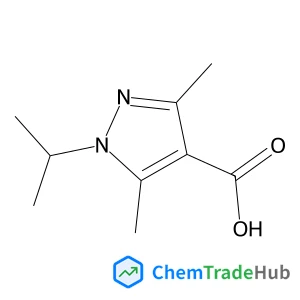
1-isopropyl-3,5-dimethyl-1H-pyrazole-4-carboxylic acid
CAS Number:
1007542-01-9
Molecular Formula:
C9H14N2O2
Following on from our recent Editorial in Issue 16 we are delighted to announce that the first issue of Molecular BioSystems is now published.
Anna-Marie Zorn, Helmut Keul, Christopher Barner-Kowollik, Martin Moeller
DOI: 10.1039/C1PY00344E
Soma Mukherjee, Philip J. Costanzo
DOI: 10.1039/C1PY00451D
Gabit Nurumbetov, Nicholas Ballard, Stefan A. F. Bon
DOI: 10.1039/C2PY00605G
Qiang Fu, Jing. M. Ren, Greg. G. Qiao
DOI: 10.1039/C1PY00362C
Akihiro Nomura, Kohji Ohno, Takeshi Fukuda
DOI: 10.1039/C1PY00215E
Jian-Bing Zeng, Qun-Ying Zhu, Xi Lu, Yi-Song He, Yu-Zhong Wang
DOI: 10.1039/C1PY00456E
Takahiro Fukumaru, Tsuyohiko Fujigaya
DOI: 10.1039/C1PY00470K
Derek M. Ryan, Bradley L. Nilsson
DOI: 10.1039/C1PY00335F
Tushar Borase, Marcello Iacono, Syed I. Ali, Paul D. Thornton
DOI: 10.1039/C2PY00610C
4-(4-tert-Butylphenyl)-1H-pyrazol-3-amine finds applications in various industri...
H3TATAB is used in the pharmaceutical industry for the synthesis of certain orga...
1-Ethyl-3-fluorobenzene (CAS: 696-39-9) is primarily used as a precursor in the ...
1-(tert-Butoxycarbonyl)-4-(4-methoxyphenyl)pyrrolidine-3-carboxylic acid is prim...
1-Cyclobutyl-4-piperidinone (CAS: 359880-05-0) is a colorless or white crystalli...
Pyridine-2,6-dicarboxylic acid mono-tert-butyl ester (CAS: 575433-76-0) is a che...
The market for 2,3-Difluorophenylalanine (CAS: 236754-62-4) is growing with incr...
(2-Hydroxy-1-naphthyl)boronic acid can be synthesized through the reduction of 2...
This compound is a crystalline solid with a molecular weight of approximately 52...
While 5,7-Dihydroxy-4-oxo-2-(3,4,5-trihydroxyphenyl)-4H-chromen-3-yl beta-D-gluc...

ChemComm publishes urgent research which is of outstanding significance and interest to experts in the field, while also appealing to the journal’s broad chemistry readership. Our communication format is ideally suited to short, urgent studies that are of such importance that they require accelerated publication. Our scope covers all topics in chemistry, and research at the interface of chemistry and other disciplines (such as materials science, nanoscience, physics, engineering and biology) where there is a significant novelty in the chemistry aspects. Major topic areas covered include: Analytical Chemistry Catalysis Chemical Biology and medicinal chemistry Computational Chemistry and Machine Learning Energy and sustainable chemistry Environmental Chemistry Green Chemistry Inorganic Chemistry Materials Chemistry Nanoscience Organic Chemistry Physical Chemistry Polymer Chemistry Supramolecular Chemistry
![2-Methyl-2-propanyl [1-(3-nitro-2-pyridinyl)-4-piperidinyl]carbamate structure](https://static.chemtradehub.com/structs/833/833452-36-1-7af5.webp "2-Methyl-2-propanyl [1-(3-nitro-2-pyridinyl)-4-piperidinyl]carbamate structure")