












From miscible to partially miscible biodegradable double crystalline poly(ethylene succinate)-b-poly(butylene succinate) multiblock copolymers
Literature Information
Publication Date
2011-12-01
DOI
10.1039/C1PY00456E
Impact Factor
5.582
Authors
Jian-Bing Zeng, Qun-Ying Zhu, Xi Lu, Yi-Song He, Yu-Zhong Wang
View Original
Abstract
A series of biodegradable double crystalline poly(ethylene succinate)-b-poly(butylene succinate) (PES-b-PBS) multiblock copolymers with various PES and PBS block lengths were successfully synthesized by chain-extension reaction of dihydroxylated poly(ethylene succinate) (HO-PES-OH) and poly(butylene succinate) (HO-PBS-OH) using 1,6-hexamethylene diisocyanate (HDI) as a chain-extender. The compositions and structures were characterized by proton nuclear magnetic resonance spectroscopy (1H NMR). The miscibility of amorphous phase and crystallization behaviors of the two blocks were investigated by standard differential scanning calorimetry (DSC), temperature modulated DSC (TMDSC), polarized light optical microscopy (POM), and wide-angle X-ray diffraction (WAXD). When the block length of PBS and PES were less than 4710 g mol−1, the amorphous phases of the two blocks were miscible. As the block length increased to more than 5430 g mol−1, the amorphous phases of the two blocks changed to be partially miscible, and the miscibility decreased with further increasing the block lengths. The crystallizability of both PBS and PES blocks increased with an increase in size of their blocks. POM observation showed that the copolymers displayed banded spherulitic morphologies, and the crystallization of PES happened in confined space after crystallization of PBS blocks. WAXD analysis suggested that the crystals of the copolymers were composed of crystals of both PES and PBS blocks.
Related Literature
One-pot controllable synthesis of oligo(carbonate-ether) triol using a Zn-Co-DMC catalyst: the special role of trimesic acid as an initiation-transfer agent
Yusheng Qin, Xuesi Chen, Xianhong Wang, Fosong Wang
2014-06-30
Paper
DOI: 10.1039/C4PY00578C
Branched polythiophenes by Ni-catalyzed Kumada coupling
Martin Scheuble, Thomas V. Richter, Miriam Goll, Steffen Link, Juan T. López Navarrete, Adrian Ruff, M. Carmen Ruiz Delgado, Sabine Ludwigs
2014-09-01
Paper
DOI: 10.1039/C4PY00899E
Low bandgap poly(thienylenemethine) derivatives bearing terarylene moieties in the side chains
Sangbum Ahn, Kazuki Yabumoto, Yongsoo Jeong, Kazuo Akagi
2014-08-26
Paper
DOI: 10.1039/C4PY00849A
Exploiting nucleobase-containing materials – from monomers to complex morphologies using RAFT dispersion polymerization
Yan Kang, Anaïs Pitto-Barry, Helen Willcock, Wen-Dong Quan, Nigel Kirby, Ana M. Sanchez, Rachel K. O'Reilly
2014-09-11
Paper
DOI: 10.1039/C4PY01074D
Dendrimer-like conjugated microporous polymers
Ting Wang, Wei Huang, Jia-Xing Jiang, Zhengkun Du, Fa-Kuen Shieh, Renqiang Yang
2016-01-04
Paper
DOI: 10.1039/C5PY01767J
Synthesis of highly reactive polyisobutylene with FeCl3/ether complexes in hexane; kinetic and mechanistic studies
Rajeev Kumar, Priyadarsi De, Bin Zheng, Kuo-Wei Huang, Jack Emert, Rudolf Faust
2014-09-12
Paper
DOI: 10.1039/C4PY01039F
Bulk AGET ATRP of methyl methacrylate using iron(iii) acetylacetonate as a catalyst
Yuan Liu, Tianchi Xu, Lifen Zhang, Zhenping Cheng, Xiulin Zhu
2014-08-13
Paper
DOI: 10.1039/C4PY00968A
Metal-free photoinduced electron transfer–atom transfer radical polymerization (PET–ATRP) via a visible light organic photocatalyst
Xiaodong Liu, Lifen Zhang, Zhenping Cheng, Xiulin Zhu
2015-11-26
Paper
DOI: 10.1039/C5PY01765C
Olefin cross-metathesis, a mild, modular approach to functionalized cellulose esters
2014-09-02
Paper
DOI: 10.1039/C4PY01102C
You might also like
Compound Q&A
How should waste containing (6-Bromo-2-naphthyl)oxy](dimethyl)(2-methyl-2-propanyl)silane be handled?
Waste containing (6-Bromo-2-naphthyl)oxy](dimethyl)(2-methyl-2-propanyl)silane (...
100751-65-3[(6-Bromo-2-naphthyl...
Compound Q&A
How is 7-Fluoro-4-isoquinolinecarboxylic acid (CAS: 1841081-40-0) typically synthesized?
7-Fluoro-4-isoquinolinecarboxylic acid can be synthesized via a multi-step proce...
1841081-40-07-Fluoro-4-isoquinol...
Compound Q&A
What are the physical and chemical properties of 2,3,5,6-Tetrabromothieno[3,2-b]thiophene (CAS: 124638-53-5)?
2,3,5,6-Tetrabromothieno[3,2-b]thiophene is a crystalline compound with a high m...
124638-53-52,3,5,6-Tetrabromoth...
Compound Q&A
Is 1-[4-(Benzylamino)-7,8-dihydro-5H-pyrano[4,3-d]pyrimidin-2-yl]-2-methyl-1H-indole-4-carboxamide (CAS: 1542705-92-9) safe?
1-[4-(Benzylamino)-7,8-dihydro-5H-pyrano[4,3-d]pyrimidin-2-yl]-2-methyl-1H-indol...
1542705-92-91-[4-(Benzylamino)-7...
Compound Q&A
What is the market or research trend for imidazo[5,1-d]-1,2,3,5-tetrazine-8-carboxylic acid, 3,4-dihydro-3-methyl-4-oxo- (CAS: 113942-30-6)?
The market for imidazo[5,1-d]-1,2,3,5-tetrazine-8-carboxylic acid, 3,4-dihydro-3...
113942-30-6Imidazo[5,1-d]-1,2,3...
Compound Q&A
What is 3-(Triisopropylsilyl)propiolaldehyde (CAS: 163271-80-5)?
3-(Triisopropylsilyl)propiolaldehyde is a synthetic organic compound with the CA...
163271-80-53-(Triisopropylsilyl...
Compound Q&A
What regulatory guidelines apply to 6-Nitro-2H-1,4-benzoxazin-3(4H)-one (CAS: 81721-87-1)?
6-Nitro-2H-1,4-benzoxazin-3(4H)-one (CAS: 81721-87-1) is subject to various regu...
81721-87-16-Nitro-2H-1,4-benzo...
Compound Q&A
How should waste containing (3-Fluorophenyl)(4-{[(2-methyl-2-propanyl)oxy]carbonyl}-1-piperazinyl)acetic acid (CAS: 885272-91-3) be handled?
Waste containing (3-Fluorophenyl)(4-{[(2-methyl-2-propanyl)oxy]carbonyl}-1-piper...
885272-91-3(3-Fluorophenyl)(4-{...
Compound Q&A
What are the physical and chemical properties of N,N'-4,4'-Biphenyldiyldiisonicotinamide (CAS: 55119-40-9)?
N,N'-4,4'-Biphenyldiyldiisonicotinamide is a white crystalline solid with a mole...
55119-40-9N,N'-4,4'-Biphenyldi...
Compound Q&A
What industries use 6-Bromo-8-fluoro-2-quinazolinol (CAS: 1036756-15-6)?
6-Bromo-8-fluoro-2-quinazolinol is primarily used in the pharmaceutical industry...
1036756-15-66-Bromo-8-fluoro-2-q...
Source Journal
Polymer Chemistry

CiteScore:
8.6
Self-citation Rate:
7.3%
Articles per Year:
457
Polymer Chemistry welcomes submissions in all areas of polymer science that have a strong focus on macromolecular chemistry. Manuscripts may cover a broad range of fields, yet no direct application focus is required.
Recommended Compounds

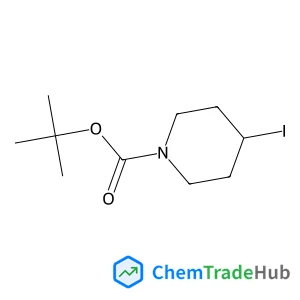
2-Methyl-2-propanyl 4-iodo-1-piperidinecarboxylate
CAS Number:
301673-14-3
Molecular Formula:
C10H18INO2
Recommended Suppliers




Disclaimer
This page provides academic journal information for reference and research purposes only. We are not affiliated with any journal publishers and do not handle publication submissions. For publication-related inquiries, please contact the respective journal publishers directly.
If you notice any inaccuracies in the information displayed, please contact us at support@chemtradehub.com. We will promptly review and address your concerns.