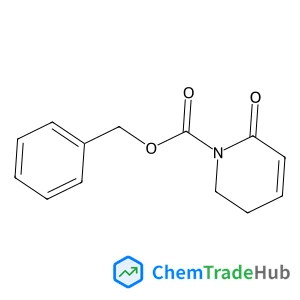
Benzyl 6-oxo-3,6-dihydro-1(2H)-pyridinecarboxylate
CAS Number:
725746-35-0
Molecular Formula:
C13H13NO3
N. Eltouny
Heterogeneous reactions on atmospheric aerosol surfaces are increasingly considered important in understanding aerosol–cloud nucleation and climate change. To understand potential reactions in polluted atmospheres, the co-adsorption of NO2 and toluene to magnetite (Fe3O4i.e. FeO·Fe2O3) nanoparticles at ambient conditions was investigated for the first time. The surface area, size distribution, and morphology of Fe3O4 nanoparticles were characterized by BET method and high-resolution transmission electron microscopy. Adsorption isotherms, collected by gas chromatography with flame ionization detection, showed that the presence of NO2 decreased the adsorption of toluene. The analyses of the surface chemical composition of Fe3O4 by X-ray photoelectron spectroscopy (XPS) reveal that, upon the addition of NO2, the surface is oxidized and a contribution at 532.5 ± 0.4 eV in the O1s spectrum appears, showing that NO2 likely competes with toluene by dissociating on Fe2+ sites and forming NO3−. Different competing effects were observed for oxidized Fe3O4; oxidation occurred when exposed solely to NO2, whereas, the mixture of toluene and NO2 resulted in a reduction of the surface i.e. increased Fe2+/Fe3+. Analyses by time of flight secondary ion mass spectrometry further suggest toluene reacts with Fe3+ sites forming oxygenated organics. Our results indicate that on reduced magnetite, NO2 is more reactive and competes with toluene; in contrast, on oxidized Fe3O4, toluene is more reactive. Because magnetite can assume a range of oxidation ratios in the environment, different competing interactions between pollutants like NO2 and toluene could influence atmospheric processes, namely, the formation of Fe2+ and the formation of atmospheric oxidants.
Gertrudis Rodríguez-López, M. Dolores Marcos, Ramón Martínez-Máñez, Félix Sancenón, Juan Soto, Luis A. Villaescusa, Danile Beltrán, Pedro Amorós
DOI: 10.1039/B406611A
Andreas Taubert, Ernst Furrer, Wolfgang Meier
DOI: 10.1039/B405610H
Konrad Swiderski, Andrew McLean, Charles M. Gordon, D. Huw Vaughan
DOI: 10.1039/B408334B
François Terrier, Régis Goumont, Taoufik Boubaker, Erwin Buncel
DOI: 10.1039/B410356D
David R. Kelly, Stanley M. Roberts
DOI: 10.1039/B404390C
Mangesh T. Bore, Hien N. Pham, Timothy L. Ward, Abhaya K. Datye
DOI: 10.1039/B407575G
Kenji Hara, Masashi Hasegawa, Yoshiyuki Kuwatani, Hideo Enozawa, Masahiko Iyoda
DOI: 10.1039/B407200F
Xueguang Wang, Kyle S. K. Lin, Jerry C. C. Chan, Soofin Cheng
DOI: 10.1039/B408022J
Dominik Wechsler, Robert McDonald, Michael J. Ferguson, Mark Stradiotto
DOI: 10.1039/B410328A
Xile Hu, Ingrid Castro-Rodriguez, Karsten Meyer
DOI: 10.1039/B409241D
N-(4-Methoxybenzyl)-2-pyridinamine (CAS: 52818-63-0) is increasingly being used ...
When handling Ethyl 4-(2-chlorophenyl)-1,3-thiazole-2-carboxylate, appropriate p...
Diethyldiselane (CAS: 628-39-7) is classified under the Globally Harmonized Syst...
The market for oxocopper (CAS: 12053-18-8) is primarily driven by its use in cat...
The market for 5-{[(2-Methyl-2-propanyl)oxy]carbonyl}-5-azaspiro[2.4]heptane-7-c...
2-(1-Pyrrolidinyl)-4-pyridinamine is a chemical compound with the CAS number 359...
2-(3-Pyridinyl)-1-azabicyclo[2.2.2]octane (CAS: 91556-75-1) is a crystalline sol...
(S)-Alpha-allyl-proline hydrochloride is usually synthesized via a Wittig reacti...
3-Methyl-1,2-oxazole-5-carboxylic acid (CAS: 4857-42-5) is an organic compound w...
Lys-SMCC-DM1 is synthesized via a multi-step process involving the coupling of S...

Physical Chemistry Chemical Physics (PCCP) is an international journal co-owned by 19 physical chemistry and physics societies from around the world. This journal publishes original, cutting-edge research in physical chemistry, chemical physics and biophysical chemistry. To be suitable for publication in PCCP, articles must include significant innovation and/or insight into physical chemistry; this is the most important criterion that reviewers and Editors will judge against when evaluating submissions. The journal has a broad scope and welcomes contributions spanning experiment, theory, computation and data science. Topical coverage includes spectroscopy, dynamics, kinetics, statistical mechanics, thermodynamics, electrochemistry, catalysis, surface science, quantum mechanics, quantum computing and machine learning. Interdisciplinary research areas such as polymers and soft matter, materials, nanoscience, energy, surfaces/interfaces, and biophysical chemistry are welcomed if they demonstrate significant innovation and/or insight into physical chemistry. Joined experimental/theoretical studies are particularly appreciated when complementary and based on up-to-date approaches.
![5'-Fluoro-[2,3'-biindolinylidene]-2',3-dione structure](https://static.chemtradehub.com/structs/251/251903-00-1-9cb1.webp "5'-Fluoro-[2,3'-biindolinylidene]-2',3-dione structure")
![1,10-bis(3,5-dimethylphenyl)-12-hydroxy-4,5,6,7-tetrahydroiindeno[7,1-de:1',7'-fg][1,3,2]dioxaphosphocine 12-oxide structure](https://static.chemtradehub.com/structs/141/1412439-82-7-b9a9.webp "1,10-bis(3,5-dimethylphenyl)-12-hydroxy-4,5,6,7-tetrahydroiindeno[7,1-de:1',7'-fg][1,3,2]dioxaphosphocine 12-oxide structure")