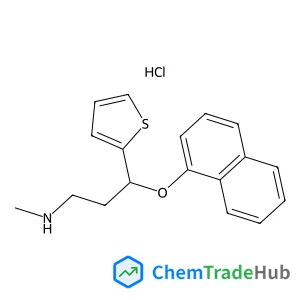
N-Methyl-3-(1-naphthyloxy)-3-(2-thienyl)-1-propanamine hydrochloride (1:1)
CAS Number:
1188266-11-6
Molecular Formula:
C18H20ClNOS
J. C. J. Camp, J. McGregor, I. M. Watson, R. A. Cox, M. Kalberer, A. D. Ward, F. D. Pope
The heterogeneous interactions of gas molecules on solid particles are crucial in many areas of science, engineering and technology. Such interactions play a critical role in atmospheric chemistry and in heterogeneous catalysis, a key technology in the energy and chemical industries. Investigating heterogeneous interactions upon single levitated particles can provide significant insight into these important processes. Various methodologies exist for levitating micron sized particles including: optical, electrical and acoustic techniques. Prior to this study, the optical levitation of solid micron scale particles has proved difficult to achieve over timescales relevant to the above applications. In this work, a new vertically configured counter propagating dual beam optical trap was optimized to levitate a range of solid particles in air. Silica (SiO2), α-alumina (Al2O3), titania (TiO2) and polystyrene were stably trapped with a high trapping efficiency (Q = 0.42). The longest stable trapping experiment was conducted continuously for 24 hours, and there are no obvious constraints on trapping time beyond this period. Therefore, the methodology described in this paper should be of major benefit to various research communities. The strength of the new technique is demonstrated by the simultaneous levitation and spectroscopic interrogation of silica particles by Raman spectroscopy. In particular, the adsorption of water upon silica was investigated under controlled relative humidity environments. Furthermore, the collision and coagulation behaviour of silica particles with microdroplets of sulphuric acid was followed using both optical imaging and Raman spectroscopy.

Russian Chemical Reviews

Pure and Applied Chemistry

Proceedings of the National Academy of Sciences of the United States of America

Science

Journal of Physics and Chemistry of Solids

Science Progress

Journal of Medicinal Chemistry

Kinetics and Catalysis

Organic Preparations and Procedures International

Nature
S. Bordiga, C. Lamberti, G. Ricchiardi, L. Regli, F. Bonino, A. Damin, K.-P. Lillerud, M. Bjorgen, A. Zecchina
DOI: 10.1039/B407246D
Yuzhong Wang, Brandon Quillian, Pingrong Wei, Xiao-Juan Yang, Gregory H. Robinson
DOI: 10.1039/B408860N
Gertrudis Rodríguez-López, M. Dolores Marcos, Ramón Martínez-Máñez, Félix Sancenón, Juan Soto, Luis A. Villaescusa, Danile Beltrán, Pedro Amorós
DOI: 10.1039/B406611A
David R. Kelly, Alastair Meek, Stanley M. Roberts
DOI: 10.1039/B404379K
Adrian-Mihail Stadler, Nathalie Kyritsakas, Jean-Marie Lehn
DOI: 10.1039/B407168A
Ken Takazawa, Yasutaka Kitahama, Yasuyuki Kimura
DOI: 10.1039/B409690H
Angelino Doppiu, Ulli Englert, Albrecht Salzer
DOI: 10.1039/B409134E
Konrad Swiderski, Andrew McLean, Charles M. Gordon, D. Huw Vaughan
DOI: 10.1039/B408334B
Patrick Gunning, Andrew C. Benniston, Robert D. Peacock
DOI: 10.1039/B409132A
Eva Hevia, Daniel J. Gallagher, Alan R. Kennedy, Robert E. Mulvey, Charles T. O'Hara, Christine Talmard
DOI: 10.1039/B410293B
Waste containing 6-Chloro-5-(2'-hydroxy-3'-methoxy-4-biphenylyl)-3-(3-methoxyphe...
(3alpha,5alpha)-3-Hydroxypregnane-11,20-dione is primarily used in the pharmaceu...
The market for 4-Amino-6-chloro-2-pyridinecarboxylic acid (CAS: 546141-56-4) is ...
Alternatives to (2-Benzoylethyl)trimethylammonium chloride (CAS: 24472-88-6) in ...
N-[4-Nitro-3-(trifluoromethyl)phenyl]acetamide (CAS: 393-12-4) is generally safe...
Alternative reagents such as other phosphates or similar functional groups can b...
There are alternatives to N,N'-Bis(3-aminopropyl)-1,3-propanediamine (CAS: 4605-...
When handling Aluminium trihexadecanoate, it is important to use appropriate per...
(1,1-Dioxido-3-oxo-1,2-benzothiazol-2(3H)-yl)acetic acid is a chemical compound ...
Several alternatives to 5,5-dimethyloxolan-2-one (CAS: 3123-97-5) can be used in...

Physical Chemistry Chemical Physics (PCCP) is an international journal co-owned by 19 physical chemistry and physics societies from around the world. This journal publishes original, cutting-edge research in physical chemistry, chemical physics and biophysical chemistry. To be suitable for publication in PCCP, articles must include significant innovation and/or insight into physical chemistry; this is the most important criterion that reviewers and Editors will judge against when evaluating submissions. The journal has a broad scope and welcomes contributions spanning experiment, theory, computation and data science. Topical coverage includes spectroscopy, dynamics, kinetics, statistical mechanics, thermodynamics, electrochemistry, catalysis, surface science, quantum mechanics, quantum computing and machine learning. Interdisciplinary research areas such as polymers and soft matter, materials, nanoscience, energy, surfaces/interfaces, and biophysical chemistry are welcomed if they demonstrate significant innovation and/or insight into physical chemistry. Joined experimental/theoretical studies are particularly appreciated when complementary and based on up-to-date approaches.
![1-(1-Benzyl-1,2,3,6-tetrahydropyridin-4-yl)-1H-benzo[d]imidazol-2(3H)-one structure](https://static.chemtradehub.com/structs/603/60373-71-9-7dfb.webp "1-(1-Benzyl-1,2,3,6-tetrahydropyridin-4-yl)-1H-benzo[d]imidazol-2(3H)-one structure")
![1-{3-[4-Amino-3-(4-phenoxyphenyl)-1H-pyrazolo[3,4-d]pyrimidin-1-yl]-1-piperidinyl}-2,3-dihydroxy-1-propanone structure](https://static.chemtradehub.com/structs/122/1226872-27-0-e037.webp "1-{3-[4-Amino-3-(4-phenoxyphenyl)-1H-pyrazolo[3,4-d]pyrimidin-1-yl]-1-piperidinyl}-2,3-dihydroxy-1-propanone structure")