












Dynamic combinatorial libraries of metalloporphyrins: templated amplification of disulfide-linked oligomers
Literature Information
Publication Date
2003-09-30
DOI
10.1039/B310438A
Impact Factor
6.222
Authors
Amy L. Kieran, Andrew D. Bond, Ana M. Belenguer, Jeremy K. M. Sanders
View Original
Abstract
Disulfide-linked cyclic porphyrin oligomers from dimer to tetramer can be selected and amplified virtually quantitatively from a dynamic combinatorial library using bis-thiol substituted zinc(II) porphyrin units with appropriate amine donor templates.
Related Literature
Probing the kinetic energy-release dynamics of H-atom products from the gas-phase reaction of O(3P) with vinyl radical C2H3
Su-Chan Jang, Jong-Ho Choi
2014-10-01
Paper
DOI: 10.1039/C4CP03046J
Gaussian analysis of Raman spectroscopy of acetic acid reveals a significant amount of monomers that effectively cooperate with hydrogen bonded linear chains
2014-09-11
Communication
DOI: 10.1039/C4CP03999H
Combinatorial effect of rolling and carbonaceous nanoparticles on the evolution of crystallographic texture and structural properties of ultra high molecular weight polyethylene
Elayaraja Kolanthai, Rajib Kalsar, Suryasarathi Bose, Satyam Suwas, Kaushik Chatterjee
2014-09-16
Paper
DOI: 10.1039/C4CP02815E
Electron spin-polarization and spin lattices in the boron- and nitrogen-doped organic framework COF-5
Xiaobiao Liu, Jie Tan, Aizhu Wang, Xiaoming Zhang, Mingwen Zhao
2014-09-10
Paper
DOI: 10.1039/C4CP03478C
Physicochemical properties of pentaglyme–sodium bis(trifluoromethanesulfonyl)amide solvate ionic liquid
Shoshi Terada, Toshihiko Mandai, Risa Nozawa, Kazuki Yoshida, Kazuhide Ueno, Seiji Tsuzuki, Masayoshi Watanabe
2014-04-25
Paper
DOI: 10.1039/C4CP00746H
Ammonia-modified Co(ii) sites in zeolites: IR spectroscopy and spin-resolved charge transfer analysis of NO adsorption complexes
Kinga Góra-Marek, Adam Stępniewski, Mariusz Radoń, Ewa Broclawik
2014-09-11
Paper
DOI: 10.1039/C4CP03350G
High performance n-type and ambipolar small organic semiconductors for organic thin film transistors
Huanli Dong, Hao-li Zhang, Wenping Hu
2014-06-26
Perspective
DOI: 10.1039/C4CP01700E
Doping indium in β-Bi2O3 to tune the electronic structure and improve the photocatalytic activities: first-principles calculations and experimental investigation
Junying Zhang, Wenqiang Dang, Xingchen Yan, Hong Gao, Zhimin Ao
2014-09-30
Paper
DOI: 10.1039/C4CP02656J
Noble-metal-free BODIPY–cobaloxime photocatalysts for visible-light-driven hydrogen production
Geng-Geng Luo, Kai Fang, Ji-Huai Wu, Jing-Cao Dai, Qing-Hua Zhao
2014-09-22
Paper
DOI: 10.1039/C4CP03343D
You might also like
Compound Q&A
What is the market or research trend for N-(4-Methoxybenzyl)-2-pyridinamine (CAS: 52818-63-0)?
N-(4-Methoxybenzyl)-2-pyridinamine (CAS: 52818-63-0) is increasingly being used ...
52818-63-0N-(4-Methoxybenzyl)-...
Compound Q&A
What precautions should be taken when handling Ethyl 4-(2-chlorophenyl)-1,3-thiazole-2-carboxylate (CAS: 1050507-06-6)?
When handling Ethyl 4-(2-chlorophenyl)-1,3-thiazole-2-carboxylate, appropriate p...
1050507-06-6Ethyl 4-(2-chlorophe...
Compound Q&A
What regulatory guidelines apply to diethyldiselane (CAS: 628-39-7)?
Diethyldiselane (CAS: 628-39-7) is classified under the Globally Harmonized Syst...
628-39-7Diethyldiselane
Compound Q&A
What is the market or research trend for oxocopper (CAS: 12053-18-8)?
The market for oxocopper (CAS: 12053-18-8) is primarily driven by its use in cat...
12053-18-8oxocopper; oxo-(oxoc...
Compound Q&A
What is the market or research trend for 5-{[(2-Methyl-2-propanyl)oxy]carbonyl}-5-azaspiro[2.4]heptane-7-carboxylic acid?
The market for 5-{[(2-Methyl-2-propanyl)oxy]carbonyl}-5-azaspiro[2.4]heptane-7-c...
1268519-54-55-{[(2-Methyl-2-prop...
Compound Q&A
What is 2-(1-Pyrrolidinyl)-4-pyridinamine (CAS: 35981-63-6)?
2-(1-Pyrrolidinyl)-4-pyridinamine is a chemical compound with the CAS number 359...
35981-63-62-(1-Pyrrolidinyl)-4...
Compound Q&A
What are the physical and chemical properties of 2-(3-Pyridinyl)-1-azabicyclo[2.2.2]octane (CAS: 91556-75-1)?
2-(3-Pyridinyl)-1-azabicyclo[2.2.2]octane (CAS: 91556-75-1) is a crystalline sol...
91556-75-12-(3-Pyridinyl)-1-az...
Compound Q&A
How is (S)-Alpha-allyl-proline hydrochloride (CAS: 129704-91-2) typically synthesized?
(S)-Alpha-allyl-proline hydrochloride is usually synthesized via a Wittig reacti...
129704-91-2(S)-Alpha-allyl-prol...
Compound Q&A
What is 3-Methyl-1,2-oxazole-5-carboxylic acid (CAS: 4857-42-5)?
3-Methyl-1,2-oxazole-5-carboxylic acid (CAS: 4857-42-5) is an organic compound w...
4857-42-53-Methyl-1,2-oxazole...
Compound Q&A
How is Lys-SMCC-DM1 (CAS: 1281816-04-3) typically synthesized?
Lys-SMCC-DM1 is synthesized via a multi-step process involving the coupling of S...
1281816-04-3Lys-SMCC-DM1
Source Journal
Chemical Communications

CiteScore:
8.6
Self-citation Rate:
4.7%
Articles per Year:
2458
ChemComm publishes urgent research which is of outstanding significance and interest to experts in the field, while also appealing to the journal’s broad chemistry readership. Our communication format is ideally suited to short, urgent studies that are of such importance that they require accelerated publication. Our scope covers all topics in chemistry, and research at the interface of chemistry and other disciplines (such as materials science, nanoscience, physics, engineering and biology) where there is a significant novelty in the chemistry aspects. Major topic areas covered include: Analytical Chemistry Catalysis Chemical Biology and medicinal chemistry Computational Chemistry and Machine Learning Energy and sustainable chemistry Environmental Chemistry Green Chemistry Inorganic Chemistry Materials Chemistry Nanoscience Organic Chemistry Physical Chemistry Polymer Chemistry Supramolecular Chemistry
Recommended Compounds
![1-oxaspiro[4.4]nonan-6-one structure](https://static.chemtradehub.com/structs/134/134179-01-4-e051.webp "1-oxaspiro[4.4]nonan-6-one structure")
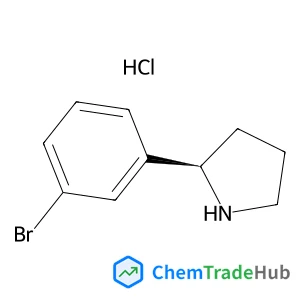
(2R)-2-(3-Bromophenyl)pyrrolidine hydrochloride (1:1)
CAS Number:
1391550-13-2
Molecular Formula:
C10H13BrClN
![N-{15-[(2,5-Dioxo-1-pyrrolidinyl)oxy]-15-oxo-3,6,9,12-tetraoxapentadec-1-yl}-2-(2-propyn-1-yloxy)acetamide structure](https://static.chemtradehub.com/structs/210/2101206-92-0-2eb5.webp "N-{15-[(2,5-Dioxo-1-pyrrolidinyl)oxy]-15-oxo-3,6,9,12-tetraoxapentadec-1-yl}-2-(2-propyn-1-yloxy)acetamide structure")
N-{15-[(2,5-Dioxo-1-pyrrolidinyl)oxy]-15-oxo-3,6,9,12-tetraoxapentadec-1-yl}-2-(2-propyn-1-yloxy)acetamide
CAS Number:
2101206-92-0
Molecular Formula:
C20H30N2O10
Recommended Suppliers







Disclaimer
This page provides academic journal information for reference and research purposes only. We are not affiliated with any journal publishers and do not handle publication submissions. For publication-related inquiries, please contact the respective journal publishers directly.
If you notice any inaccuracies in the information displayed, please contact us at support@chemtradehub.com. We will promptly review and address your concerns.