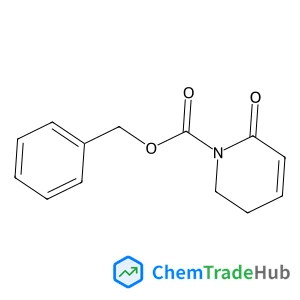
Benzyl 6-oxo-3,6-dihydro-1(2H)-pyridinecarboxylate
CAS Number:
725746-35-0
Molecular Formula:
C13H13NO3
A graphical abstract is available for this content
Yi Sun, Hoi-Shan Chan, Pierre H. Dixneuf, Zuowei Xie
DOI: 10.1039/B409772F
Konrad Swiderski, Andrew McLean, Charles M. Gordon, D. Huw Vaughan
DOI: 10.1039/B408334B
Guang Yang, Raphael G. Raptis
DOI: 10.1039/B404269G
Tryg R. Jensen, Laurie E. Breyfogle, Marc A. Hillmyer, William B. Tolman
DOI: 10.1039/B405362A
Mami Tojino, Yoshitaka Uenoyama, Takahide Fukuyama, Ilhyong Ryu
DOI: 10.1039/B408746A
Yuting Li, Ravin Narain, Yinghua Ma, Andrew L. Lewis, Steven P. Armes
DOI: 10.1039/B410150B
Alex Fragoso, Eduardo Almirall, Roberto Cao, Luis Echegoyen, Raúl González-Jonte
DOI: 10.1039/B407792J
Changwei Xu, Pei Kang Shen
DOI: 10.1039/B408589B
Eva Hevia, Daniel J. Gallagher, Alan R. Kennedy, Robert E. Mulvey, Charles T. O'Hara, Christine Talmard
DOI: 10.1039/B410293B
David R. Kelly, Stanley M. Roberts
DOI: 10.1039/B404390C
N-(4-Methoxybenzyl)-2-pyridinamine (CAS: 52818-63-0) is increasingly being used ...
When handling Ethyl 4-(2-chlorophenyl)-1,3-thiazole-2-carboxylate, appropriate p...
Diethyldiselane (CAS: 628-39-7) is classified under the Globally Harmonized Syst...
The market for oxocopper (CAS: 12053-18-8) is primarily driven by its use in cat...
The market for 5-{[(2-Methyl-2-propanyl)oxy]carbonyl}-5-azaspiro[2.4]heptane-7-c...
2-(1-Pyrrolidinyl)-4-pyridinamine is a chemical compound with the CAS number 359...
2-(3-Pyridinyl)-1-azabicyclo[2.2.2]octane (CAS: 91556-75-1) is a crystalline sol...
(S)-Alpha-allyl-proline hydrochloride is usually synthesized via a Wittig reacti...
3-Methyl-1,2-oxazole-5-carboxylic acid (CAS: 4857-42-5) is an organic compound w...
Lys-SMCC-DM1 is synthesized via a multi-step process involving the coupling of S...

Physical Chemistry Chemical Physics (PCCP) is an international journal co-owned by 19 physical chemistry and physics societies from around the world. This journal publishes original, cutting-edge research in physical chemistry, chemical physics and biophysical chemistry. To be suitable for publication in PCCP, articles must include significant innovation and/or insight into physical chemistry; this is the most important criterion that reviewers and Editors will judge against when evaluating submissions. The journal has a broad scope and welcomes contributions spanning experiment, theory, computation and data science. Topical coverage includes spectroscopy, dynamics, kinetics, statistical mechanics, thermodynamics, electrochemistry, catalysis, surface science, quantum mechanics, quantum computing and machine learning. Interdisciplinary research areas such as polymers and soft matter, materials, nanoscience, energy, surfaces/interfaces, and biophysical chemistry are welcomed if they demonstrate significant innovation and/or insight into physical chemistry. Joined experimental/theoretical studies are particularly appreciated when complementary and based on up-to-date approaches.

![1,10-bis(3,5-dimethylphenyl)-12-hydroxy-4,5,6,7-tetrahydroiindeno[7,1-de:1',7'-fg][1,3,2]dioxaphosphocine 12-oxide structure](https://static.chemtradehub.com/structs/141/1412439-82-7-b9a9.webp "1,10-bis(3,5-dimethylphenyl)-12-hydroxy-4,5,6,7-tetrahydroiindeno[7,1-de:1',7'-fg][1,3,2]dioxaphosphocine 12-oxide structure")