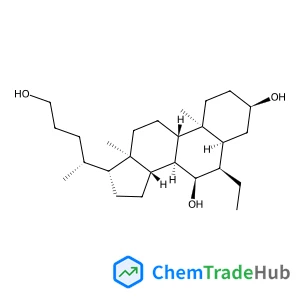
(3alpha,5beta,6alpha,7alpha)-6-Ethylcholane-3,7,24-triol
CAS Number:
1537866-49-1
Molecular Formula:
C26H46O3
Gaussian analysis of Raman spectroscopy reveals three significant structures in the liquid acetic acid (AA): linear chains involving C–H⋯OC and O–H⋯OC hydrogen bonding, cyclic dimers and dissociated monomers that can effectively cooperate with hydrogen bonded stacks of linear AA or polymer chains.
David R. Kelly, Alastair Meek, Stanley M. Roberts
DOI: 10.1039/B404379K
Cheng-Hsien Yang, Kai-Hung Fang, Chun-Hung Chen, I-Wen Sun
DOI: 10.1039/B406958G
Shosuke Kojo, Hiromi Uchino, Mayu Yoshimura, Kyoko Tanaka
DOI: 10.1039/B409941A
Dominik Wechsler, Robert McDonald, Michael J. Ferguson, Mark Stradiotto
DOI: 10.1039/B410328A
Tadashi Kawamoto, Takehiko Mori, Hiroshi Moriyama, Yutaka Nishio, Koji Kajita
DOI: 10.1039/B409631B
Shin-ichiro Kato, Taisuke Matsumoto, Tsutomu Ishi-i, Thies Thiemann, Motoyuki Shigeiwa, Hideki Gorohmaru, Shuichi Maeda, Yoshiro Yamashita, Shuntaro Mataka
DOI: 10.1039/B410016F
Michel Frigoli, Georg H. Mehl
DOI: 10.1039/B407561G
Daniel C. H. Oakes, Brian S. Kimberley, Vernon C. Gibson, David J. Jones, Andrew J. P. White, David J. Williams
DOI: 10.1039/B409870F
Agustino Zulys, Tarun K. Panda, Michael T. Gamer, Peter W. Roesky
DOI: 10.1039/B410918J
Takayuki Suzuki, Tatsuya Kato, Hiraku Shinozaki
DOI: 10.1039/B407342H
N-(4-Methoxybenzyl)-2-pyridinamine (CAS: 52818-63-0) is increasingly being used ...
When handling Ethyl 4-(2-chlorophenyl)-1,3-thiazole-2-carboxylate, appropriate p...
Diethyldiselane (CAS: 628-39-7) is classified under the Globally Harmonized Syst...
The market for oxocopper (CAS: 12053-18-8) is primarily driven by its use in cat...
The market for 5-{[(2-Methyl-2-propanyl)oxy]carbonyl}-5-azaspiro[2.4]heptane-7-c...
2-(1-Pyrrolidinyl)-4-pyridinamine is a chemical compound with the CAS number 359...
2-(3-Pyridinyl)-1-azabicyclo[2.2.2]octane (CAS: 91556-75-1) is a crystalline sol...
(S)-Alpha-allyl-proline hydrochloride is usually synthesized via a Wittig reacti...
3-Methyl-1,2-oxazole-5-carboxylic acid (CAS: 4857-42-5) is an organic compound w...
Lys-SMCC-DM1 is synthesized via a multi-step process involving the coupling of S...

Physical Chemistry Chemical Physics (PCCP) is an international journal co-owned by 19 physical chemistry and physics societies from around the world. This journal publishes original, cutting-edge research in physical chemistry, chemical physics and biophysical chemistry. To be suitable for publication in PCCP, articles must include significant innovation and/or insight into physical chemistry; this is the most important criterion that reviewers and Editors will judge against when evaluating submissions. The journal has a broad scope and welcomes contributions spanning experiment, theory, computation and data science. Topical coverage includes spectroscopy, dynamics, kinetics, statistical mechanics, thermodynamics, electrochemistry, catalysis, surface science, quantum mechanics, quantum computing and machine learning. Interdisciplinary research areas such as polymers and soft matter, materials, nanoscience, energy, surfaces/interfaces, and biophysical chemistry are welcomed if they demonstrate significant innovation and/or insight into physical chemistry. Joined experimental/theoretical studies are particularly appreciated when complementary and based on up-to-date approaches.
![N-{[(2-Methyl-2-propanyl)oxy]carbonyl}-L-methionylglycine structure](https://static.chemtradehub.com/structs/234/23446-03-9-e1e5.webp "N-{[(2-Methyl-2-propanyl)oxy]carbonyl}-L-methionylglycine structure")