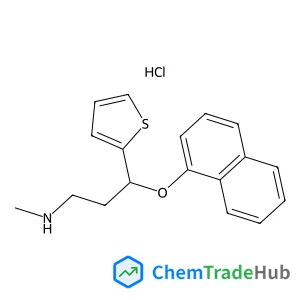
N-Methyl-3-(1-naphthyloxy)-3-(2-thienyl)-1-propanamine hydrochloride (1:1)
CAS Number:
1188266-11-6
Molecular Formula:
C18H20ClNOS
Guillaume Bégis, David Cladingboel, William B. Motherwell
Amidocyclopropanes are readily prepared by reaction of N-diethoxymethyl amides with alkenes in the presence of zinc amagalm, zinc chloride and chlorotrimethylsilane.
J. Roman-Perez, S. P. Centeno, M. R. López-Ramírez, J. F. Arenas, J. Soto, I. López-Tocón, J. C. Otero
DOI: 10.1039/C4CP03984J
Sigalit Aharon, Shany Gamliel, Bat El Cohen, Lioz Etgar
DOI: 10.1039/C4CP00460D
Carlos Zaldo, Concepción Cascales
DOI: 10.1039/C4CP03616F
Yongli Huang, Zengsheng Ma, Yichun Zhou, Weitao Zheng, Ji Zhou, Chang Q. Sun
DOI: 10.1039/C4CP02516D
L. A. Ferreira, A. Chervenak, S. Placko, A. Kestranek, P. P. Madeira, B. Y. Zaslavsky
DOI: 10.1039/C4CP02084G
Hanne Jacob, Sandra Ulrich, Ulrich Jung, Sonja Lemke, Talina Rusch, Christian Schütt, Finn Petersen, Thomas Strunskus, Olaf Magnussen, Rainer Herges, Felix Tuczek
DOI: 10.1039/C4CP03438D
Peter Spijker, Nico Holmberg, Adam S. Foster
DOI: 10.1039/C4CP02375G
Jagadish K. Salunke, Prashant Sonar, F. L. Wong, V. A. L. Roy, C. S. Lee, Prakash P. Wadgaonkar
DOI: 10.1039/C4CP03693J
Er Hong Song, Sung Ho Yoo, Jae Joon Kim, Shiau Wu Lai, Qing Jiang, Sung Oh Cho
DOI: 10.1039/C4CP02638A
N-(4-Methoxybenzyl)-2-pyridinamine (CAS: 52818-63-0) is increasingly being used ...
When handling Ethyl 4-(2-chlorophenyl)-1,3-thiazole-2-carboxylate, appropriate p...
Diethyldiselane (CAS: 628-39-7) is classified under the Globally Harmonized Syst...
The market for oxocopper (CAS: 12053-18-8) is primarily driven by its use in cat...
The market for 5-{[(2-Methyl-2-propanyl)oxy]carbonyl}-5-azaspiro[2.4]heptane-7-c...
2-(1-Pyrrolidinyl)-4-pyridinamine is a chemical compound with the CAS number 359...
2-(3-Pyridinyl)-1-azabicyclo[2.2.2]octane (CAS: 91556-75-1) is a crystalline sol...
(S)-Alpha-allyl-proline hydrochloride is usually synthesized via a Wittig reacti...
3-Methyl-1,2-oxazole-5-carboxylic acid (CAS: 4857-42-5) is an organic compound w...
Lys-SMCC-DM1 is synthesized via a multi-step process involving the coupling of S...

ChemComm publishes urgent research which is of outstanding significance and interest to experts in the field, while also appealing to the journal’s broad chemistry readership. Our communication format is ideally suited to short, urgent studies that are of such importance that they require accelerated publication. Our scope covers all topics in chemistry, and research at the interface of chemistry and other disciplines (such as materials science, nanoscience, physics, engineering and biology) where there is a significant novelty in the chemistry aspects. Major topic areas covered include: Analytical Chemistry Catalysis Chemical Biology and medicinal chemistry Computational Chemistry and Machine Learning Energy and sustainable chemistry Environmental Chemistry Green Chemistry Inorganic Chemistry Materials Chemistry Nanoscience Organic Chemistry Physical Chemistry Polymer Chemistry Supramolecular Chemistry
![5'-Fluoro-[2,3'-biindolinylidene]-2',3-dione structure](https://static.chemtradehub.com/structs/251/251903-00-1-9cb1.webp "5'-Fluoro-[2,3'-biindolinylidene]-2',3-dione structure")