












Total synthesis of (±)-acetoxyodontoschismenol using zirconium chemistry
Literature Information
Publication Date
2003-10-11
DOI
10.1039/B309848F
Impact Factor
6.222
Authors
Ian R. Baldwin, Richard J. Whitby
View Original
Abstract
The dolabellane diterpene (±)-acetoxyodontoschismenol has been synthesised for the first time by a short route in which a three component coupling on zirconium is used to assemble all the carbons needed for the skeleton in one-pot.
Recommended Journals
Related Literature
The mechanism of polyleucine catalysed asymmetric epoxidation
David R. Kelly, Stanley M. Roberts
2004-08-25
Communication
DOI: 10.1039/B404390C
Oligomer preparation from hexane by radical polyaddition with bis(α-trifluoromethyl-β,β-difluorovinyl) terephthalate
Tadashi Narita, Hiroshi Hamana, Satoshi Hattori
2004-09-07
Communication
DOI: 10.1039/B406116K
The anion sequence in the phase transformation of mesostructures templated by non-ionic block copolymers
Jiawei Tang, Chengzhong Yu, Xufeng Zhou, Xiaoxia Yan, Dongyuan Zhao
2004-08-25
Communication
DOI: 10.1039/B408100E
Photoinduced production of NAD(P)H from an activated fluorescein–DNA monolayer
Heinz-Bernhard Kraatz, Jeremy S. Lee
2004-08-10
Communication
DOI: 10.1039/B406689H
Synthesis of core–shell polyurethane–ureananoparticles containing 4,4′-methylenedi-p-phenyl diisocyanate and isophorone diisocyanate by self-assembled neutralization emulsification
In Woo Cheong, Jung Hyun Kim
2004-09-14
Communication
DOI: 10.1039/B409755F
A first oxalamidino complex of samarium via reduction-coupling of carbodiimine: synthesis and molecular structure of [η4-C2(NR)4][(MeC5H4)2Sm(HMPA)]2·2THF (R = Pri, Cy)
Mingyu Deng, Yingmin Yao, Yong Zhang
2004-10-15
Communication
DOI: 10.1039/B410599K
Self-assembled zinc(ii) Schiff basepolymers for applications in polymer light-emitting devices
Chi-Chung Kwok, Sze-Chit Yu, Iona H. T. Sham, Chi-Ming Che
2004-10-20
Communication
DOI: 10.1039/B412762E
A supramolecular approach to the selective detection of dopamine in the presence of ascorbate
Alex Fragoso, Eduardo Almirall, Roberto Cao, Luis Echegoyen, Raúl González-Jonte
2004-08-23
Communication
DOI: 10.1039/B407792J
Ionic hydrogenation of C-20, 22-ketene dithioacetal: stereoselective synthesis of steroidal C (20R) aldehydes
Bapurao B. Shingate, Braja G. Hazra, Vandana S. Pore, Rajesh G. Gonnade, Mohan M. Bhadbhade
2004-08-19
Communication
DOI: 10.1039/B407952C
New Pb–Pb bonds: syntheses and molecular structures of hexabiphenyldiplumbane and tri(trisbiphenylplumbyl)plumbate
Yuzhong Wang, Brandon Quillian, Pingrong Wei, Xiao-Juan Yang, Gregory H. Robinson
2004-08-20
Communication
DOI: 10.1039/B408860N
You might also like
Compound Q&A
What is the market or research trend for N-(4-Methoxybenzyl)-2-pyridinamine (CAS: 52818-63-0)?
N-(4-Methoxybenzyl)-2-pyridinamine (CAS: 52818-63-0) is increasingly being used ...
52818-63-0N-(4-Methoxybenzyl)-...
Compound Q&A
What precautions should be taken when handling Ethyl 4-(2-chlorophenyl)-1,3-thiazole-2-carboxylate (CAS: 1050507-06-6)?
When handling Ethyl 4-(2-chlorophenyl)-1,3-thiazole-2-carboxylate, appropriate p...
1050507-06-6Ethyl 4-(2-chlorophe...
Compound Q&A
What regulatory guidelines apply to diethyldiselane (CAS: 628-39-7)?
Diethyldiselane (CAS: 628-39-7) is classified under the Globally Harmonized Syst...
628-39-7Diethyldiselane
Compound Q&A
What is the market or research trend for oxocopper (CAS: 12053-18-8)?
The market for oxocopper (CAS: 12053-18-8) is primarily driven by its use in cat...
12053-18-8oxocopper; oxo-(oxoc...
Compound Q&A
What is the market or research trend for 5-{[(2-Methyl-2-propanyl)oxy]carbonyl}-5-azaspiro[2.4]heptane-7-carboxylic acid?
The market for 5-{[(2-Methyl-2-propanyl)oxy]carbonyl}-5-azaspiro[2.4]heptane-7-c...
1268519-54-55-{[(2-Methyl-2-prop...
Compound Q&A
What is 2-(1-Pyrrolidinyl)-4-pyridinamine (CAS: 35981-63-6)?
2-(1-Pyrrolidinyl)-4-pyridinamine is a chemical compound with the CAS number 359...
35981-63-62-(1-Pyrrolidinyl)-4...
Compound Q&A
What are the physical and chemical properties of 2-(3-Pyridinyl)-1-azabicyclo[2.2.2]octane (CAS: 91556-75-1)?
2-(3-Pyridinyl)-1-azabicyclo[2.2.2]octane (CAS: 91556-75-1) is a crystalline sol...
91556-75-12-(3-Pyridinyl)-1-az...
Compound Q&A
How is (S)-Alpha-allyl-proline hydrochloride (CAS: 129704-91-2) typically synthesized?
(S)-Alpha-allyl-proline hydrochloride is usually synthesized via a Wittig reacti...
129704-91-2(S)-Alpha-allyl-prol...
Compound Q&A
What is 3-Methyl-1,2-oxazole-5-carboxylic acid (CAS: 4857-42-5)?
3-Methyl-1,2-oxazole-5-carboxylic acid (CAS: 4857-42-5) is an organic compound w...
4857-42-53-Methyl-1,2-oxazole...
Compound Q&A
How is Lys-SMCC-DM1 (CAS: 1281816-04-3) typically synthesized?
Lys-SMCC-DM1 is synthesized via a multi-step process involving the coupling of S...
1281816-04-3Lys-SMCC-DM1
Source Journal
Chemical Communications

CiteScore:
8.6
Self-citation Rate:
4.7%
Articles per Year:
2458
ChemComm publishes urgent research which is of outstanding significance and interest to experts in the field, while also appealing to the journal’s broad chemistry readership. Our communication format is ideally suited to short, urgent studies that are of such importance that they require accelerated publication. Our scope covers all topics in chemistry, and research at the interface of chemistry and other disciplines (such as materials science, nanoscience, physics, engineering and biology) where there is a significant novelty in the chemistry aspects. Major topic areas covered include: Analytical Chemistry Catalysis Chemical Biology and medicinal chemistry Computational Chemistry and Machine Learning Energy and sustainable chemistry Environmental Chemistry Green Chemistry Inorganic Chemistry Materials Chemistry Nanoscience Organic Chemistry Physical Chemistry Polymer Chemistry Supramolecular Chemistry
Recommended Compounds
![1-[6-(1H-Imidazol-1-yl)-3-pyridinyl]methanamine structure](https://static.chemtradehub.com/structs/914/914637-08-4-8825.webp "1-[6-(1H-Imidazol-1-yl)-3-pyridinyl]methanamine structure")
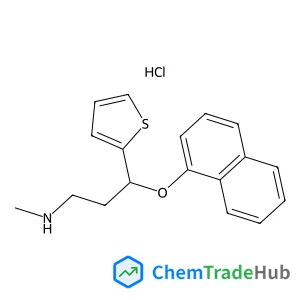
N-Methyl-3-(1-naphthyloxy)-3-(2-thienyl)-1-propanamine hydrochloride (1:1)
CAS Number:
1188266-11-6
Molecular Formula:
C18H20ClNOS
Recommended Suppliers





Disclaimer
This page provides academic journal information for reference and research purposes only. We are not affiliated with any journal publishers and do not handle publication submissions. For publication-related inquiries, please contact the respective journal publishers directly.
If you notice any inaccuracies in the information displayed, please contact us at support@chemtradehub.com. We will promptly review and address your concerns.