












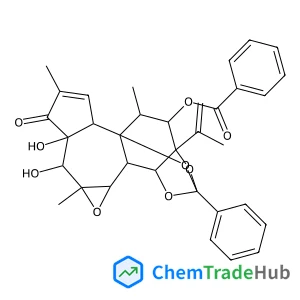
First supramolecular poly(taco complex)
Literature Information
Publication Date
2003-05-20
DOI
10.1039/B302682E
Impact Factor
6.222
Authors
Feihe Huang, Frank R. Fronczek, Harry W. Gibson
View Original
Abstract
The first supramolecular poly(taco complex) was formed in the solid state as shown by X-ray analysis.
Related Literature
Silyloxyazadienes: one intermediate and two competitive pericyclic reactions
Alessandro Bongini, Mauro Panunzio, Alessandro Venturini
2010-03-29
Paper
DOI: 10.1039/B925351C
Core shell structure for solid gas synthesis of LiBD4
D. Wallacher, A. Hoser, Y. W. Cho, K. H. Oh
2010-03-17
Paper
DOI: 10.1039/B927068J
Water adsorption on hydrophilic and hydrophobic self-assembled monolayers as proxies for atmospheric surfaces. A grand canonical Monte Carlo simulation study
Martina Roeselová
2010-03-16
Paper
DOI: 10.1039/B923382B
Supersonic jet UV spectrum and nonradiative processes of the thymine analogue 5-methyl-2-hydroxypyrimidine
Simon Lobsiger, Hans-Martin Frey, Samuel Leutwyler
2010-03-06
Paper
DOI: 10.1039/B924395J
Lipid coated mesoporous silicananoparticles as photosensitive drug carriers
Yang Yang, Weixing Song, Anhe Wang, Pengli Zhu, Jinbo Fei
2010-02-24
Paper
DOI: 10.1039/B924370D
Direct spectroscopy of contact charge transfer states: Possible consequences for tryptophan excited-state deactivation pathways by O2 and formation of reactive oxygen species
Swen Siegert, Ferdinand Vogeler, Joachim Schiedt, Rainer Weinkauf
2010-03-27
Paper
DOI: 10.1039/B926289J
Thermodynamic theory of two-dimensional to three-dimensional growth transition in quantum dotsself-assembly
Xinlei Li, Yuanyuan Cao, Guowei Yang
2010-03-16
Paper
DOI: 10.1039/B927189A
Adsorption of cyanodiacetylene on ice: a periodic approach
Frédéric Labat, Claude Pouchan
2009-05-12
Paper
DOI: 10.1039/B817809G
Caging and solvent effects on the tautomeric equilibrium of 3-pyridone/3-hydroxypyridine in the ground state: a study in cyclodextrins and binary solvents
Osama K. Abou-Zied, Othman I. K. Al-Shihi
2009-04-20
Paper
DOI: 10.1039/B823405A
You might also like
Compound Q&A
What are the main uses of (3.beta.)-3-Hydroxy-N,N-dimethyl-chol-5-en-24-amide (CAS: 79066-03-8)?
(3.beta.)-3-Hydroxy-N,N-dimethyl-chol-5-en-24-amide (CAS: 79066-03-8) is primari...
79066-03-8(3.beta.)-3-Hydroxy-...
Compound Q&A
What regulatory guidelines apply to 5-(aminomethyl)-2-methoxyphenol (CAS: 89702-89-6)?
5-(Aminomethyl)-2-methoxyphenol (CAS: 89702-89-6) is classified under GHS as a s...
89702-89-65-(aminomethyl)-2-me...
Compound Q&A
What is Thieno[2,3-c]pyridin-7(6H)-one (CAS: 28981-13-7)?
Thieno[2,3-c]pyridin-7(6H)-one (CAS: 28981-13-7) is a heterocyclic organic compo...
28981-13-7Thieno[2,3-c]pyridin...
Compound Q&A
Is 1-[(6-Methoxy-3-pyridinyl)methyl]-4-piperidinamine dihydrochloride (CAS: 1185311-28-7) safe?
1-[(6-Methoxy-3-pyridinyl)methyl]-4-piperidinamine dihydrochloride is generally ...
1185311-28-71-[(6-Methoxy-3-pyri...
Compound Q&A
What regulatory guidelines apply to [(2E)-3-Phenyl-2-propen-1-yl]phosphonic acid (CAS: 146404-58-2)?
[(2E)-3-Phenyl-2-propen-1-yl]phosphonic acid (CAS: 146404-58-2) is regulated und...
146404-58-2[(2E)-3-Phenyl-2-pro...
Compound Q&A
What regulatory guidelines apply to 6-Bromo-7-methoxyquinoline (CAS: 1620515-86-7)?
6-Bromo-7-methoxyquinoline (CAS: 1620515-86-7) falls under the scope of the Glob...
1620515-86-76-Bromo-7-methoxyqui...
Compound Q&A
What industries use (2R)-1-(1-Benzofuran-2-yl)-N-propyl-2-pentanamine (CAS: 260550-89-8)?
This compound is primarily used in the pharmaceutical industry for the developme...
260550-89-8(2R)-1-(1-Benzofuran...
Compound Q&A
What are the main uses of 1-Ethyl-7-[2-methyl-6-(4H-1,2,4-triazol-3-yl)-3-pyridinyl]-3,5-dihydropyrazino[2,3-b]pyrazin-2(1H)-one (CAS: 1228013-15-7)?
1-Ethyl-7-[2-methyl-6-(4H-1,2,4-triazol-3-yl)-3-pyridinyl]-3,5-dihydropyrazino[2...
1228013-15-71-Ethyl-7-[2-methyl-...
Compound Q&A
Are there alternatives to {5-(Acryloylamino)-2-[(dimethylamino)methyl]phenyl}boronic acid (CAS: 1217500-78-1) in synthesis?
Alternative reagents such as 2-[(dimethylamino)methyl]phenylboronic acid or rela...
1217500-78-1{5-(Acryloylamino)-2...
Compound Q&A
What is 3-(Piperidin-4-yloxy)pyridine (CAS: 310881-48-2)?
3-(Piperidin-4-yloxy)pyridine (CAS: 310881-48-2) is an organic compound with the...
310881-48-23-(Piperidin-4-yloxy...
Source Journal
Chemical Communications

CiteScore:
8.6
Self-citation Rate:
4.7%
Articles per Year:
2458
ChemComm publishes urgent research which is of outstanding significance and interest to experts in the field, while also appealing to the journal’s broad chemistry readership. Our communication format is ideally suited to short, urgent studies that are of such importance that they require accelerated publication. Our scope covers all topics in chemistry, and research at the interface of chemistry and other disciplines (such as materials science, nanoscience, physics, engineering and biology) where there is a significant novelty in the chemistry aspects. Major topic areas covered include: Analytical Chemistry Catalysis Chemical Biology and medicinal chemistry Computational Chemistry and Machine Learning Energy and sustainable chemistry Environmental Chemistry Green Chemistry Inorganic Chemistry Materials Chemistry Nanoscience Organic Chemistry Physical Chemistry Polymer Chemistry Supramolecular Chemistry
Recommended Compounds
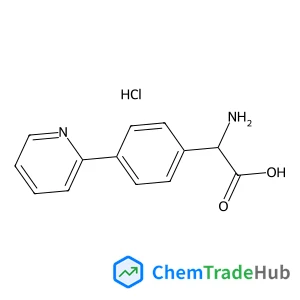
2-Amino-2-(4-(pyridin-2-YL)phenyl)acetic acid hydrochloride
CAS Number:
1135818-89-1
Molecular Formula:
C13H13ClN2O2
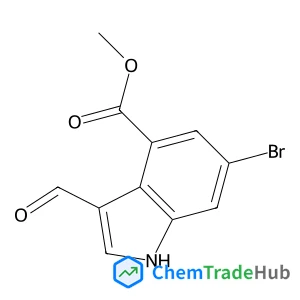
methyl 6-bromo-3-formyl-1H-indole-4-carboxylate
CAS Number:
1353636-63-1
Molecular Formula:
C11H8BrNO3
Recommended Suppliers





Disclaimer
This page provides academic journal information for reference and research purposes only. We are not affiliated with any journal publishers and do not handle publication submissions. For publication-related inquiries, please contact the respective journal publishers directly.
If you notice any inaccuracies in the information displayed, please contact us at support@chemtradehub.com. We will promptly review and address your concerns.