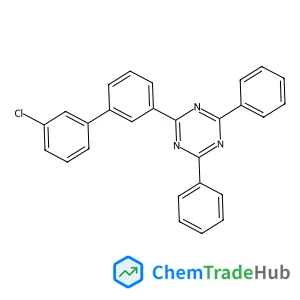
2-(3'-Chlorobiphenyl-3-yl)-4,6-diphenyl-1,3,5-triazine
CAS Number:
1443049-83-9
Molecular Formula:
C27H18ClN3
Simon Lobsiger, Hans-Martin Frey, Samuel Leutwyler
We investigate the infrared and electronic absorption spectra and the excited-state nonradiative processes of supersonic jet-cooled 5-methyl-2-hydroxypyrimidine (5M2HP), the enol form of deoxythymine, using two-color resonant two-photon ionization (R2PI) and infrared–UV depletion spectroscopies. Unlike uracil and thymine, which exhibit structureless electronic absorption spectra, the vibronic spectrum of 5M2HP is structured with narrow vibronic bands, allowing for the first time to probe the excited state of a thymine analogue. The S0 state infrared depletion spectrum shows an O–H and no N–H stretch band, identifying the spectrum as that of the enol tautomer. The S1 ← S0 electronic transition is 1nπ*, as evidenced by the rotational contour of the 000 band. Vibronic excitations of the in-plane benzene-type vibrations , , and are observed, while none are observed for the out-of plane fundamental excitations, implying that the 1nπ* excited state of 5M2HP has a planar pyrimidine frame. From 1200 to 3600 cm−1 the vibronic bands become steadily broader, signaling a coupling to a lower-lying electronic state that increases with increasing energy. At ∼3600 cm−1 above the origin, the R2PI spectrum broadens completely, indicating that the two states are strongly mixed. Delayed ionization measurements show that the coupled electronic state has a >5 μs lifetime. No fluorescence has been observed from the 1nπ* state, implying relaxation to the lower-lying long-lived state is very efficient. Separate ionization potentials are measured for the 1nπ* state (9.178 eV) and for the long-lived state (∼9.46 eV), hence the latter lies ∼2200 cm−1 below the 1nπ* state. Time-dependent B3LYP calculations of the excited states of 5M2HP indeed predict the S1 state to be 1nπ* with a planar hydroxypyrimidine moiety. The T1 (3ππ*) state is calculated to lie 3000 cm−1 below the S1 state, in excellent agreement with the experiment.
Thi X. T. Sayle, Stephen C. Parker, Dean C. Sayle
DOI: 10.1039/B408752F
Panagiotis Manesiotis, Andrew J. Hall, Marco Emgenbroich, Milena Quaglia, Ersilia De Lorenzi, Börje Sellergren
DOI: 10.1039/B407870E
Radek Pohl, Dmitry Aldakov, Pavel Kubát, Karolina Jursíková, Manuel Marquez, Pavel Anzenbacher, Jr.
DOI: 10.1039/B315268E
Deirdre Ledwith, Suresh C. Pillai, Graeme W. Watson, John M. Kelly
DOI: 10.1039/B407768G
Rajan Venkatesh, Bastiaan B P Staal, Bert Klumperman
DOI: 10.1039/B403342F
Donna C. Arnold, Chris J. Nuttall, Alexandros Lappas
DOI: 10.1039/B405907G
Nan Ding, Duck-Young Chung, Mercouri G. Kanatzidis
DOI: 10.1039/B402686A
Liya Muslinkina, Ernö Pretsch
DOI: 10.1039/B401864H
Marcin Drąg, Adam Jezierski, Pawel Kafarski
DOI: 10.1039/B401633E
Francis D'Souza, Suresh Gadde, Melvin E. Zandler, Mitsunari Itou, Yasuyuki Araki, Osamu Ito
DOI: 10.1039/B407985J
When handling 2-Chloro-1,2-bis(4-methylphenyl)ethanone (CAS: 71193-32-3), it is ...
4-Ethoxy-3-(5-methyl-4-oxo-7-propyl-1,4-dihydroimidazo[5,1-f][1,2,4]triazin-2-yl...
Methyl 3-Oxo-4-Androsten-17-Carboxylate (CAS: 2681-55-2) should be stored in a c...
(R)-3-Amino-4-(3-hexylphenylamino)-4-oxobutylphosphonic acid is primarily used i...
2-Methyl-2-propanyl 3-amino-3-carbamoyl-1-azetidinecarboxylate (CAS: 1254120-14-...
There are alternative reagents that can be used in synthesis instead of (E)-4-(t...
[2-(3-Chlorophenyl)-1,3-thiazol-4-yl]methanol (CAS: 121202-20-8) is a crystallin...
The market and research trends for Methyl (2S)-[(4S)-2,2-dimethyl-1,3-dioxolan-4...
The market for 1-Bromo-2-isocyanatoethane (CAS: 42865-19-0) is driven by its use...
4-Nitro-D-phenylalanine hydrochloride (CAS: 147065-06-3) is primarily used in re...

Physical Chemistry Chemical Physics (PCCP) is an international journal co-owned by 19 physical chemistry and physics societies from around the world. This journal publishes original, cutting-edge research in physical chemistry, chemical physics and biophysical chemistry. To be suitable for publication in PCCP, articles must include significant innovation and/or insight into physical chemistry; this is the most important criterion that reviewers and Editors will judge against when evaluating submissions. The journal has a broad scope and welcomes contributions spanning experiment, theory, computation and data science. Topical coverage includes spectroscopy, dynamics, kinetics, statistical mechanics, thermodynamics, electrochemistry, catalysis, surface science, quantum mechanics, quantum computing and machine learning. Interdisciplinary research areas such as polymers and soft matter, materials, nanoscience, energy, surfaces/interfaces, and biophysical chemistry are welcomed if they demonstrate significant innovation and/or insight into physical chemistry. Joined experimental/theoretical studies are particularly appreciated when complementary and based on up-to-date approaches.