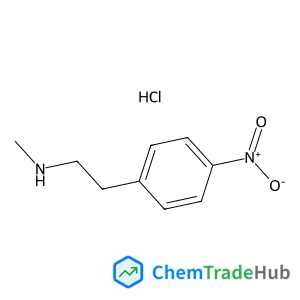
N-Methyl-2-(4-nitrophenyl)ethanamine hydrochloride (1:1)
CAS Number:
166943-39-1
Molecular Formula:
C9H13ClN2O2
Frédéric Labat, Claude Pouchan
The adsorption of cyanodiacetylene (HC5N) on ice has been investigated within a periodic approach at the density functional theory level using the parameter-free PBE0 hybrid functional. Two adsorption models, involving monodentate hydrogen bonding, have been considered. A third model, corresponding to a bridging binding model, has also been taken into account but found unstable. Calculations have been carried out considering two orientations of a proton-ordered model of ice surfaces, using two different unit cells in each case. Eight different cases of the adsorption of HC5N on ice have been investigated in depth at the geometric, energetic and electronic levels. Although HC5N is found to mainly bind to ice by direct hydrogen bonding, densities of states analysis suggest that its π system plays a relevant role in the adsorption, especially by interaction with dangling surface hydrogen atoms, leading to significantly different adsorption geometries in all cases investigated. Analysis of the infrared spectral signature of HC5N shows the typical large red-shift of the H–C stretching mode frequency in the adsorption model involving hydrogen bonding between the H atom of HC5N and ice, in line with both experimental and previous theoretical findings based on cluster approaches.
David Norton, Richard J. Whitby, Ed Griffen
DOI: 10.1039/B403337J
Rajan Venkatesh, Bastiaan B P Staal, Bert Klumperman
DOI: 10.1039/B403342F
Mizuki Kitamatsu, Masanori Shigeyasu, Tomoyuki Okada, Masahiko Sisido
DOI: 10.1039/B401057D
Tomoka Yamaguchi, Yukinari Sunatsuki, Masaaki Kojima, Haruo Akashi, Masanobu Tsuchimoto, Nazzareno Re, Shutaro Osa, Naohide Matsumoto
DOI: 10.1039/B401033G
Jennifer L. Czlapinski, Terry L. Sheppard
DOI: 10.1039/B410493E
Kristof T. J. Loones, Bert U. W. Maes, Roger A. Dommisse, Guy L. F. Lemière
DOI: 10.1039/B409161B
Nan Ding, Duck-Young Chung, Mercouri G. Kanatzidis
DOI: 10.1039/B402686A
Deirdre Ledwith, Suresh C. Pillai, Graeme W. Watson, John M. Kelly
DOI: 10.1039/B407768G
David Curiel, Paul D. Beer, Rowena L. Paul, Andrew Cowley, Mark R. Sambrook, Fridrich Szemes
DOI: 10.1039/B401900H
Steven M. Miles, Stephen P. Marsden, Robin J. Leatherbarrow, William J. Coates
DOI: 10.1039/B409528F
When handling 2-Chloro-1,2-bis(4-methylphenyl)ethanone (CAS: 71193-32-3), it is ...
4-Ethoxy-3-(5-methyl-4-oxo-7-propyl-1,4-dihydroimidazo[5,1-f][1,2,4]triazin-2-yl...
Methyl 3-Oxo-4-Androsten-17-Carboxylate (CAS: 2681-55-2) should be stored in a c...
(R)-3-Amino-4-(3-hexylphenylamino)-4-oxobutylphosphonic acid is primarily used i...
2-Methyl-2-propanyl 3-amino-3-carbamoyl-1-azetidinecarboxylate (CAS: 1254120-14-...
There are alternative reagents that can be used in synthesis instead of (E)-4-(t...
[2-(3-Chlorophenyl)-1,3-thiazol-4-yl]methanol (CAS: 121202-20-8) is a crystallin...
The market and research trends for Methyl (2S)-[(4S)-2,2-dimethyl-1,3-dioxolan-4...
The market for 1-Bromo-2-isocyanatoethane (CAS: 42865-19-0) is driven by its use...
4-Nitro-D-phenylalanine hydrochloride (CAS: 147065-06-3) is primarily used in re...

Physical Chemistry Chemical Physics (PCCP) is an international journal co-owned by 19 physical chemistry and physics societies from around the world. This journal publishes original, cutting-edge research in physical chemistry, chemical physics and biophysical chemistry. To be suitable for publication in PCCP, articles must include significant innovation and/or insight into physical chemistry; this is the most important criterion that reviewers and Editors will judge against when evaluating submissions. The journal has a broad scope and welcomes contributions spanning experiment, theory, computation and data science. Topical coverage includes spectroscopy, dynamics, kinetics, statistical mechanics, thermodynamics, electrochemistry, catalysis, surface science, quantum mechanics, quantum computing and machine learning. Interdisciplinary research areas such as polymers and soft matter, materials, nanoscience, energy, surfaces/interfaces, and biophysical chemistry are welcomed if they demonstrate significant innovation and/or insight into physical chemistry. Joined experimental/theoretical studies are particularly appreciated when complementary and based on up-to-date approaches.