













Direct spectroscopy of contact charge transfer states: Possible consequences for tryptophan excited-state deactivation pathways by O2 and formation of reactive oxygen species
Literature Information
Publication Date
2010-03-27
DOI
10.1039/B926289J
Impact Factor
3.676
Authors
Swen Siegert, Ferdinand Vogeler, Joachim Schiedt, Rainer Weinkauf
View Original
Abstract
This paper demonstrates that photodetachment photoelectron spectroscopy (PD-PES) of non-covalently bound heteromolecular anion clusters allows direct access to neutral contact charge transfer (CCT) states. The 2,2′-bithiophene·indole cluster is investigated as a model system in such a way that both chromophores have similar optical excitation cross-sections and hence the PD-PES shows the signature of both molecules. For the complexes O2·stilbene, O2·indole and O2·N-methylindole the optical cross-sections of the conjugated chromophores are much larger than that of O2. This forces most of the anion-to-neutral photoexcitation into the CCT state. The CCT states lie below S1 for 2,2′-bithiophene·indole and O2·stilbene or even below T1 for O2·indole and O2·N-methylindole. Significant differences are found between the PD-PES of O2 with indole and N-methylindole indicating that different collision sites may have different CCT state energies and as a result different 1Δg oxygen formation efficiencies. We discuss the possible consequences of the energetics and the geometry changes for the excited-state deactivation of tryptophan via the CCT state O2−·tryptophan+.
Related Literature
Self-assembly of a novel pentanuclear centred-tetrahedral silver species
Edwin C. Constable, Catherine E. Housecroft, Markus Neuburger, Sebastien Reymann, Sylvia Schaffner
2004-03-29
Communication
DOI: 10.1039/B402376E
First example of the chemical, oxidative cleavage of the C–P bond in aminophosphonate chemistry. The oxidation of 1-amino-1-(3,4-dihydroxyphenyl)methylphosphonic acid by NaIO4
Marcin Drąg, Adam Jezierski, Pawel Kafarski
2004-04-08
Communication
DOI: 10.1039/B401633E
Insertion of (E)-(1,2-dihalovinyl)lithium and (2-haloethynyl)lithium into zirconacycles
David Norton, Richard J. Whitby, Ed Griffen
2004-04-23
Communication
DOI: 10.1039/B403337J
Cu@C60 formation in rf-plasma and ring-current induced magnetism of C60
Houjin Huang, Masafumi Ata, Yoko Yoshimoto
2004-04-20
Communication
DOI: 10.1039/B402196G
The rediscovery of Alfred Werner's second hexol
W. Gregory Jackson, Josephine A. McKeon, Margareta Zehnder, Markus Neuberger, Silvio Fallab
2004-09-06
Communication
DOI: 10.1039/B408277J
A novel 2D net-like supramolecular polymer constructed from Ln6Cu24 node and trans-Cu(Gly)2 bridge
Jian-Jun Zhang, Sheng-Qing Xia, Tian-Lu Sheng, Sheng-Min Hu, Guido Leibeling, Franc Meyer, Xin-Tao Wu, Sheng-Chang Xiang, Rui-Biao Fu
2004-04-14
Communication
DOI: 10.1039/B400447G
Self-assembly of aluminium–salen coupled nanostructures from encoded modules with cleavable disulfide DNA-linkers
Raymond S. Brown, Morten Nielsen, Kurt V. Gothelf
2004-05-27
Communication
DOI: 10.1039/B403956D
Synthesis and properties of rhenium tricarbonyl complex bearing N-fused tetraphenylporphyrin ligand
Motoki Toganoh, Tomoya Ishizuka
2004-09-20
Communication
DOI: 10.1039/B406234E
Molecularly imprinted polymer sensor arrays
Nathaniel T. Greene, Stephen L. Morgan, Ken D. Shimizu
2004-04-28
Communication
DOI: 10.1039/B401677G
A novel supramolecular assembly in an iron(iii) compound exhibiting magnetic ordering at 70 K
Donatella Armentano, Giovanni De Munno, Teresa F. Mastropietro, Miguel Julve, Francesc Lloret
2004-04-21
Communication
DOI: 10.1039/B402055C
You might also like
Compound Q&A
What precautions should be taken when handling 2-Chloro-1,2-bis(4-methylphenyl)ethanone (CAS: 71193-32-3)?
When handling 2-Chloro-1,2-bis(4-methylphenyl)ethanone (CAS: 71193-32-3), it is ...
71193-32-32-Chloro-1,2-bis(4-m...
Compound Q&A
What industries use 4-Ethoxy-3-(5-methyl-4-oxo-7-propyl-1,4-dihydroimidazo[5,1-f][1,2,4]triazin-2-yl)benzenesulfonyl chloride (CAS: 224789-26-8)?
4-Ethoxy-3-(5-methyl-4-oxo-7-propyl-1,4-dihydroimidazo[5,1-f][1,2,4]triazin-2-yl...
224789-26-84-Ethoxy-3-(5-methyl...
Compound Q&A
How should Methyl 3-Oxo-4-Androsten-17-Carboxylate (CAS: 2681-55-2) be stored?
Methyl 3-Oxo-4-Androsten-17-Carboxylate (CAS: 2681-55-2) should be stored in a c...
2681-55-2Methyl 3-Oxo-4-Andro...
Compound Q&A
What are the main uses of (R)-3-Amino-4-(3-hexylphenylamino)-4-oxobutylphosphonic acid (CAS: 909725-61-7)?
(R)-3-Amino-4-(3-hexylphenylamino)-4-oxobutylphosphonic acid is primarily used i...
909725-61-7(R)-3-Amino-4-(3-hex...
Compound Q&A
What regulatory guidelines apply to 2-Methyl-2-propanyl 3-amino-3-carbamoyl-1-azetidinecarboxylate (CAS: 1254120-14-3)?
2-Methyl-2-propanyl 3-amino-3-carbamoyl-1-azetidinecarboxylate (CAS: 1254120-14-...
1254120-14-32-Methyl-2-propanyl ...
Compound Q&A
Are there alternatives to (E)-4-(tert-Butoxy)-4-oxobut-2-enoic acid (CAS: 135355-96-3) in synthesis?
There are alternative reagents that can be used in synthesis instead of (E)-4-(t...
135355-96-3(E)-4-(tert-Butoxy)-...
Compound Q&A
What are the physical and chemical properties of [2-(3-Chlorophenyl)-1,3-thiazol-4-yl]methanol (CAS: 121202-20-8)?
[2-(3-Chlorophenyl)-1,3-thiazol-4-yl]methanol (CAS: 121202-20-8) is a crystallin...
121202-20-8[2-(3-Chlorophenyl)-...
Compound Q&A
What is the market or research trend for Methyl (2S)-[(4S)-2,2-dimethyl-1,3-dioxolan-4-yl]{[(4-methylphenyl)sulfonyl]oxy}acetate (CAS: 166249-17-8)?
The market and research trends for Methyl (2S)-[(4S)-2,2-dimethyl-1,3-dioxolan-4...
166249-17-8Methyl (2S)-[(4S)-2,...
Compound Q&A
What is the market or research trend for 1-Bromo-2-isocyanatoethane (CAS: 42865-19-0)?
The market for 1-Bromo-2-isocyanatoethane (CAS: 42865-19-0) is driven by its use...
42865-19-01-Bromo-2-isocyanato...
Compound Q&A
What are the main uses of 4-Nitro-D-phenylalanine hydrochloride (CAS: 147065-06-3)?
4-Nitro-D-phenylalanine hydrochloride (CAS: 147065-06-3) is primarily used in re...
147065-06-34-Nitro-D-phenylalan...
Source Journal
Physical Chemistry Chemical Physics

CiteScore:
5.5
Self-citation Rate:
10.3%
Articles per Year:
3036
Physical Chemistry Chemical Physics (PCCP) is an international journal co-owned by 19 physical chemistry and physics societies from around the world. This journal publishes original, cutting-edge research in physical chemistry, chemical physics and biophysical chemistry. To be suitable for publication in PCCP, articles must include significant innovation and/or insight into physical chemistry; this is the most important criterion that reviewers and Editors will judge against when evaluating submissions. The journal has a broad scope and welcomes contributions spanning experiment, theory, computation and data science. Topical coverage includes spectroscopy, dynamics, kinetics, statistical mechanics, thermodynamics, electrochemistry, catalysis, surface science, quantum mechanics, quantum computing and machine learning. Interdisciplinary research areas such as polymers and soft matter, materials, nanoscience, energy, surfaces/interfaces, and biophysical chemistry are welcomed if they demonstrate significant innovation and/or insight into physical chemistry. Joined experimental/theoretical studies are particularly appreciated when complementary and based on up-to-date approaches.
Recommended Compounds
![2-Hydroxy-4-[({[(4-methylphenyl)sulfonyl]oxy}acetyl)amino]benzoic acid structure](https://static.chemtradehub.com/structs/501/501919-59-1-579f.webp "2-Hydroxy-4-[({[(4-methylphenyl)sulfonyl]oxy}acetyl)amino]benzoic acid structure")
2-Hydroxy-4-[({[(4-methylphenyl)sulfonyl]oxy}acetyl)amino]benzoic acid
CAS Number:
501919-59-1
Molecular Formula:
C16H15NO7S
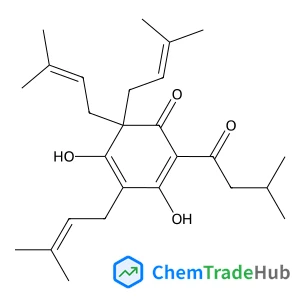
3,5-Dihydroxy-4-(3-methylbutanoyl)-2,6,6-tris(3-methyl-2-buten-1-yl)-2,4-cyclohexadien-1-one
CAS Number:
468-28-0
Molecular Formula:
C26H38O4
Recommended Suppliers




Disclaimer
This page provides academic journal information for reference and research purposes only. We are not affiliated with any journal publishers and do not handle publication submissions. For publication-related inquiries, please contact the respective journal publishers directly.
If you notice any inaccuracies in the information displayed, please contact us at support@chemtradehub.com. We will promptly review and address your concerns.