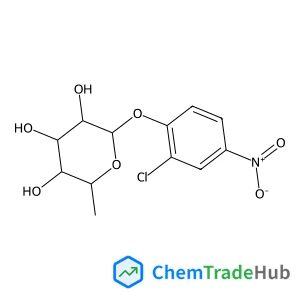
2-Chloro-4-nitrophenyl 6-deoxy-alpha-L-galactopyranoside
CAS Number:
157843-41-9
Molecular Formula:
C12H14ClNO7
Martina Roeselová
Grand canonical Monte Carlo simulations are used to determine water adsorption on prototypical organic surfaces as a function of relative humidity at 300 K. Three model surfaces formed by well-ordered self-assembled monolayers (SAMs) of alkanethiolate chains on gold are investigated: (i) a smooth hydrophobic surface of methyl–terminated C7–CH3 SAM; (ii) a rough hydrophobic surface of randomly mixed two-component SAM, composed of equal fractions of C5–CH3 and C7–CH3 chains (C5/C7–CH3 SAM); and (iii) a smooth hydrophilic surface of carboxyl–terminated C7–COOH SAM. The all atom CHARMM22 force field is used for the SAM chains together with the SPC/E model for water. No noticeable water adsorption is observed on the smooth hydrophobic surface up to saturation. The mild surface roughness introduced by the uneven chain length of the two components constituting the C5/C7–CH3 SAM has no significant effect on the surface hydrophobicity, and the rough hydrophobic surface also remains dry up to the point when water condensation occurs. In contrast, water readily adsorbs onto the hydrophilic surface by forming hydrogen bonds with the COOH groups of the substrate. In addition, hydrogen bonding with pre-adsorbed water molecules contributes to the mechanism of water uptake. Under low humidity conditions, water is present on the hydrophilic surface as individual molecules or small water clusters and, with increasing relative humidity, the surface coverage grows continuously beyond a monolayer formation. The adsorbed water film is observed to be rather inhomogeneous with patches of bare surface exposed. The amount of water constituting a stable adsorption layer prior to condensation is estimated to consist of about 2–5 molecular layers. Detailed analysis of the simulation results is used to obtain important insights into the structure and energetics of water adsorbed on highly oxidized organic surfaces exposed to ambient air of increasing relative humidity.
Masahiro Fujino, Takamitsu Amano, Hiroki Akutsu, Jun-ichi Yamada, Shin'ichi Nakatsuji
DOI: 10.1039/B408432B
Junfeng Geng, David A. Jefferson, Brian F. G. Johnson
DOI: 10.1039/B406227B
Nathaniel T. Greene, Stephen L. Morgan, Ken D. Shimizu
DOI: 10.1039/B401677G
Isabelle Gener, Philippe Ayrault, Michel Guisnet
DOI: 10.1039/B409964H
G. Carja, G. Delahay, C. Signorile, B. Coq
DOI: 10.1039/B402660H
Nakcheol Jeong, Dong Hoon Kim, Jun Hun Choi
DOI: 10.1039/B401288G
Martina H. Stenzel, Thomas P. Davis, Christopher Barner-Kowollik
DOI: 10.1039/B404763J
Myroslav O. Vysotsky, Anca Bogdan, Leyong Wang, Volker Böhmer
DOI: 10.1039/B402719A
Nan Ding, Duck-Young Chung, Mercouri G. Kanatzidis
DOI: 10.1039/B402686A
Xuefeng Zhu, Haihui Wang, Weishen Yang
DOI: 10.1039/B400857J
When handling 2-Chloro-1,2-bis(4-methylphenyl)ethanone (CAS: 71193-32-3), it is ...
4-Ethoxy-3-(5-methyl-4-oxo-7-propyl-1,4-dihydroimidazo[5,1-f][1,2,4]triazin-2-yl...
Methyl 3-Oxo-4-Androsten-17-Carboxylate (CAS: 2681-55-2) should be stored in a c...
(R)-3-Amino-4-(3-hexylphenylamino)-4-oxobutylphosphonic acid is primarily used i...
2-Methyl-2-propanyl 3-amino-3-carbamoyl-1-azetidinecarboxylate (CAS: 1254120-14-...
There are alternative reagents that can be used in synthesis instead of (E)-4-(t...
[2-(3-Chlorophenyl)-1,3-thiazol-4-yl]methanol (CAS: 121202-20-8) is a crystallin...
The market and research trends for Methyl (2S)-[(4S)-2,2-dimethyl-1,3-dioxolan-4...
The market for 1-Bromo-2-isocyanatoethane (CAS: 42865-19-0) is driven by its use...
4-Nitro-D-phenylalanine hydrochloride (CAS: 147065-06-3) is primarily used in re...

Physical Chemistry Chemical Physics (PCCP) is an international journal co-owned by 19 physical chemistry and physics societies from around the world. This journal publishes original, cutting-edge research in physical chemistry, chemical physics and biophysical chemistry. To be suitable for publication in PCCP, articles must include significant innovation and/or insight into physical chemistry; this is the most important criterion that reviewers and Editors will judge against when evaluating submissions. The journal has a broad scope and welcomes contributions spanning experiment, theory, computation and data science. Topical coverage includes spectroscopy, dynamics, kinetics, statistical mechanics, thermodynamics, electrochemistry, catalysis, surface science, quantum mechanics, quantum computing and machine learning. Interdisciplinary research areas such as polymers and soft matter, materials, nanoscience, energy, surfaces/interfaces, and biophysical chemistry are welcomed if they demonstrate significant innovation and/or insight into physical chemistry. Joined experimental/theoretical studies are particularly appreciated when complementary and based on up-to-date approaches.