












Electrochemically controlled interactions between TTF-based dendrimers and an electron-rich oligomer
Literature Information
Publication Date
2002-11-20
DOI
10.1039/B209765F
Impact Factor
6.222
Authors
Andrew Beeby, Martin R. Bryce, Christian A. Christensen, Graeme Cooke, Florence M. A. Duclairoir, Vincent M. Rotello
View Original
Abstract
Electrochemically controlled interactions have been shown to occur between TTF containing dendrimers 1 and 2 and the electron-rich oligomer 3.
Related Literature
Effect of curing reaction types on the structures and properties of acetylene-containing thermosets: towards optimization of curing procedure
Junli Zhu, Liquan Wang, Jiaping Lin, Lei Du, Qixin Zhuang
2021-06-01
Paper
DOI: 10.1039/D0CP05580H
Atmospheric oxidation of fluoroalcohols initiated by ˙OH radicals in the presence of water and mineral dusts: mechanism, kinetics, and risk assessment
Feng-Yang Bai, Ming-Shuai Deng, Mei-Yan Chen, Lian Kong, Shuang Ni, Xiu-Mei Pan
2021-04-29
Paper
DOI: 10.1039/D1CP01324F
Biliverdin chiral derivatives as chiroptical switches for pH and metal cation sensing
Simone Ghidinelli, Giuseppe Mazzeo, Stefan E. Boiadjiev, David A. Lightner
2021-08-26
Paper
DOI: 10.1039/D1CP02571F
Insights from QM/MM-ONIOM calculations: the TADF phenomenon of phenanthro[9,10-d]imidazole-anthraquinone in the solid state
Huixue Li, Xiaofeng Wang, Kun Yuan, Lingling Lv, Zhifeng Li
2021-08-19
Paper
DOI: 10.1039/D1CP00578B
Glass transition and dynamics of semiflexible polymer brushes
Jian-Hua Huang, Dan-Dan Sun, Rong-Xing Lu
2021-05-28
Paper
DOI: 10.1039/D1CP00089F
Mode-specific dynamics in multichannel reaction NH+ + H2
Weiliang Shi, Kun Wang, Ping Zhang, Le Yu, Anyang Li
2021-08-20
Paper
DOI: 10.1039/D1CP02603H
Prediction of the standard potentials for one-electron oxidation of N,N,N′,N′ tetrasubstituted p-phenylenediamines by calculation
Cecilie L. Andersen, Evanildo G. Lacerda, Jr, Jørn B. Christensen, Stephan P. A. Sauer, Ole Hammerich
2021-09-02
Paper
DOI: 10.1039/D1CP02315B
The manner and extent to which the hydration shell impacts interactions between hydrated species
Jinyang Jiang, Le Guo, Luping Tang, Yu Zhang
2021-08-17
Paper
DOI: 10.1039/D1CP03368A
Surface hopping dynamics reveal ultrafast triplet generation promoted by S1–T2–T1 spin-vibronic coupling in 2-mercaptobenzothiazole
Chithra M. J., Probal Nag, Sivaranjana Reddy Vennapusa
2021-08-27
Paper
DOI: 10.1039/D1CP02587B
Surface electronic states mediate concerted electron and proton transfer at metal nanoscale interfaces for catalytic hydride reduction of –NO2 to –NH2
Bing-Qian Shan, Jia-Feng Zhou, Meng Ding, Xiao-Dan Hu
2021-05-25
Communication
DOI: 10.1039/D1CP01792F
You might also like
Compound Q&A
What is the market or research trend for N-(4-Methoxybenzyl)-2-pyridinamine (CAS: 52818-63-0)?
N-(4-Methoxybenzyl)-2-pyridinamine (CAS: 52818-63-0) is increasingly being used ...
52818-63-0N-(4-Methoxybenzyl)-...
Compound Q&A
What precautions should be taken when handling Ethyl 4-(2-chlorophenyl)-1,3-thiazole-2-carboxylate (CAS: 1050507-06-6)?
When handling Ethyl 4-(2-chlorophenyl)-1,3-thiazole-2-carboxylate, appropriate p...
1050507-06-6Ethyl 4-(2-chlorophe...
Compound Q&A
What regulatory guidelines apply to diethyldiselane (CAS: 628-39-7)?
Diethyldiselane (CAS: 628-39-7) is classified under the Globally Harmonized Syst...
628-39-7Diethyldiselane
Compound Q&A
What is the market or research trend for oxocopper (CAS: 12053-18-8)?
The market for oxocopper (CAS: 12053-18-8) is primarily driven by its use in cat...
12053-18-8oxocopper; oxo-(oxoc...
Compound Q&A
What is the market or research trend for 5-{[(2-Methyl-2-propanyl)oxy]carbonyl}-5-azaspiro[2.4]heptane-7-carboxylic acid?
The market for 5-{[(2-Methyl-2-propanyl)oxy]carbonyl}-5-azaspiro[2.4]heptane-7-c...
1268519-54-55-{[(2-Methyl-2-prop...
Compound Q&A
What is 2-(1-Pyrrolidinyl)-4-pyridinamine (CAS: 35981-63-6)?
2-(1-Pyrrolidinyl)-4-pyridinamine is a chemical compound with the CAS number 359...
35981-63-62-(1-Pyrrolidinyl)-4...
Compound Q&A
What are the physical and chemical properties of 2-(3-Pyridinyl)-1-azabicyclo[2.2.2]octane (CAS: 91556-75-1)?
2-(3-Pyridinyl)-1-azabicyclo[2.2.2]octane (CAS: 91556-75-1) is a crystalline sol...
91556-75-12-(3-Pyridinyl)-1-az...
Compound Q&A
How is (S)-Alpha-allyl-proline hydrochloride (CAS: 129704-91-2) typically synthesized?
(S)-Alpha-allyl-proline hydrochloride is usually synthesized via a Wittig reacti...
129704-91-2(S)-Alpha-allyl-prol...
Compound Q&A
What is 3-Methyl-1,2-oxazole-5-carboxylic acid (CAS: 4857-42-5)?
3-Methyl-1,2-oxazole-5-carboxylic acid (CAS: 4857-42-5) is an organic compound w...
4857-42-53-Methyl-1,2-oxazole...
Compound Q&A
How is Lys-SMCC-DM1 (CAS: 1281816-04-3) typically synthesized?
Lys-SMCC-DM1 is synthesized via a multi-step process involving the coupling of S...
1281816-04-3Lys-SMCC-DM1
Source Journal
Chemical Communications

CiteScore:
8.6
Self-citation Rate:
4.7%
Articles per Year:
2458
ChemComm publishes urgent research which is of outstanding significance and interest to experts in the field, while also appealing to the journal’s broad chemistry readership. Our communication format is ideally suited to short, urgent studies that are of such importance that they require accelerated publication. Our scope covers all topics in chemistry, and research at the interface of chemistry and other disciplines (such as materials science, nanoscience, physics, engineering and biology) where there is a significant novelty in the chemistry aspects. Major topic areas covered include: Analytical Chemistry Catalysis Chemical Biology and medicinal chemistry Computational Chemistry and Machine Learning Energy and sustainable chemistry Environmental Chemistry Green Chemistry Inorganic Chemistry Materials Chemistry Nanoscience Organic Chemistry Physical Chemistry Polymer Chemistry Supramolecular Chemistry
Recommended Compounds
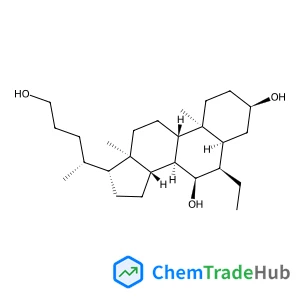
(3alpha,5beta,6alpha,7alpha)-6-Ethylcholane-3,7,24-triol
CAS Number:
1537866-49-1
Molecular Formula:
C26H46O3
Recommended Suppliers






Disclaimer
This page provides academic journal information for reference and research purposes only. We are not affiliated with any journal publishers and do not handle publication submissions. For publication-related inquiries, please contact the respective journal publishers directly.
If you notice any inaccuracies in the information displayed, please contact us at support@chemtradehub.com. We will promptly review and address your concerns.