












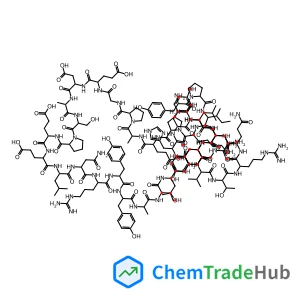
Spectroscopic evidence for the preferential hydration of RNase A in glycerol–water mixtures: Dielectric relaxation studies
Literature Information
Publication Date
2001-03-26
DOI
10.1039/B008827G
Impact Factor
3.676
Authors
H. Betting, M. Häckel, H.-J. Hinz, M. Stockhausen
View Original
Abstract
The elucidation of the molecular mechanism of the interaction of denaturing and stabilizing agents with proteins is a problem of eminent fundamental and practical consequences. In the present study we provide strong evidence by dielectric relaxation studies on RNase A–glycerol–water solutions that the protein creates for itself an aqueous environment in its immediate vicinity by attracting water molecules from the bulk solvent, thereby increasing the glycerol concentration of the bulk solution. This finding provides direct spectroscopic support for the thermodynamic results of Gekko and Timasheff (K. Gekko and S. N. Timasheff, Biochemistry, 1981, 20, 4668; K. Gekko and S. N. Timasheff, Biochemistry, 1981, 20, 4677) who reported preferential exclusion of glycerol from the protein domain.
Recommended Journals
Related Literature
Crystal structure of the new FeSe1−x superconductor
Serena Margadonna, Yasuhiro Takabayashi, Martin T. McDonald, Karolina Kasperkiewicz, Yoshikazu Mizuguchi, Yoshihiko Takano, Andrew N. Fitch, Emmanuelle Suard, Kosmas Prassides
2008-09-26
Communication
DOI: 10.1039/B813076K
A two-step spin crossover mononuclear iron(ii) complex with a [HS–LS–LS] intermediate phase
Sylvestre Bonnet, Maxime A. Siegler, José Sánchez Costa, Gábor Molnár, Azzedine Bousseksou, Anthony L. Spek, Patrick Gamez, Jan Reedijk
2008-09-29
Communication
DOI: 10.1039/B811746B
In vivo studies of a platinum(ii) metallointercalator
Dianne M. Fisher, Ronald R. Fenton, Janice R. Aldrich-Wright
2008-09-26
Communication
DOI: 10.1039/B811723C
Crystalline low band-gap alternating indolocarbazole and benzothiadiazole-cored oligothiophene copolymer for organic solar cell applications‡
Jianping Lu, Fushun Liang, Nicolas Drolet, Jianfu Ding, Ye Tao, Raluca Movileanu
2008-09-15
Communication
DOI: 10.1039/B811031J
Greatly reduced amino acid alphabets in directed evolution: making the right choice for saturation mutagenesis at homologous enzyme positions
Manfred T. Reetz, Sheng Wu
2008-10-02
Communication
DOI: 10.1039/B813388C
Internal amide-triggered cycloaromatization of maduropeptin-like nine-membered enediyne
Yutaro Norizuki, Kazuo Komano, Itaru Sato, Masahiro Hirama
2008-09-15
Communication
DOI: 10.1039/B811355F
Unprecedented steric deformation of ortho-carborane
Brian W. Hutton, Fraser MacIntosh, David Ellis, Fabien Herisse, Stuart A. Macgregor, David McKay, Victoria Petrie-Armstrong, Georgina M. Rosair, Dmitry S. Perekalin, Hugo Tricas, Alan J. Welch
2008-09-19
Communication
DOI: 10.1039/B810702E
Aqueous-only, pH-induced nanoassembly of dual pKa-driven contraphilic block copolymers
Nam S. Lee, Yali Li, C. Marcus Ruda, Karen L. Wooley
2008-09-18
Communication
DOI: 10.1039/B810934F
Cycloaddition reactions of transition metal hydrazides with alkynes and heteroalkynes: coupling of TiNNPh2 with PhCCMe, PhCCH, MeCN and tBuCP
Jonathan D. Selby, Christian Schulten, Andrew D. Schwarz, Andreas Stasch, Eric Clot, Cameron Jones, Philip Mountford
2008-09-23
Communication
DOI: 10.1039/B813911C
Design of chiral bifunctional secondary amine catalysts for asymmetric enamine catalysis
Taichi Kano, Keiji Maruoka
2008-09-10
Feature Article
DOI: 10.1039/B809301F
You might also like
Compound Q&A
What are the main uses of 1H-Indazole-6-carbonitrile (CAS: 141290-59-7)?
1H-Indazole-6-carbonitrile finds applications in pharmaceuticals, where it serve...
141290-59-71H-Indazole-6-carbon...
Compound Q&A
How should waste containing Dioctyl (2E)-2-butenedioate (CAS: 2997-85-5) be handled?
Waste containing Dioctyl (2E)-2-butenedioate (CAS: 2997-85-5) should be collecte...
2997-85-5Dioctyl (2E)-2-buten...
Compound Q&A
What industries use Sodium [(1,2-benzoxazol-3-ylmethyl)sulfonyl]azanide (CAS: 68291-98-5)?
Sodium [(1,2-benzoxazol-3-ylmethyl)sulfonyl]azanide is primarily used in pharmac...
68291-98-5Sodium [(1,2-benzoxa...
Compound Q&A
Are there alternatives to Dimethyl 4-(4,4,5,5-tetramethyl-1,3,2-dioxaborolan-2-yl)-2,6-pyridinedicarboxylate (CAS: 741709-66-0) in synthesis?
Dimethyl 4-(4,4,5,5-tetramethyl-1,3,2-dioxaborolan-2-yl)-2,6-pyridinedicarboxyla...
741709-66-0Dimethyl 4-(4,4,5,5-...
Compound Q&A
How should waste containing 2-Fluoro-6-hydrazinopyridine (CAS: 80714-39-2) be handled?
Waste containing 2-Fluoro-6-hydrazinopyridine (CAS: 80714-39-2) should be manage...
80714-39-22-Fluoro-6-hydrazino...
Compound Q&A
What is 6-Formyl-2-pyridinecarboxylic acid (CAS: 499214-11-8)?
6-Formyl-2-pyridinecarboxylic acid is an organic compound with the molecular for...
499214-11-86-Formyl-2-pyridinec...
Compound Q&A
What is the market or research trend for 3-(3,4-dimethoxyphenyl)-2,5-dimethyl-N-(2-morpholin-4-ylethyl)pyrazolo[1,5-a]pyrimidin-7-amine (CAS: 900874-91-1)?
Research trends for this compound indicate a focus on its potential applications...
900874-91-13-(3,4-dimethoxyphen...
Compound Q&A
How is 9H-Tribenzo[b,d,f]azepine (CAS: 29875-73-8) typically synthesized?
9H-Tribenzo[b,d,f]azepine is typically synthesized via a multi-step process invo...
29875-73-89H-Tribenzo[b,d,f]az...
Compound Q&A
How is 1-Cyclopropyl-7-ethoxy-6-fluoro-8-methoxy-4-oxo-1,4-dihydro-3-quinolinecarboxylic acid (CAS: 1797982-51-4) typically synthesized?
1-Cyclopropyl-7-ethoxy-6-fluoro-8-methoxy-4-oxo-1,4-dihydro-3-quinolinecarboxyli...
1797982-51-41-Cyclopropyl-7-etho...
Compound Q&A
How should waste containing Methyl 3-oxo-1,2,3,4-tetrahydro-6-quinoxalinecarboxylate (CAS: 671820-52-3) be handled?
Waste containing Methyl 3-oxo-1,2,3,4-tetrahydro-6-quinoxalinecarboxylate (CAS: ...
671820-52-3Methyl 3-oxo-1,2,3,4...
Source Journal
Physical Chemistry Chemical Physics

CiteScore:
5.5
Self-citation Rate:
10.3%
Articles per Year:
3036
Physical Chemistry Chemical Physics (PCCP) is an international journal co-owned by 19 physical chemistry and physics societies from around the world. This journal publishes original, cutting-edge research in physical chemistry, chemical physics and biophysical chemistry. To be suitable for publication in PCCP, articles must include significant innovation and/or insight into physical chemistry; this is the most important criterion that reviewers and Editors will judge against when evaluating submissions. The journal has a broad scope and welcomes contributions spanning experiment, theory, computation and data science. Topical coverage includes spectroscopy, dynamics, kinetics, statistical mechanics, thermodynamics, electrochemistry, catalysis, surface science, quantum mechanics, quantum computing and machine learning. Interdisciplinary research areas such as polymers and soft matter, materials, nanoscience, energy, surfaces/interfaces, and biophysical chemistry are welcomed if they demonstrate significant innovation and/or insight into physical chemistry. Joined experimental/theoretical studies are particularly appreciated when complementary and based on up-to-date approaches.
Recommended Compounds



Recommended Suppliers







Disclaimer
This page provides academic journal information for reference and research purposes only. We are not affiliated with any journal publishers and do not handle publication submissions. For publication-related inquiries, please contact the respective journal publishers directly.
If you notice any inaccuracies in the information displayed, please contact us at support@chemtradehub.com. We will promptly review and address your concerns.