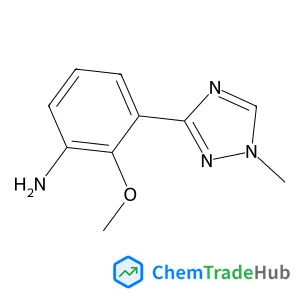
2-Methoxy-3-(1-methyl-1H-1,2,4-triazol-3-yl)aniline
CAS Number:
1609394-10-6
Molecular Formula:
C10H12N4O
Nam S. Lee, Yali Li, C. Marcus Ruda, Karen L. Wooley
pH-Responsive block copolymers, having two segments with functionalities of differing pKa, were prepared by NMP, providing a “green” route to the assembly of core–shell functionalizable nanostructures.
Barbara Becker, Katarzyna Baranowska, Jarosław Chojnacki, Wiesław Wojnowski
DOI: 10.1039/B313576D
Hélène Audrain, Laurent Martarello, Antony Gee, Dirk Bender
DOI: 10.1039/B314982J
Naoyoshi Maezaki, Hiroaki Tominaga, Naoto Kojima, Minori Yanai, Daisuke Urabe, Tetsuaki Tanaka
DOI: 10.1039/B312362F
Ken Sasaki, Hiroki Nakagawa, Xiaoyong Zhang, Shinichi Sakurai, Koji Kano, Yasuhisa Kuroda
DOI: 10.1039/B311079F
Ibon Odriozola, Nathalie Kyritsakas, Jean-Marie Lehn
DOI: 10.1039/B311045A
James G. Worden, Andrew W. Shaffer, Qun Huo
DOI: 10.1039/B312819A
R. Vijayaraghavan, D. R. MacFarlane
DOI: 10.1039/B315100J
Concepción López, Amparo Caubet, Sonia Pérez, Xavier Solans, Mercè Font-Bardía
DOI: 10.1039/B315157C
Victorio Cadierno, Sergio E. García-Garrido, José Gimeno
DOI: 10.1039/B313069J
Arindam Mukherjee, Manas K. Saha, Munirathinam Nethaji, Akhil R. Chakravarty
DOI: 10.1039/B316275C
1H-Indazole-6-carbonitrile finds applications in pharmaceuticals, where it serve...
Waste containing Dioctyl (2E)-2-butenedioate (CAS: 2997-85-5) should be collecte...
Sodium [(1,2-benzoxazol-3-ylmethyl)sulfonyl]azanide is primarily used in pharmac...
Dimethyl 4-(4,4,5,5-tetramethyl-1,3,2-dioxaborolan-2-yl)-2,6-pyridinedicarboxyla...
Waste containing 2-Fluoro-6-hydrazinopyridine (CAS: 80714-39-2) should be manage...
6-Formyl-2-pyridinecarboxylic acid is an organic compound with the molecular for...
Research trends for this compound indicate a focus on its potential applications...
9H-Tribenzo[b,d,f]azepine is typically synthesized via a multi-step process invo...
1-Cyclopropyl-7-ethoxy-6-fluoro-8-methoxy-4-oxo-1,4-dihydro-3-quinolinecarboxyli...
Waste containing Methyl 3-oxo-1,2,3,4-tetrahydro-6-quinoxalinecarboxylate (CAS: ...

ChemComm publishes urgent research which is of outstanding significance and interest to experts in the field, while also appealing to the journal’s broad chemistry readership. Our communication format is ideally suited to short, urgent studies that are of such importance that they require accelerated publication. Our scope covers all topics in chemistry, and research at the interface of chemistry and other disciplines (such as materials science, nanoscience, physics, engineering and biology) where there is a significant novelty in the chemistry aspects. Major topic areas covered include: Analytical Chemistry Catalysis Chemical Biology and medicinal chemistry Computational Chemistry and Machine Learning Energy and sustainable chemistry Environmental Chemistry Green Chemistry Inorganic Chemistry Materials Chemistry Nanoscience Organic Chemistry Physical Chemistry Polymer Chemistry Supramolecular Chemistry
![Benzeneacetic acid, 2-[(2,6-dichlorophenyl)amino]-, compd. with 1-pyrrolidineethanol (1:1) structure](https://static.chemtradehub.com/structs/119/119623-66-4-5301.webp "Benzeneacetic acid, 2-[(2,6-dichlorophenyl)amino]-, compd. with 1-pyrrolidineethanol (1:1) structure")