













Two desorption components of product CO2 in steady-state CO oxidation on Pd(110)
Literature Information
Publication Date
DOI
10.1039/A903458G
Impact Factor
3.676
Authors
View Original
Abstract
The velocity and angular distributions of desorbing product CO2 were studied in steady-state CO oxidation on Pd(110) by means of cross-correlation time-of-flight techniques. CO2 desorption was always collimated along the surface-normal direction. The velocity distribution curves involved two desorption components, a fast one and a slow one. The former showed translational temperatures above 2300 K and was suddenly suppressed above a critical CO pressure at which CO retarded the reaction. On the other hand, the latter showed a Maxwellian distribution at the surface temperature and was not suddenly suppressed around the critical CO pressure, decreasing slowly at higher CO pressures. Below the critical CO pressure, the fraction of this component was around 0.3, and above it, the value abruptly increased to approximately 0.9. The slow component appears to be formed on sites which are suitable for oxygen dissociation, such as structural defects.
Related Literature
An oxime–carbapalladacycle complex covalently anchored to silica as an active and reusable heterogeneous catalyst for Suzuki cross-coupling in water
Avelino Corma, Hermenegildo García, Antonio Leyva
2003-02-03
Communication
DOI: 10.1039/B211742H
A ruthenium catalyst that does not require an N–H ligand to achieve high enantioselectivity for hydrogenation of an alkyl-aryl ketone
Carolyn G. Leong, Okwado M. Akotsi, Michael J. Ferguson, Steven H. Bergens
2003-02-25
Communication
DOI: 10.1039/B212544G
Cooperative effects in the complexation of anions and Lewis bases by a heteronuclear bifunctional Lewis acid
James D. Hoefelmeyer, François P. Gabbaï
2003-02-14
Communication
DOI: 10.1039/B212127A
TEM stereo-imaging of mesoporous zeolite single crystals
Iver Schmidt, Anna Carlsson, Søren Dahl, Michael Brorson, Claus J. H. Jacobsen
2003-03-14
Communication
DOI: 10.1039/B212646J
Fe(AsO4): A new iron(iii) arsenate synthesized from thermal treatment of (NH4)[Fe(AsO4)F]
Begoña Bazán, José L. Mesa, José L. Pizarro, Andrés T. Aguayo, María I. Arriortua, Teófilo Rojo
2003-02-06
Communication
DOI: 10.1039/B210998K
Synthesis of a η2-2,3-diphosphabutadiene complex of zerovalent platinum from the corresponding η2-phosphaalkyne complex
Maria Helena Araujo, Peter B. Hitchcock, John F. Nixon, Uwe Kuehner, Othmar Stelzer
2003-04-02
Communication
DOI: 10.1039/B301335A
Formal radical cyclization onto benzene rings—a general method proceeding via cross-conjugated dienones
Derrick L. J. Clive, Stephen P. Fletcher, (in part) Mingzhao Zhu
2003-01-20
Communication
DOI: 10.1039/B212223E
Structural characterization of the first hydrothermally synthesized plutonium compound, PuO2(IO3)2·H2O
Wolfgang Runde, Thomas E. Albrecht-Schmitt, Brian L. Scott
2003-01-16
Communication
DOI: 10.1039/B211018K
A novel bioassay for screening and quantification of taxanes
Sergi Morais, P. C. Pandey, Wilfred Chen, Ashok Mulchandani
2003-04-17
Communication
DOI: 10.1039/B302112B
Synthesis and characterization of highly ordered functional mesoporous silica thin films with positively chargeable –NH2 groups
Nanguo Liu, Roger A. Assink, Bernd Smarsly
2003-04-16
Communication
DOI: 10.1039/B301910A
You might also like
Compound Q&A
What precautions should be taken when handling 4-(2-Furylmethyl)thiomorpholine 1,1-dioxide (CAS: 79206-94-3)?
When handling 4-(2-Furylmethyl)thiomorpholine 1,1-dioxide (CAS: 79206-94-3), it ...
79206-94-34-(2-Furylmethyl)thi...
Compound Q&A
What precautions should be taken when handling 4-Chloro-N-[2-(4-morpholinyl)ethyl]benzamide (CAS: 71320-77-9)?
When handling 4-Chloro-N-[2-(4-morpholinyl)ethyl]benzamide (CAS: 71320-77-9), it...
71320-77-94-Chloro-N-[2-(4-mor...
Compound Q&A
How should waste containing 2-[2-(2-Methoxyethoxy)ethoxy]ethyl 4-methylbenzenesulfonate (CAS: 62921-74-8) be handled?
Waste containing this compound (CAS: 62921-74-8) should be handled according to ...
62921-74-82-[2-(2-Methoxyethox...
Compound Q&A
How should waste containing (S)-Methyl 2-amino-3-cyclohexylpropanoate be handled?
Waste containing (S)-Methyl 2-amino-3-cyclohexylpropanoate should be collected i...
40056-18-6(S)-Methyl 2-amino-3...
Compound Q&A
How is 5-({4-[(2S,4R)-4-Hydroxy-2-methyltetrahydro-2H-pyran-4-yl]-2-thienyl}sulfanyl)-1-methyl-1,3-dihydro-2H-indol-2-one (CAS: 166882-70-8) typically synthesized?
This compound can be synthesized using a multi-step process involving the conjug...
166882-70-85-({4-[(2S,4R)-4-Hyd...
Compound Q&A
Are there alternatives to (2E)-3-(3,4-Dichlorophenyl)acrylic acid (CAS: 7312-27-8) in synthesis?
There are several alternatives to (2E)-3-(3,4-Dichlorophenyl)acrylic acid in syn...
7312-27-8(2E)-3-(3,4-Dichloro...
Compound Q&A
How should Ethyl 6-(2-nitrophenyl)imidazo[2,1-b][1,3]thiazole-3-carboxylate (CAS: 925437-84-9) be stored?
Ethyl 6-(2-nitrophenyl)imidazo[2,1-b][1,3]thiazole-3-carboxylate (CAS: 925437-84...
925437-84-9Ethyl 6-(2-nitrophen...
Compound Q&A
How should waste containing 2-(1,3-Thiazol-2-yl)ethanamine (CAS: 18453-07-1) be handled?
Waste containing 2-(1,3-Thiazol-2-yl)ethanamine (CAS: 18453-07-1) should be coll...
18453-07-12-(1,3-Thiazol-2-yl)...
Compound Q&A
How is Methyl 5-iodo-2-methylbenzoate (CAS: 103440-54-6) typically synthesized?
Methyl 5-iodo-2-methylbenzoate can be synthesized through the iodination of meth...
103440-54-6Methyl 5-iodo-2-meth...
Compound Q&A
How is 5-Chloro[1,2,4]triazolo[1,5-a]pyridine (CAS: 1427399-34-5) typically synthesized?
5-Chloro[1,2,4]triazolo[1,5-a]pyridine is commonly synthesized via the condensat...
1427399-34-55-Chloro[1,2,4]triaz...
Source Journal
Physical Chemistry Chemical Physics

CiteScore:
5.5
Self-citation Rate:
10.3%
Articles per Year:
3036
Physical Chemistry Chemical Physics (PCCP) is an international journal co-owned by 19 physical chemistry and physics societies from around the world. This journal publishes original, cutting-edge research in physical chemistry, chemical physics and biophysical chemistry. To be suitable for publication in PCCP, articles must include significant innovation and/or insight into physical chemistry; this is the most important criterion that reviewers and Editors will judge against when evaluating submissions. The journal has a broad scope and welcomes contributions spanning experiment, theory, computation and data science. Topical coverage includes spectroscopy, dynamics, kinetics, statistical mechanics, thermodynamics, electrochemistry, catalysis, surface science, quantum mechanics, quantum computing and machine learning. Interdisciplinary research areas such as polymers and soft matter, materials, nanoscience, energy, surfaces/interfaces, and biophysical chemistry are welcomed if they demonstrate significant innovation and/or insight into physical chemistry. Joined experimental/theoretical studies are particularly appreciated when complementary and based on up-to-date approaches.
Recommended Compounds
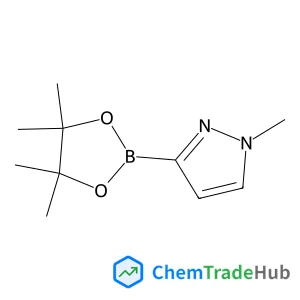
1-Methyl-3-(4,4,5,5-tetramethyl-1,3,2-dioxaborolan-2-yl)-1H-pyrazole
CAS Number:
1020174-04-2
Molecular Formula:
C10H17BN2O2

Recommended Suppliers






Disclaimer
This page provides academic journal information for reference and research purposes only. We are not affiliated with any journal publishers and do not handle publication submissions. For publication-related inquiries, please contact the respective journal publishers directly.
If you notice any inaccuracies in the information displayed, please contact us at support@chemtradehub.com. We will promptly review and address your concerns.