













Inter- and intramolecular electron transfer in the complex OC···ICl determined from iodine and chlorine nuclear quadrupole hyperfine structure in its rotational spectrum
Literature Information
Publication Date
DOI
10.1039/A903182K
Impact Factor
3.676
Authors
View Original
Abstract
The ground-state rotational spectra of three isotopomers O12C···I35Cl, O12C···I37Cl and O13C···I35Cl of a linear (or quasi-linear) complex formed by carbon monoxide and iodine monochloride were observed by using a pulsed-nozzle, Fourier transform microwave spectrometer. The spectroscopic constants B0, DJ, χaa(I), χaa(Cl) and Mbb(I) were determined for each isotopomer. Simple models were used to interpret the spectroscopic constants to give details of the geometry, binding strength and electric charge redistribution in OC···ICl. It was concluded that the nuclei lie in the order OC···ICl with the distance r(C···I)=3.011(1) Å, that the quadratic intermolecular stretching force constant kσ=8.00(3) N m-1, and that, when CO achieves its equilibrium position in the complex, the changes in the iodine and chlorine nuclear quadrupole coupling constants of ICl are consistent with the transfer of a fraction δ1=0.025(2) of an electronic charge from C to I and an intramolecular transfer of a fraction δ2=0.048(2) from I to Cl. A comparison of the r(C···X), kσ and δ2 values for the series of complexes OC···XY, where XY=ClF, Cl2, BrCl, Br2 and ICl is presented. The order of kσ is ICl>ClF>BrCl>Br2>Cl2, while the order of δ2 is Cl2∽ClF
Related Literature
Formation and destruction of the guanine quartet in solution observed by cold-spray ionization mass spectrometry
Shigeru Sakamoto, Isao Saito
2003-02-17
Communication
DOI: 10.1039/B212432G
New thermally stable cationic η3-allyl(1,4-diphospha-(1,3)-butadiene)nickel complexes for ethylene polymerization
Alex Ionkin, William Marshall
2003-02-17
Communication
DOI: 10.1039/B211252C
Cationic benzyl zirconium heteroscorpionates: synthesis and characterization of a novel ethylene polymerisation catalyst showing an unusual temperature dependent polymerisation mechanism
Stefano Milione, Cosimo Montefusco, Tomas Cuenca, Alfonso Grassi
2003-04-16
Communication
DOI: 10.1039/B301997G
Synthesis and crystallographic structure of a novel photoresponsive azobenzene-containing organosilane
Nanguo Liu, Darren R. Dunphy, Mark A. Rodriguez, Sarany Singer
2003-04-10
Communication
DOI: 10.1039/B301569F
High temperature synthesis of a noncentrosymmetric site-ordered cobalt aluminophosphate related to the pollucite structure
P. Bishop
2003-02-17
Communication
DOI: 10.1039/B300037K
A convenient stereoselective synthesis of trifluoromethyl-substituted polyfunctionalized cyclopropane: synthesis of (±)-trans-trifluoronorcoronamic acid
Biao Jiang, Fangjiang Zhang, Wennan Xiong
2003-01-29
Communication
DOI: 10.1039/B210642F
Palladium(0) catalyzed regioselective carbonyl propargylation across tetragonal tin(ii) oxidevia redox transmetallation
Moloy Banerjee, Sujit Roy
2003-01-15
Communication
DOI: 10.1039/B211555G
A novel dry route to ortho-functionalized triarylbismuthanes that are difficult to access by conventional wet routes
Mika Urano, Shinobu Wada, Hitomi Suzuki
2003-04-22
Communication
DOI: 10.1039/B301983G
Transfer hydrogenation using recyclable polyurea-encapsulated palladium: efficient and chemoselective reduction of aryl ketones
Jin-Quan Yu, Hai-Chen Wu, Chandrashekar Ramarao, Jonathan B. Spencer, Steven V. Ley
2003-02-12
Communication
DOI: 10.1039/B300074P
Soluble polymer-supported convergent parallel library synthesis
Jung-Mo Ahn, Paul Wentworth Jr., Kim D. Janda
2003-01-27
Communication
DOI: 10.1039/B210696E
You might also like
Compound Q&A
What precautions should be taken when handling 4-(2-Furylmethyl)thiomorpholine 1,1-dioxide (CAS: 79206-94-3)?
When handling 4-(2-Furylmethyl)thiomorpholine 1,1-dioxide (CAS: 79206-94-3), it ...
79206-94-34-(2-Furylmethyl)thi...
Compound Q&A
What precautions should be taken when handling 4-Chloro-N-[2-(4-morpholinyl)ethyl]benzamide (CAS: 71320-77-9)?
When handling 4-Chloro-N-[2-(4-morpholinyl)ethyl]benzamide (CAS: 71320-77-9), it...
71320-77-94-Chloro-N-[2-(4-mor...
Compound Q&A
How should waste containing 2-[2-(2-Methoxyethoxy)ethoxy]ethyl 4-methylbenzenesulfonate (CAS: 62921-74-8) be handled?
Waste containing this compound (CAS: 62921-74-8) should be handled according to ...
62921-74-82-[2-(2-Methoxyethox...
Compound Q&A
How should waste containing (S)-Methyl 2-amino-3-cyclohexylpropanoate be handled?
Waste containing (S)-Methyl 2-amino-3-cyclohexylpropanoate should be collected i...
40056-18-6(S)-Methyl 2-amino-3...
Compound Q&A
How is 5-({4-[(2S,4R)-4-Hydroxy-2-methyltetrahydro-2H-pyran-4-yl]-2-thienyl}sulfanyl)-1-methyl-1,3-dihydro-2H-indol-2-one (CAS: 166882-70-8) typically synthesized?
This compound can be synthesized using a multi-step process involving the conjug...
166882-70-85-({4-[(2S,4R)-4-Hyd...
Compound Q&A
Are there alternatives to (2E)-3-(3,4-Dichlorophenyl)acrylic acid (CAS: 7312-27-8) in synthesis?
There are several alternatives to (2E)-3-(3,4-Dichlorophenyl)acrylic acid in syn...
7312-27-8(2E)-3-(3,4-Dichloro...
Compound Q&A
How should Ethyl 6-(2-nitrophenyl)imidazo[2,1-b][1,3]thiazole-3-carboxylate (CAS: 925437-84-9) be stored?
Ethyl 6-(2-nitrophenyl)imidazo[2,1-b][1,3]thiazole-3-carboxylate (CAS: 925437-84...
925437-84-9Ethyl 6-(2-nitrophen...
Compound Q&A
How should waste containing 2-(1,3-Thiazol-2-yl)ethanamine (CAS: 18453-07-1) be handled?
Waste containing 2-(1,3-Thiazol-2-yl)ethanamine (CAS: 18453-07-1) should be coll...
18453-07-12-(1,3-Thiazol-2-yl)...
Compound Q&A
How is Methyl 5-iodo-2-methylbenzoate (CAS: 103440-54-6) typically synthesized?
Methyl 5-iodo-2-methylbenzoate can be synthesized through the iodination of meth...
103440-54-6Methyl 5-iodo-2-meth...
Compound Q&A
How is 5-Chloro[1,2,4]triazolo[1,5-a]pyridine (CAS: 1427399-34-5) typically synthesized?
5-Chloro[1,2,4]triazolo[1,5-a]pyridine is commonly synthesized via the condensat...
1427399-34-55-Chloro[1,2,4]triaz...
Source Journal
Physical Chemistry Chemical Physics

CiteScore:
5.5
Self-citation Rate:
10.3%
Articles per Year:
3036
Physical Chemistry Chemical Physics (PCCP) is an international journal co-owned by 19 physical chemistry and physics societies from around the world. This journal publishes original, cutting-edge research in physical chemistry, chemical physics and biophysical chemistry. To be suitable for publication in PCCP, articles must include significant innovation and/or insight into physical chemistry; this is the most important criterion that reviewers and Editors will judge against when evaluating submissions. The journal has a broad scope and welcomes contributions spanning experiment, theory, computation and data science. Topical coverage includes spectroscopy, dynamics, kinetics, statistical mechanics, thermodynamics, electrochemistry, catalysis, surface science, quantum mechanics, quantum computing and machine learning. Interdisciplinary research areas such as polymers and soft matter, materials, nanoscience, energy, surfaces/interfaces, and biophysical chemistry are welcomed if they demonstrate significant innovation and/or insight into physical chemistry. Joined experimental/theoretical studies are particularly appreciated when complementary and based on up-to-date approaches.
Recommended Compounds
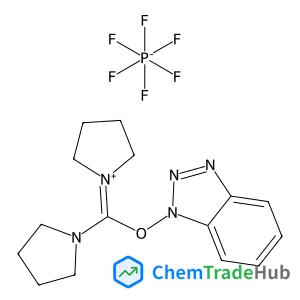
(1H-Benzotriazol-1-yloxy)(di-1-pyrrolidinyl)methylium hexafluorophosphate
CAS Number:
105379-24-6
Molecular Formula:
C15H21F6N5OP

(3beta,7beta,12beta)-3,7,12-Trihydroxy-11,15,23-trioxolanost-8-en-26-oic acid
CAS Number:
98665-22-6
Molecular Formula:
C30H44O8
![N-[(Benzyloxy)carbonyl]serine structure](https://static.chemtradehub.com/structs/276/2768-56-1-77f7.webp "N-[(Benzyloxy)carbonyl]serine structure")
Recommended Suppliers






Disclaimer
This page provides academic journal information for reference and research purposes only. We are not affiliated with any journal publishers and do not handle publication submissions. For publication-related inquiries, please contact the respective journal publishers directly.
If you notice any inaccuracies in the information displayed, please contact us at support@chemtradehub.com. We will promptly review and address your concerns.