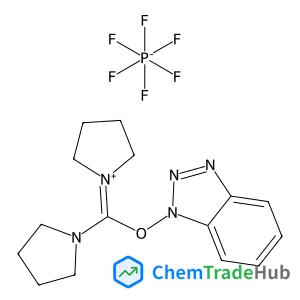
(1H-Benzotriazol-1-yloxy)(di-1-pyrrolidinyl)methylium hexafluorophosphate
CAS Number:
105379-24-6
Molecular Formula:
C15H21F6N5OP
Stefano Milione, Cosimo Montefusco, Tomas Cuenca, Alfonso Grassi
The reaction of (bpzmp)Zr(CH2Ph)3 with B(C6F5)3 produces the active ethylene polymerisation catalyst [(bpzmp)Zr(CH2Ph)2]+[PhCH2B(C6F5)3]− which showed a temperature dependent polymerisation mechanism identified by variable temperature 1H NMR analysis of the catalyst solution.
Supacha Buttranon, Juthamas Jaroensuk, Patchara Chaichol, Pimchai Chaiyen
DOI: 10.1039/D1RE00394A
Andrew B. Lowe
DOI: 10.1039/B9PY00216B
Nhat-Khuong Nguyen, Pradip Singha, Hongjie An, Hoang-Phuong Phan, Nam-Trung Nguyen, Chin Hong Ooi
DOI: 10.1039/D1RE00121C
Susana Hernández-Castillo, Héctor Martínez-Hernández, J. Arturo Mendoza-Nieto
DOI: 10.1039/D1RE00087J
Iasonas Ioannou, Sebastiano Carlo D'Angelo, Ángel Galán-Martín, Carlos Pozo, Javier Pérez-Ramírez, Gonzalo Guillén-Gosálbez
DOI: 10.1039/D0RE00451K
Lan-Ying Zhang, Xiao-Lin Guan, Xing-He Fan, Zhihao Shen, Xiao-Fang Chen, Qi-Feng Zhou
DOI: 10.1039/B9PY00368A
Bruno Lacerda de Oliveira Campos, Karla Herrera Delgado, Stefan Wild, Stephan Pitter, Jörg Sauer
DOI: 10.1039/D1RE90031E
When handling 4-(2-Furylmethyl)thiomorpholine 1,1-dioxide (CAS: 79206-94-3), it ...
When handling 4-Chloro-N-[2-(4-morpholinyl)ethyl]benzamide (CAS: 71320-77-9), it...
Waste containing this compound (CAS: 62921-74-8) should be handled according to ...
Waste containing (S)-Methyl 2-amino-3-cyclohexylpropanoate should be collected i...
This compound can be synthesized using a multi-step process involving the conjug...
There are several alternatives to (2E)-3-(3,4-Dichlorophenyl)acrylic acid in syn...
Ethyl 6-(2-nitrophenyl)imidazo[2,1-b][1,3]thiazole-3-carboxylate (CAS: 925437-84...
Waste containing 2-(1,3-Thiazol-2-yl)ethanamine (CAS: 18453-07-1) should be coll...
Methyl 5-iodo-2-methylbenzoate can be synthesized through the iodination of meth...
5-Chloro[1,2,4]triazolo[1,5-a]pyridine is commonly synthesized via the condensat...

ChemComm publishes urgent research which is of outstanding significance and interest to experts in the field, while also appealing to the journal’s broad chemistry readership. Our communication format is ideally suited to short, urgent studies that are of such importance that they require accelerated publication. Our scope covers all topics in chemistry, and research at the interface of chemistry and other disciplines (such as materials science, nanoscience, physics, engineering and biology) where there is a significant novelty in the chemistry aspects. Major topic areas covered include: Analytical Chemistry Catalysis Chemical Biology and medicinal chemistry Computational Chemistry and Machine Learning Energy and sustainable chemistry Environmental Chemistry Green Chemistry Inorganic Chemistry Materials Chemistry Nanoscience Organic Chemistry Physical Chemistry Polymer Chemistry Supramolecular Chemistry