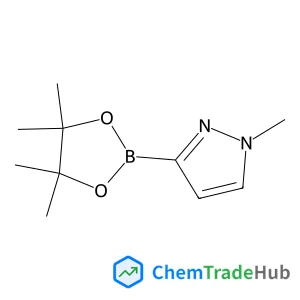
1-Methyl-3-(4,4,5,5-tetramethyl-1,3,2-dioxaborolan-2-yl)-1H-pyrazole
CAS Number:
1020174-04-2
Molecular Formula:
C10H17BN2O2
Moloy Banerjee, Sujit Roy
Facile homopropargylation of aldehydes by propargyl bromides over tetragonal tin(II)oxide and catalytic palladium(0) occurs which is proposed to involve the prior formation of dinuclear allenylpalladium followed by redox transmetallation to β-SnO.
Daniel Kinzel, Jesús González-Vázquez, Leticia González
DOI: 10.1039/C1CP22646K
Satoshi Maeda, Koichi Ohno
DOI: 10.1039/C3CP44063J
Motohiro Banno, Keisuke Tominaga
DOI: 10.1039/C2CP23647H
Amir Handelman, Peter Beker, Nadav Amdursky, Gil Rosenman
DOI: 10.1039/C2CP40157F
Curt Wittig
DOI: 10.1039/C2CP22974A
Jia-Yuan Tao, De-Cai Fang, Gregory A. Chass
DOI: 10.1039/C2CP40067G
Wei Lü, Hongpeng You
DOI: 10.1039/C3CP50363A
Zhiwei Lin, Brad Bendiak, Igor V. Rubtsov
DOI: 10.1039/C2CP23245F
Li Liu, Li Zhang, Tianyu Wang, Minghua Liu
DOI: 10.1039/C3CP50384D
When handling 4-(2-Furylmethyl)thiomorpholine 1,1-dioxide (CAS: 79206-94-3), it ...
When handling 4-Chloro-N-[2-(4-morpholinyl)ethyl]benzamide (CAS: 71320-77-9), it...
Waste containing this compound (CAS: 62921-74-8) should be handled according to ...
Waste containing (S)-Methyl 2-amino-3-cyclohexylpropanoate should be collected i...
This compound can be synthesized using a multi-step process involving the conjug...
There are several alternatives to (2E)-3-(3,4-Dichlorophenyl)acrylic acid in syn...
Ethyl 6-(2-nitrophenyl)imidazo[2,1-b][1,3]thiazole-3-carboxylate (CAS: 925437-84...
Waste containing 2-(1,3-Thiazol-2-yl)ethanamine (CAS: 18453-07-1) should be coll...
Methyl 5-iodo-2-methylbenzoate can be synthesized through the iodination of meth...
5-Chloro[1,2,4]triazolo[1,5-a]pyridine is commonly synthesized via the condensat...

ChemComm publishes urgent research which is of outstanding significance and interest to experts in the field, while also appealing to the journal’s broad chemistry readership. Our communication format is ideally suited to short, urgent studies that are of such importance that they require accelerated publication. Our scope covers all topics in chemistry, and research at the interface of chemistry and other disciplines (such as materials science, nanoscience, physics, engineering and biology) where there is a significant novelty in the chemistry aspects. Major topic areas covered include: Analytical Chemistry Catalysis Chemical Biology and medicinal chemistry Computational Chemistry and Machine Learning Energy and sustainable chemistry Environmental Chemistry Green Chemistry Inorganic Chemistry Materials Chemistry Nanoscience Organic Chemistry Physical Chemistry Polymer Chemistry Supramolecular Chemistry