












![5-Acetyl-2,3-dihydrobenzo[b]furan structure](https://static.chemtradehub.com/structs/908/90843-31-5-eea4.webp "5-Acetyl-2,3-dihydrobenzo[b]furan structure")
Modification of alkanethiolate monolayers on Au-substrate by low energy electron irradiation: Alkyl chains and the S/Au interface
Literature Information
Publication Date
DOI
10.1039/A902013F
Impact Factor
3.676
Authors
View Original
Abstract
Low-energy electron irradiation damage in alkanethiol (AT) self-assembled monolayers (SAM) has been studied by using hexadecanethiolate [HDT: CH3–(CH2)15–S-] film on Au-substrate as a model system. The induced changes were monitored by insitu photoelectron spectroscopy and angle resolved near edge X-ray absorption fine structure spectroscopy. AT SAMs are found to be very sensitive to low-energy electron irradiation. Both the alkyl chains and the S/Au interface are affected simultaneously through the electron-induced dissociation of C–H, C–C, C–S, and Au–thiolate bonds. The most noticeable processes are the loss of the orientational and conformational order, partial dehydrogenation and desorption of the film, and the appearance of new sulfur species. The latter process can be related to the formation of disulfide at the S/Au interface or an incorporation of the thiolate (or the corresponding radical) into the alkyl matrix via bonding to irradiation-induced carbon radicals in the adjacent aliphatic chains. The most essential damage in the AT films occurs in the early stages of irradiation. Irradiation with a dose of 1000 µC cm-2 (about 13 electrons per HDT chain) at the primary electron energy of 50 eV results in almost complete breakdown of the orientational order in the initially well-ordered HDT film, a decrease of its thickness by about 25%, and a destruction of ≈40% of the original Au–thiolate bonds. The film becomes a disordered structure comprising both saturated and unsaturated hydrocarbons. Further irradiation of the residual film is accompanied by a continuous C–C bond cleavage and the desorption of the remaining hydrogen, which merely leads to increasing cross-linking and the transformation of saturated hydrocarbons into unsaturated ones through C2C double bond formation.
Related Literature
Structural and magnetic properties of a self-assembled spheroidal triakonta-hexanuclear Cu36 cluster
Tareque S. M. Abedin, Laurence K. Thompson, David O. Miller, Erik Krupicka
2003-02-14
Communication
DOI: 10.1039/B211401C
Cooperative effects in the complexation of anions and Lewis bases by a heteronuclear bifunctional Lewis acid
James D. Hoefelmeyer, François P. Gabbaï
2003-02-14
Communication
DOI: 10.1039/B212127A
Preparation of novel polythioether dendrons on a solid support
Adi Dahan, Avi Weissberg, Moshe Portnoy
2003-04-22
Communication
DOI: 10.1039/B302324A
Control of Al distribution in ZSM-5 by conditions of zeolite synthesis
2003-04-23
Communication
DOI: 10.1039/B301634J
Fe(AsO4): A new iron(iii) arsenate synthesized from thermal treatment of (NH4)[Fe(AsO4)F]
Begoña Bazán, José L. Mesa, José L. Pizarro, Andrés T. Aguayo, María I. Arriortua, Teófilo Rojo
2003-02-06
Communication
DOI: 10.1039/B210998K
Self-organized formation of a hierarchical self-similar structure with calcium carbonate
Hiroaki Imai, Tomohiro Terada, Satoshi Yamabi
2003-01-24
Communication
DOI: 10.1039/B211240J
A new organic superconductor, (DODHT)2BF4·H2O
Hiroyuki Nishikawa, Asami Machida, Takanobu Morimoto, Koichi Kikuchi, Takeshi Kodama, Isao Ikemoto, Jun-ichi Yamada, Harukazu Yoshino, Keizo Murata
2003-01-27
Communication
DOI: 10.1039/B211275B
An oxime–carbapalladacycle complex covalently anchored to silica as an active and reusable heterogeneous catalyst for Suzuki cross-coupling in water
Avelino Corma, Hermenegildo García, Antonio Leyva
2003-02-03
Communication
DOI: 10.1039/B211742H
Synthesis, structure and reductive dechlorination of the C-centred phosphorus(iii) β-diketiminate PCl(Ph)L [L = C{C(Me)NC6H3Pri2-2,6}{C(Me)NHC6H3Pri2-2,6}]
Peter B. Hitchcock, Michael F. Lappert, Jacek E. Nycz
2003-04-16
Communication
DOI: 10.1039/B301294H
Thiation of 2′-deoxy-5,6-dihydropyrimidine nucleosides with Lawesson’s reagent: Characterisation of oxathiaphosphepane intermediates
Frédéric Peyrane, Jean-Louis Fourrey, Pascale Clivio
2003-02-21
Communication
DOI: 10.1039/B211405D
You might also like
Compound Q&A
What precautions should be taken when handling 4-(2-Furylmethyl)thiomorpholine 1,1-dioxide (CAS: 79206-94-3)?
When handling 4-(2-Furylmethyl)thiomorpholine 1,1-dioxide (CAS: 79206-94-3), it ...
79206-94-34-(2-Furylmethyl)thi...
Compound Q&A
What precautions should be taken when handling 4-Chloro-N-[2-(4-morpholinyl)ethyl]benzamide (CAS: 71320-77-9)?
When handling 4-Chloro-N-[2-(4-morpholinyl)ethyl]benzamide (CAS: 71320-77-9), it...
71320-77-94-Chloro-N-[2-(4-mor...
Compound Q&A
How should waste containing 2-[2-(2-Methoxyethoxy)ethoxy]ethyl 4-methylbenzenesulfonate (CAS: 62921-74-8) be handled?
Waste containing this compound (CAS: 62921-74-8) should be handled according to ...
62921-74-82-[2-(2-Methoxyethox...
Compound Q&A
How should waste containing (S)-Methyl 2-amino-3-cyclohexylpropanoate be handled?
Waste containing (S)-Methyl 2-amino-3-cyclohexylpropanoate should be collected i...
40056-18-6(S)-Methyl 2-amino-3...
Compound Q&A
How is 5-({4-[(2S,4R)-4-Hydroxy-2-methyltetrahydro-2H-pyran-4-yl]-2-thienyl}sulfanyl)-1-methyl-1,3-dihydro-2H-indol-2-one (CAS: 166882-70-8) typically synthesized?
This compound can be synthesized using a multi-step process involving the conjug...
166882-70-85-({4-[(2S,4R)-4-Hyd...
Compound Q&A
Are there alternatives to (2E)-3-(3,4-Dichlorophenyl)acrylic acid (CAS: 7312-27-8) in synthesis?
There are several alternatives to (2E)-3-(3,4-Dichlorophenyl)acrylic acid in syn...
7312-27-8(2E)-3-(3,4-Dichloro...
Compound Q&A
How should Ethyl 6-(2-nitrophenyl)imidazo[2,1-b][1,3]thiazole-3-carboxylate (CAS: 925437-84-9) be stored?
Ethyl 6-(2-nitrophenyl)imidazo[2,1-b][1,3]thiazole-3-carboxylate (CAS: 925437-84...
925437-84-9Ethyl 6-(2-nitrophen...
Compound Q&A
How should waste containing 2-(1,3-Thiazol-2-yl)ethanamine (CAS: 18453-07-1) be handled?
Waste containing 2-(1,3-Thiazol-2-yl)ethanamine (CAS: 18453-07-1) should be coll...
18453-07-12-(1,3-Thiazol-2-yl)...
Compound Q&A
How is Methyl 5-iodo-2-methylbenzoate (CAS: 103440-54-6) typically synthesized?
Methyl 5-iodo-2-methylbenzoate can be synthesized through the iodination of meth...
103440-54-6Methyl 5-iodo-2-meth...
Compound Q&A
How is 5-Chloro[1,2,4]triazolo[1,5-a]pyridine (CAS: 1427399-34-5) typically synthesized?
5-Chloro[1,2,4]triazolo[1,5-a]pyridine is commonly synthesized via the condensat...
1427399-34-55-Chloro[1,2,4]triaz...
Source Journal
Physical Chemistry Chemical Physics

CiteScore:
5.5
Self-citation Rate:
10.3%
Articles per Year:
3036
Physical Chemistry Chemical Physics (PCCP) is an international journal co-owned by 19 physical chemistry and physics societies from around the world. This journal publishes original, cutting-edge research in physical chemistry, chemical physics and biophysical chemistry. To be suitable for publication in PCCP, articles must include significant innovation and/or insight into physical chemistry; this is the most important criterion that reviewers and Editors will judge against when evaluating submissions. The journal has a broad scope and welcomes contributions spanning experiment, theory, computation and data science. Topical coverage includes spectroscopy, dynamics, kinetics, statistical mechanics, thermodynamics, electrochemistry, catalysis, surface science, quantum mechanics, quantum computing and machine learning. Interdisciplinary research areas such as polymers and soft matter, materials, nanoscience, energy, surfaces/interfaces, and biophysical chemistry are welcomed if they demonstrate significant innovation and/or insight into physical chemistry. Joined experimental/theoretical studies are particularly appreciated when complementary and based on up-to-date approaches.
Recommended Compounds
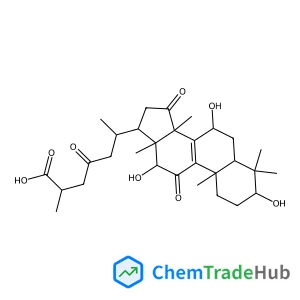
(3beta,7beta,12beta)-3,7,12-Trihydroxy-11,15,23-trioxolanost-8-en-26-oic acid
CAS Number:
98665-22-6
Molecular Formula:
C30H44O8
Recommended Suppliers



Disclaimer
This page provides academic journal information for reference and research purposes only. We are not affiliated with any journal publishers and do not handle publication submissions. For publication-related inquiries, please contact the respective journal publishers directly.
If you notice any inaccuracies in the information displayed, please contact us at support@chemtradehub.com. We will promptly review and address your concerns.