













A new organic superconductor, (DODHT)2BF4·H2O
Literature Information
Publication Date
2003-01-27
DOI
10.1039/B211275B
Impact Factor
6.222
Authors
Hiroyuki Nishikawa, Asami Machida, Takanobu Morimoto, Koichi Kikuchi, Takeshi Kodama, Isao Ikemoto, Jun-ichi Yamada, Harukazu Yoshino, Keizo Murata
View Original
Abstract
In addition to two organic superconductors (DODHT)2X [DODHT = (1,4-dioxane-2,3-diyldithio)dihydrotetrathiafulvalene; X = PF6 and AsF6] previously reported by us, the BF4 salt of DODHT containing one water molecule [(DODHT)2BF4路H2O] has been found to undergo a superconducting transition at 3.2 K under a hydrostatic pressure of 15.5 kbar.
Recommended Journals
Related Literature
Oxygen reduction activity of Pd–Mn3O4nanoparticles and performance enhancement by voltammetrically accelerated degradation
Chang Hyuck Choi, Sung Hyeon Park, Seong Ihl Woo
2012-03-26
Paper
DOI: 10.1039/C2CP24128E
Visible-to-infrared quantum cutting by phonon-assisted energy transfer in YPO4:Tm3+, Yb3+ phosphors
2012-03-05
Paper
DOI: 10.1039/C2CP24044K
Interfacial assembly of amphiphilic styrylquinoxalines: alkyl chain length tunable topochemical reactions and supramolecular chirality
Li Liu, Li Zhang, Tianyu Wang, Minghua Liu
2013-02-27
Paper
DOI: 10.1039/C3CP50384D
H-abstraction is more efficient than cis–trans isomerization in (4-methylcyclohexylidene) fluoromethane. An ab initio molecular dynamics study
Daniel Kinzel, Jesús González-Vázquez, Leticia González
2011-10-18
Paper
DOI: 10.1039/C1CP22646K
Band engineered ternary solid solution CdSxSe1−x-sensitized mesoscopic TiO2 solar cells
Md. Anower Hossain, James Robert Jennings, Nripan Mathews, Qing Wang
2012-03-15
Paper
DOI: 10.1039/C2CP40277G
The role of the hydrogen bond in dense nanoparticle–gas suspensions
Maryam Tahmasebpoor, Lilian de Martín, Mojgan Talebi, Navid Mostoufi, J. Ruud van Ommen
2013-02-19
Paper
DOI: 10.1039/C3CP43687J
Reynolds numbers exhibit dramatic influence on directionality of movement of self-propelled systems
Guanjia Zhao, Martin Pumera
2012-03-16
Paper
DOI: 10.1039/C2CP40331E
Vibrational dynamics of acetate in D2O studied by infrared pump–probe spectroscopy
Motohiro Banno, Keisuke Tominaga
2012-02-01
Paper
DOI: 10.1039/C2CP23647H
Light controlled assembling of iodine-free dye-sensitized solar cells with poly(3,4-ethylenedioxythiophene) as a hole conductor reaching 7.1% efficiency
Yueming Cheng, Long Wang, Liping Cai, Bin Liu
2012-03-21
Paper
DOI: 10.1039/C2CP40882A
You might also like
Compound Q&A
What precautions should be taken when handling 4-(2-Furylmethyl)thiomorpholine 1,1-dioxide (CAS: 79206-94-3)?
When handling 4-(2-Furylmethyl)thiomorpholine 1,1-dioxide (CAS: 79206-94-3), it ...
79206-94-34-(2-Furylmethyl)thi...
Compound Q&A
What precautions should be taken when handling 4-Chloro-N-[2-(4-morpholinyl)ethyl]benzamide (CAS: 71320-77-9)?
When handling 4-Chloro-N-[2-(4-morpholinyl)ethyl]benzamide (CAS: 71320-77-9), it...
71320-77-94-Chloro-N-[2-(4-mor...
Compound Q&A
How should waste containing 2-[2-(2-Methoxyethoxy)ethoxy]ethyl 4-methylbenzenesulfonate (CAS: 62921-74-8) be handled?
Waste containing this compound (CAS: 62921-74-8) should be handled according to ...
62921-74-82-[2-(2-Methoxyethox...
Compound Q&A
How should waste containing (S)-Methyl 2-amino-3-cyclohexylpropanoate be handled?
Waste containing (S)-Methyl 2-amino-3-cyclohexylpropanoate should be collected i...
40056-18-6(S)-Methyl 2-amino-3...
Compound Q&A
How is 5-({4-[(2S,4R)-4-Hydroxy-2-methyltetrahydro-2H-pyran-4-yl]-2-thienyl}sulfanyl)-1-methyl-1,3-dihydro-2H-indol-2-one (CAS: 166882-70-8) typically synthesized?
This compound can be synthesized using a multi-step process involving the conjug...
166882-70-85-({4-[(2S,4R)-4-Hyd...
Compound Q&A
Are there alternatives to (2E)-3-(3,4-Dichlorophenyl)acrylic acid (CAS: 7312-27-8) in synthesis?
There are several alternatives to (2E)-3-(3,4-Dichlorophenyl)acrylic acid in syn...
7312-27-8(2E)-3-(3,4-Dichloro...
Compound Q&A
How should Ethyl 6-(2-nitrophenyl)imidazo[2,1-b][1,3]thiazole-3-carboxylate (CAS: 925437-84-9) be stored?
Ethyl 6-(2-nitrophenyl)imidazo[2,1-b][1,3]thiazole-3-carboxylate (CAS: 925437-84...
925437-84-9Ethyl 6-(2-nitrophen...
Compound Q&A
How should waste containing 2-(1,3-Thiazol-2-yl)ethanamine (CAS: 18453-07-1) be handled?
Waste containing 2-(1,3-Thiazol-2-yl)ethanamine (CAS: 18453-07-1) should be coll...
18453-07-12-(1,3-Thiazol-2-yl)...
Compound Q&A
How is Methyl 5-iodo-2-methylbenzoate (CAS: 103440-54-6) typically synthesized?
Methyl 5-iodo-2-methylbenzoate can be synthesized through the iodination of meth...
103440-54-6Methyl 5-iodo-2-meth...
Compound Q&A
How is 5-Chloro[1,2,4]triazolo[1,5-a]pyridine (CAS: 1427399-34-5) typically synthesized?
5-Chloro[1,2,4]triazolo[1,5-a]pyridine is commonly synthesized via the condensat...
1427399-34-55-Chloro[1,2,4]triaz...
Source Journal
Chemical Communications

CiteScore:
8.6
Self-citation Rate:
4.7%
Articles per Year:
2458
ChemComm publishes urgent research which is of outstanding significance and interest to experts in the field, while also appealing to the journal’s broad chemistry readership. Our communication format is ideally suited to short, urgent studies that are of such importance that they require accelerated publication. Our scope covers all topics in chemistry, and research at the interface of chemistry and other disciplines (such as materials science, nanoscience, physics, engineering and biology) where there is a significant novelty in the chemistry aspects. Major topic areas covered include: Analytical Chemistry Catalysis Chemical Biology and medicinal chemistry Computational Chemistry and Machine Learning Energy and sustainable chemistry Environmental Chemistry Green Chemistry Inorganic Chemistry Materials Chemistry Nanoscience Organic Chemistry Physical Chemistry Polymer Chemistry Supramolecular Chemistry
Recommended Compounds
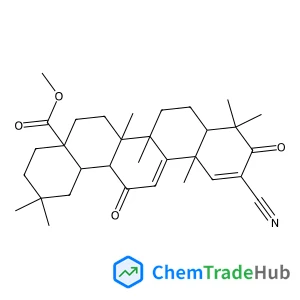
Methyl 2-cyano-3,12-dioxooleana-1,9(11)-dien-28-oate
CAS Number:
218600-53-4
Molecular Formula:
C32H43NO4

Recommended Suppliers






Disclaimer
This page provides academic journal information for reference and research purposes only. We are not affiliated with any journal publishers and do not handle publication submissions. For publication-related inquiries, please contact the respective journal publishers directly.
If you notice any inaccuracies in the information displayed, please contact us at support@chemtradehub.com. We will promptly review and address your concerns.