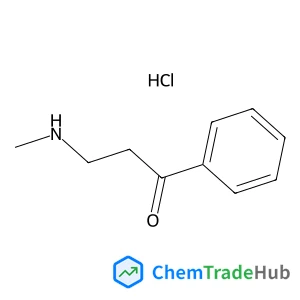
3-(Methylamino)-1-phenyl-1-propanone hydrochloride (1:1)
CAS Number:
2538-50-3
Molecular Formula:
C10H14ClNO
Tareque S. M. Abedin, Laurence K. Thompson, David O. Miller, Erik Krupicka
An extended tritopic picolinic dihydrazide ligand with terminal oxime groups (dpocco) undergoes spontaneous self-assembly in the presence of copper acetate to produce a unique Cu36 cluster exhibiting intramolecular anti-ferromagnetic exchange.
Andreas M. Wenge, Andreas Schmaunz, Uwe Kensy, Bernhard Dick
DOI: 10.1039/C2CP40349H
Xiao-Lian Jing, Qing-Chuan Chen, Chong He, Xue-Quan Zhu, Wei-Zheng Weng, Wen-Sheng Xia, Hui-Lin Wan
DOI: 10.1039/C2CP40086C
Wei Lü, Hongpeng You
DOI: 10.1039/C3CP50363A
Sung-Hyun Ahn, Deok-Soo Kim, Daeha Seo, Wonjun Choi, Gi-Ra Yi, Hyunjoon Song, Q-Han Park, Zee Hwan Kim
DOI: 10.1039/C2CP43365F
Amir Handelman, Peter Beker, Nadav Amdursky, Gil Rosenman
DOI: 10.1039/C2CP40157F
Ruchira Chatterjee, Sergey Milikisiyants, K. V. Lakshmi
DOI: 10.1039/C2CP40416H
Andrzej L. Sobolewski, Raffaele Borrelli, Wolfgang Domcke
DOI: 10.1039/C3CP44585B
Satoshi Maeda, Koichi Ohno
DOI: 10.1039/C3CP44063J
When handling 4-(2-Furylmethyl)thiomorpholine 1,1-dioxide (CAS: 79206-94-3), it ...
When handling 4-Chloro-N-[2-(4-morpholinyl)ethyl]benzamide (CAS: 71320-77-9), it...
Waste containing this compound (CAS: 62921-74-8) should be handled according to ...
Waste containing (S)-Methyl 2-amino-3-cyclohexylpropanoate should be collected i...
This compound can be synthesized using a multi-step process involving the conjug...
There are several alternatives to (2E)-3-(3,4-Dichlorophenyl)acrylic acid in syn...
Ethyl 6-(2-nitrophenyl)imidazo[2,1-b][1,3]thiazole-3-carboxylate (CAS: 925437-84...
Waste containing 2-(1,3-Thiazol-2-yl)ethanamine (CAS: 18453-07-1) should be coll...
Methyl 5-iodo-2-methylbenzoate can be synthesized through the iodination of meth...
5-Chloro[1,2,4]triazolo[1,5-a]pyridine is commonly synthesized via the condensat...

ChemComm publishes urgent research which is of outstanding significance and interest to experts in the field, while also appealing to the journal’s broad chemistry readership. Our communication format is ideally suited to short, urgent studies that are of such importance that they require accelerated publication. Our scope covers all topics in chemistry, and research at the interface of chemistry and other disciplines (such as materials science, nanoscience, physics, engineering and biology) where there is a significant novelty in the chemistry aspects. Major topic areas covered include: Analytical Chemistry Catalysis Chemical Biology and medicinal chemistry Computational Chemistry and Machine Learning Energy and sustainable chemistry Environmental Chemistry Green Chemistry Inorganic Chemistry Materials Chemistry Nanoscience Organic Chemistry Physical Chemistry Polymer Chemistry Supramolecular Chemistry