



AD
2-(2-Quinolinyl)-1H-indene-1,3(2H)-dione(CAS: 8003-22-3)
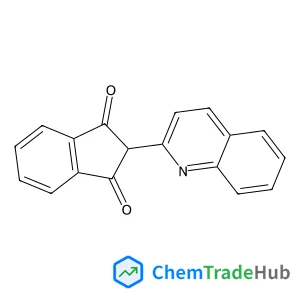
CAS Number
Related Products
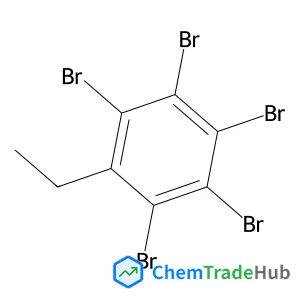
Benzene,1,2,3,4,5-pentabromo-6-ethyl-
CAS Number: 85-22-3
![(2-METHYL-3-PHENYLPHENYL)METHYL (1S,3S)-3-[(Z)-2-CHLORO-3,3,3-TRIFLUOROPROP-1-ENYL]-2,2-DIMETHYLCYCLOPROPANE-1-CARBOXYLATE](https://static.chemtradehub.com/structs/826/82657-04-3-1a86.webp)
![(R)-8-chloro-1-methyl-2,3,4,5-tetrahydro-1H-benzo[d]azepine hydrochloride](https://static.chemtradehub.com/structs/846/846589-98-8-cb1a.webp)
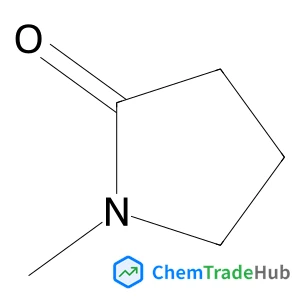
1-Methyl-2-pyrrolidinone
CAS Number: 872-50-4
![3-(~2~H_3_)Methyl-3H-imidazo[4,5-f]quinolin-2-amine](https://static.chemtradehub.com/structs/820/82050-10-0-0d66.webp)
![N,N'-Bis(2,3-dihydroxypropyl)-2,4,6-triiodo-5-[(methoxyacetyl)amino]-N-methylisophthalamide](https://static.chemtradehub.com/structs/733/73334-07-3-2422.webp)
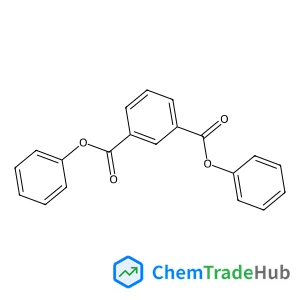
Diphenyl isophthalate
CAS Number: 744-45-6
Other Suppliers for 2-(2-Quinolinyl)-1H-indene-1,3(2H)-dione








Basic Information
Molecular Formula
C18H11NO2
Molecular Weight
273.29 g/mol
Physical Properties
Melting Point
239-242°C
Boiling Point
514.5 °C at 760 mmHg
Density
1.345
Flash Point
260 °C
Chemical Identifiers
SMILES
O=C1C(c2ccc3c(n2)cccc3)C(=O)c2c1cccc2
InChIKey
IZMJMCDDWKSTTK-UHFFFAOYSA-N
Database References
MDL Number
MFCD00011593
FAQ
2-(2-Quinolinyl)-1H-indene-1,3(2H)-dione (CAS: 8003-22-3) is a crystalline compound with a molecular weight of approximately 313.25 g/mol. It has a low solubility in water but is soluble in common organic solvents like dichloromethane and acetonitrile. Chemically, it is relatively stable but can react with strong bases or acids. It also exhibits fluorescence properties, making it useful in various applications requiring optical sensing.
2-(2-Quinolinyl)-1H-indene-1,3(2H)-dione (CAS: 8003-22-3) is usually synthesized via a condensation reaction between 2-quinolinecarboxylic acid and 1H-indene-1,3(2H)-dione, using a suitable base as a catalyst. The process involves mild heating and can achieve a yield of up to 85%, with good selectivity towards the desired product.
2-(2-Quinolinyl)-1H-indene-1,3(2H)-dione (CAS: 8003-22-3) is primarily used in the pharmaceutical industry for the synthesis of drugs that require specific optical properties. It is also utilized in the semiconductor industry for its fluorescence characteristics, making it suitable for use in optoelectronic devices. Additionally, it finds applications in the development of sensors and as a building block in the synthesis of various organic materials.
When handling 2-(2-Quinolinyl)-1H-indene-1,3(2H)-dione (CAS: 8003-22-3), it is essential to wear appropriate personal protective equipment (PPE), including gloves, goggles, and a lab coat. Work should be conducted in a well-ventilated area or a fume hood. Spills should be cleaned up immediately with appropriate absorbents, and the area should be thoroughly washed down. For detailed safety information, refer to the Material Safety Data Sheet (MSDS/SDS).
Safety Notice
Please verify product specifications and safety data before use. Contact the supplier for detailed safety information.
Always follow proper handling procedures
Contact Information
szxys126@126.com