












Front cover
Literature Information
Publication Date
2024-01-23
DOI
10.1039/D4EE90006E
Impact Factor
38.532
Authors
View Original
Abstract
A graphical abstract is available for this content
Related Literature
Sieving behaviour of nanoscopic pores by hydrated ions
Joohan Lee, Juhyoun Kwak
2006-04-20
Communication
DOI: 10.1039/B601613H
Effect of tetrabutylphosphonium cation on the physico-chemical properties of amino-acid ionic liquids
Junko Kagimoto, Kenta Fukumoto, Hiroyuki Ohno
2006-04-25
Communication
DOI: 10.1039/B600771F
Non-catalytic and template-free growth of aligned CdS nanowires exhibiting high field emission current densities
Yi-Feng Lin, Yung-Jung Hsu, Shih-Yuan Lu, Sheng-Chin Kung
2006-05-02
Communication
DOI: 10.1039/B604309G
Monitoring the formation of TTF dimers by Na+ complexation
Marc Sallé, Jean-Yves Balandier, Franck Le Derf, Eric Levillain, Magali Allain, Pascal Viel, Serge Palacin
2006-03-30
Communication
DOI: 10.1039/B518275A
Hosomi–Sakurai reactions of silacyclic allyl silanes
Jonathan D. Sellars, Patrick G. Steel, Michael J. Turner
2006-05-02
Communication
DOI: 10.1039/B602642G
A catenane consisting of a large ring threaded through both cyclic units of a handcuff-like compound
Julien Frey, Tomáš Kraus, Valérie Heitz, Jean-Pierre Sauvage
2005-09-23
Communication
DOI: 10.1039/B509745B
A missing allene of heavy Group 14 elements: 2-germadisilaallene
Takeaki Iwamoto, Takashi Abe, Chizuko Kabuto, Mitsuo Kira
2005-09-12
Communication
DOI: 10.1039/B509878E
Sandwich-shaped silver(i) metallomacrocycles encapsulating a XF62− (X = Si, Ge and Sn) anion
Masahiko Maekawa, Susumu Kitagawa, Takayoshi Kuroda-Sowa, Megumu Munakata
2006-03-17
Communication
DOI: 10.1039/B518411H
Cyclopolymerization of dimethyl dipropargylmalonate in supercritical carbon dioxide to give a highly regular polyene containing predominantly five-membered rings
Ji Won Pack, Young-Jae Hur, Hwayong Kim, Youn-Woo Lee
2005-09-21
Communication
DOI: 10.1039/B510046A
You might also like
Compound Q&A
What are the main uses of 1H-Indazole-6-carbonitrile (CAS: 141290-59-7)?
1H-Indazole-6-carbonitrile finds applications in pharmaceuticals, where it serve...
141290-59-71H-Indazole-6-carbon...
Compound Q&A
How should waste containing Dioctyl (2E)-2-butenedioate (CAS: 2997-85-5) be handled?
Waste containing Dioctyl (2E)-2-butenedioate (CAS: 2997-85-5) should be collecte...
2997-85-5Dioctyl (2E)-2-buten...
Compound Q&A
What industries use Sodium [(1,2-benzoxazol-3-ylmethyl)sulfonyl]azanide (CAS: 68291-98-5)?
Sodium [(1,2-benzoxazol-3-ylmethyl)sulfonyl]azanide is primarily used in pharmac...
68291-98-5Sodium [(1,2-benzoxa...
Compound Q&A
Are there alternatives to Dimethyl 4-(4,4,5,5-tetramethyl-1,3,2-dioxaborolan-2-yl)-2,6-pyridinedicarboxylate (CAS: 741709-66-0) in synthesis?
Dimethyl 4-(4,4,5,5-tetramethyl-1,3,2-dioxaborolan-2-yl)-2,6-pyridinedicarboxyla...
741709-66-0Dimethyl 4-(4,4,5,5-...
Compound Q&A
How should waste containing 2-Fluoro-6-hydrazinopyridine (CAS: 80714-39-2) be handled?
Waste containing 2-Fluoro-6-hydrazinopyridine (CAS: 80714-39-2) should be manage...
80714-39-22-Fluoro-6-hydrazino...
Compound Q&A
What is 6-Formyl-2-pyridinecarboxylic acid (CAS: 499214-11-8)?
6-Formyl-2-pyridinecarboxylic acid is an organic compound with the molecular for...
499214-11-86-Formyl-2-pyridinec...
Compound Q&A
What is the market or research trend for 3-(3,4-dimethoxyphenyl)-2,5-dimethyl-N-(2-morpholin-4-ylethyl)pyrazolo[1,5-a]pyrimidin-7-amine (CAS: 900874-91-1)?
Research trends for this compound indicate a focus on its potential applications...
900874-91-13-(3,4-dimethoxyphen...
Compound Q&A
How is 9H-Tribenzo[b,d,f]azepine (CAS: 29875-73-8) typically synthesized?
9H-Tribenzo[b,d,f]azepine is typically synthesized via a multi-step process invo...
29875-73-89H-Tribenzo[b,d,f]az...
Compound Q&A
How is 1-Cyclopropyl-7-ethoxy-6-fluoro-8-methoxy-4-oxo-1,4-dihydro-3-quinolinecarboxylic acid (CAS: 1797982-51-4) typically synthesized?
1-Cyclopropyl-7-ethoxy-6-fluoro-8-methoxy-4-oxo-1,4-dihydro-3-quinolinecarboxyli...
1797982-51-41-Cyclopropyl-7-etho...
Compound Q&A
How should waste containing Methyl 3-oxo-1,2,3,4-tetrahydro-6-quinoxalinecarboxylate (CAS: 671820-52-3) be handled?
Waste containing Methyl 3-oxo-1,2,3,4-tetrahydro-6-quinoxalinecarboxylate (CAS: ...
671820-52-3Methyl 3-oxo-1,2,3,4...
Source Journal
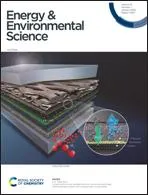
Energy & Environmental Science
CiteScore:
32.34
Self-citation Rate:
3.4%
Articles per Year:
481
Energy & Environmental Science is an international journal dedicated to publishing exceptionally important and high quality, agenda-setting research tackling the key global and societal challenges of ensuring the provision of energy and protecting our environment for the future. The scope is intentionally broad and the journal recognises the complexity of issues and challenges relating to energy conversion and storage, alternative fuel technologies and environmental science. For work to be published it must be linked to the energy-environment nexus and be of significant general interest to our community-spanning readership. All scales of studies and analysis, from impactful fundamental advances, to interdisciplinary research across the (bio)chemical, (bio/geo)physical sciences and chemical engineering disciplines are welcomed. Topics include, but are not limited to, the following: Solar energy conversion and photovoltaics Solar fuels and artificial photosynthesis Fuel cells Hydrogen storage and (bio) hydrogen production Materials for energy systems Capture, storage and fate of CO2, including chemicals and fuels from CO2 Catalysis for a variety of feedstocks (for example, oil, gas, coal, biomass and synthesis gas) Biofuels and biorefineries Materials in extreme environments Environmental impacts of energy technologies Global atmospheric chemistry and climate change as related to energy systems Water-energy nexus Energy systems and networks Globally applicable principles of energy policy and techno-economics
Recommended Compounds
Recommended Suppliers






Disclaimer
This page provides academic journal information for reference and research purposes only. We are not affiliated with any journal publishers and do not handle publication submissions. For publication-related inquiries, please contact the respective journal publishers directly.
If you notice any inaccuracies in the information displayed, please contact us at support@chemtradehub.com. We will promptly review and address your concerns.