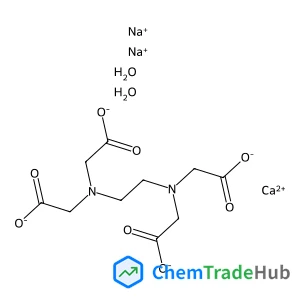
EthylenediaminetetraaceticacidcalciumDisodiumsalthydrate
CAS Number:
23411-34-9
Molecular Formula:
C10H16CaN2Na2O10
The first page of this article is displayed as the abstract.
Sihao Xu, Nathaniel Corrigan, Cyrille Boyer
DOI: 10.1039/D0PY00889C
Guillaume Noirbent, Damien Brunel, Didier Gigmes, Pu Xiao, Frédéric Dumur
DOI: 10.1039/D0PY01197E
Haobo Yuan, Takumitsu Kida, Ryo Tanaka, Zhengguo Cai, Yuushou Nakayama, Takeshi Shiono
DOI: 10.1039/D1PY90010B
Lourdes Mónica Bravo-Anaya, Julien Rosselgong, Ye Xiao, Amélie Vax, Emmanuel Ibarboure, Anna Ruban, Coralie Lebleu, Gilles Joucla, Bertrand Garbay, Elisabeth Garanger, Sébastien Lecommandoux
DOI: 10.1039/D0PY01293A
Pramith Priyananda
DOI: 10.1039/D0PY00769B
Zhe Yu, Hua Li, Yiyang Jia, Youbei Qiao, Chaoli Wang, Qing Zhou, Xin He, Shibin Yu, Tiehong Yang, Hong Wu
DOI: 10.1039/D0PY01130D
Yuki Kametani, Makoto Ouchi
DOI: 10.1039/D0PY01079K
Yeasmin Nahar, James Horne, Vinh Truong, Alex C. Bissember, Stuart C. Thickett
DOI: 10.1039/D0PY01159B
1H-Indazole-6-carbonitrile finds applications in pharmaceuticals, where it serve...
Waste containing Dioctyl (2E)-2-butenedioate (CAS: 2997-85-5) should be collecte...
Sodium [(1,2-benzoxazol-3-ylmethyl)sulfonyl]azanide is primarily used in pharmac...
Dimethyl 4-(4,4,5,5-tetramethyl-1,3,2-dioxaborolan-2-yl)-2,6-pyridinedicarboxyla...
Waste containing 2-Fluoro-6-hydrazinopyridine (CAS: 80714-39-2) should be manage...
6-Formyl-2-pyridinecarboxylic acid is an organic compound with the molecular for...
Research trends for this compound indicate a focus on its potential applications...
9H-Tribenzo[b,d,f]azepine is typically synthesized via a multi-step process invo...
1-Cyclopropyl-7-ethoxy-6-fluoro-8-methoxy-4-oxo-1,4-dihydro-3-quinolinecarboxyli...
Waste containing Methyl 3-oxo-1,2,3,4-tetrahydro-6-quinoxalinecarboxylate (CAS: ...

ChemComm publishes urgent research which is of outstanding significance and interest to experts in the field, while also appealing to the journal’s broad chemistry readership. Our communication format is ideally suited to short, urgent studies that are of such importance that they require accelerated publication. Our scope covers all topics in chemistry, and research at the interface of chemistry and other disciplines (such as materials science, nanoscience, physics, engineering and biology) where there is a significant novelty in the chemistry aspects. Major topic areas covered include: Analytical Chemistry Catalysis Chemical Biology and medicinal chemistry Computational Chemistry and Machine Learning Energy and sustainable chemistry Environmental Chemistry Green Chemistry Inorganic Chemistry Materials Chemistry Nanoscience Organic Chemistry Physical Chemistry Polymer Chemistry Supramolecular Chemistry