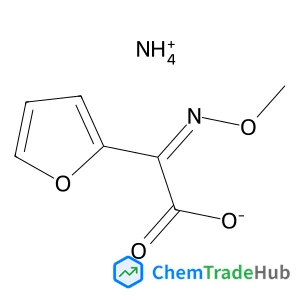
Ammonium (Z)-2-(furan-2-yl)-2-(methoxyimino)acetate
CAS Number:
97148-39-5
Molecular Formula:
C7H10N2O4
Joohan Lee, Juhyoun Kwak
In this study, for the first time, the anion dependency of Ag-deposition on self-assembled monolayers (SAMs) with alkyl chains long enough to meet the densely packed and well-organized surface is reported. Irrespective of pH, types of terminal groups of the SAMs, and the convective mass transfer condition, SAM structures show the “sieving behaviour” to the Ag deposition by the composition of the electrolytes.
Clara Coll-Satue, Shahana Bishnoi, Jiantao Chen, Leticia Hosta-Rigau
DOI: 10.1039/D0BM01767A
Adam D. Gill, Briana L. Hickey, Siwen Wang
DOI: 10.1039/C9CC07002H
Olivier Back, Bruno Donnadieu, Moritz von Hopffgarten, Susanne Klein, Ralf Tonner, Gernot Frenking, Guy Bertrand
DOI: 10.1039/C1SC00027F
Jiajia Lang, Shaojian Lin
DOI: 10.1039/C9CC90478F
Serhat Döker
DOI: 10.1039/C6AY03140D
Felix Engelhardt, Christian Maaß, Diego M. Andrada, Regine Herbst-Irmer, Dietmar Stalke
DOI: 10.1039/C7SC05368A
Xiang-Jin Kong, Chao Peng, Yao-Han Lan, Wen-xiu Li, Shuai-Shuai Chi, Chao Zheng, Lin-Yi Dong, Xian-Hua Wang
DOI: 10.1039/C9AY01229J
1H-Indazole-6-carbonitrile finds applications in pharmaceuticals, where it serve...
Waste containing Dioctyl (2E)-2-butenedioate (CAS: 2997-85-5) should be collecte...
Sodium [(1,2-benzoxazol-3-ylmethyl)sulfonyl]azanide is primarily used in pharmac...
Dimethyl 4-(4,4,5,5-tetramethyl-1,3,2-dioxaborolan-2-yl)-2,6-pyridinedicarboxyla...
Waste containing 2-Fluoro-6-hydrazinopyridine (CAS: 80714-39-2) should be manage...
6-Formyl-2-pyridinecarboxylic acid is an organic compound with the molecular for...
Research trends for this compound indicate a focus on its potential applications...
9H-Tribenzo[b,d,f]azepine is typically synthesized via a multi-step process invo...
1-Cyclopropyl-7-ethoxy-6-fluoro-8-methoxy-4-oxo-1,4-dihydro-3-quinolinecarboxyli...
Waste containing Methyl 3-oxo-1,2,3,4-tetrahydro-6-quinoxalinecarboxylate (CAS: ...

ChemComm publishes urgent research which is of outstanding significance and interest to experts in the field, while also appealing to the journal’s broad chemistry readership. Our communication format is ideally suited to short, urgent studies that are of such importance that they require accelerated publication. Our scope covers all topics in chemistry, and research at the interface of chemistry and other disciplines (such as materials science, nanoscience, physics, engineering and biology) where there is a significant novelty in the chemistry aspects. Major topic areas covered include: Analytical Chemistry Catalysis Chemical Biology and medicinal chemistry Computational Chemistry and Machine Learning Energy and sustainable chemistry Environmental Chemistry Green Chemistry Inorganic Chemistry Materials Chemistry Nanoscience Organic Chemistry Physical Chemistry Polymer Chemistry Supramolecular Chemistry