












Monitoring the formation of TTF dimers by Na+ complexation
Literature Information
Publication Date
2006-03-30
DOI
10.1039/B518275A
Impact Factor
6.222
Authors
Marc Sallé, Jean-Yves Balandier, Franck Le Derf, Eric Levillain, Magali Allain, Pascal Viel, Serge Palacin
View Original
Abstract
The formation of the two dimeric species [(TTF)2]+˙ and (TTF+˙)2 can be monitored by complexation of Na+ on a calix[4]arene–TTF assembly.
Recommended Journals
Related Literature
Synthesis of a multicyclic polymer with hyperbranched structure by click polymerization of an AB2 cyclic macromonomer
Chao Liu, Hua-Long Zhang, Wen Xu, Cai-Yuan Pan, Chun-Yan Hong
2021-01-04
Paper
DOI: 10.1039/D0PY01604G
Multimesophase transitions of main-chain liquid crystalline copolymers with strictly alternating fluorocarbon chains
Enjie He, Kai Tu, Jiannan Cheng, Huanjun Lu, Lifen Zhang, Zhenping Cheng, Xiulin Zhu
2021-01-05
Paper
DOI: 10.1039/D0PY01644F
One-component rapid Norrish Type II photoinitiation of bulk photo-CuAAC polymer networks
Abhishek U. Shete, Bryan P. Sutherland
2020-11-03
Paper
DOI: 10.1039/D0PY01310B
Retracted Article: Non-thermal microwave effects in radical polymerization of bio-based terpenoid (meth)acrylates
Amaia Agirre, José M. Asua
2020-10-13
Paper
DOI: 10.1039/D0PY01192D
Correction: Synthesis and properties of block copolymers composed of norbornene/higher α-olefin gradient segments using ansa-fluorenylamidodimethyltitanium-[Ph3C][B(C6F5)4] catalyst system
Haobo Yuan, Takumitsu Kida, Ryo Tanaka, Zhengguo Cai, Yuushou Nakayama, Takeshi Shiono
2021-01-21
Correction
DOI: 10.1039/D1PY90010B
Autonomous self-healing polyisoprene elastomers with high modulus and good toughness based on the synergy of dynamic ionic crosslinks and highly disordered crystals
Mayu Yamada, Yu Shinke, Shoichi Kutsumizu
2020-09-07
Paper
DOI: 10.1039/D0PY01034K
α-Diimine nickel complexes bearing axially bulky terphenyl and equatorially bulky dibenzobarrelene groups: synthesis, characterization and olefin polymerization studies
Bo Dong, Qi Yang
2020-09-26
Paper
DOI: 10.1039/D0PY01152E
Reaction-induced phase transitions with block copolymers in solution and bulk
Joshua Lequieu, Andrew J. D. Magenau
2020-08-06
Review Article
DOI: 10.1039/D0PY00722F
Semifluorinated, kinked polyarylenes via direct arylation polycondensation
Fabian Kempe, Felix Riehle, Hartmut Komber, Rukiya Matsidik, Michael Walter, Michael Sommer
2020-10-07
Paper
DOI: 10.1039/D0PY00973C
You might also like
Compound Q&A
What are the main uses of 1H-Indazole-6-carbonitrile (CAS: 141290-59-7)?
1H-Indazole-6-carbonitrile finds applications in pharmaceuticals, where it serve...
141290-59-71H-Indazole-6-carbon...
Compound Q&A
How should waste containing Dioctyl (2E)-2-butenedioate (CAS: 2997-85-5) be handled?
Waste containing Dioctyl (2E)-2-butenedioate (CAS: 2997-85-5) should be collecte...
2997-85-5Dioctyl (2E)-2-buten...
Compound Q&A
What industries use Sodium [(1,2-benzoxazol-3-ylmethyl)sulfonyl]azanide (CAS: 68291-98-5)?
Sodium [(1,2-benzoxazol-3-ylmethyl)sulfonyl]azanide is primarily used in pharmac...
68291-98-5Sodium [(1,2-benzoxa...
Compound Q&A
Are there alternatives to Dimethyl 4-(4,4,5,5-tetramethyl-1,3,2-dioxaborolan-2-yl)-2,6-pyridinedicarboxylate (CAS: 741709-66-0) in synthesis?
Dimethyl 4-(4,4,5,5-tetramethyl-1,3,2-dioxaborolan-2-yl)-2,6-pyridinedicarboxyla...
741709-66-0Dimethyl 4-(4,4,5,5-...
Compound Q&A
How should waste containing 2-Fluoro-6-hydrazinopyridine (CAS: 80714-39-2) be handled?
Waste containing 2-Fluoro-6-hydrazinopyridine (CAS: 80714-39-2) should be manage...
80714-39-22-Fluoro-6-hydrazino...
Compound Q&A
What is 6-Formyl-2-pyridinecarboxylic acid (CAS: 499214-11-8)?
6-Formyl-2-pyridinecarboxylic acid is an organic compound with the molecular for...
499214-11-86-Formyl-2-pyridinec...
Compound Q&A
What is the market or research trend for 3-(3,4-dimethoxyphenyl)-2,5-dimethyl-N-(2-morpholin-4-ylethyl)pyrazolo[1,5-a]pyrimidin-7-amine (CAS: 900874-91-1)?
Research trends for this compound indicate a focus on its potential applications...
900874-91-13-(3,4-dimethoxyphen...
Compound Q&A
How is 9H-Tribenzo[b,d,f]azepine (CAS: 29875-73-8) typically synthesized?
9H-Tribenzo[b,d,f]azepine is typically synthesized via a multi-step process invo...
29875-73-89H-Tribenzo[b,d,f]az...
Compound Q&A
How is 1-Cyclopropyl-7-ethoxy-6-fluoro-8-methoxy-4-oxo-1,4-dihydro-3-quinolinecarboxylic acid (CAS: 1797982-51-4) typically synthesized?
1-Cyclopropyl-7-ethoxy-6-fluoro-8-methoxy-4-oxo-1,4-dihydro-3-quinolinecarboxyli...
1797982-51-41-Cyclopropyl-7-etho...
Compound Q&A
How should waste containing Methyl 3-oxo-1,2,3,4-tetrahydro-6-quinoxalinecarboxylate (CAS: 671820-52-3) be handled?
Waste containing Methyl 3-oxo-1,2,3,4-tetrahydro-6-quinoxalinecarboxylate (CAS: ...
671820-52-3Methyl 3-oxo-1,2,3,4...
Source Journal
Chemical Communications

CiteScore:
8.6
Self-citation Rate:
4.7%
Articles per Year:
2458
ChemComm publishes urgent research which is of outstanding significance and interest to experts in the field, while also appealing to the journal’s broad chemistry readership. Our communication format is ideally suited to short, urgent studies that are of such importance that they require accelerated publication. Our scope covers all topics in chemistry, and research at the interface of chemistry and other disciplines (such as materials science, nanoscience, physics, engineering and biology) where there is a significant novelty in the chemistry aspects. Major topic areas covered include: Analytical Chemistry Catalysis Chemical Biology and medicinal chemistry Computational Chemistry and Machine Learning Energy and sustainable chemistry Environmental Chemistry Green Chemistry Inorganic Chemistry Materials Chemistry Nanoscience Organic Chemistry Physical Chemistry Polymer Chemistry Supramolecular Chemistry
Recommended Compounds
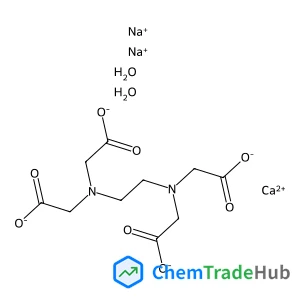
EthylenediaminetetraaceticacidcalciumDisodiumsalthydrate
CAS Number:
23411-34-9
Molecular Formula:
C10H16CaN2Na2O10



Recommended Suppliers



Disclaimer
This page provides academic journal information for reference and research purposes only. We are not affiliated with any journal publishers and do not handle publication submissions. For publication-related inquiries, please contact the respective journal publishers directly.
If you notice any inaccuracies in the information displayed, please contact us at support@chemtradehub.com. We will promptly review and address your concerns.