












Precisely segmented PEEK–ionene + ionic liquid composite membranes for CO2 separation
Literature Information
Publication Date
2023-12-20
DOI
10.1039/D3TA05223K
Impact Factor
12.732
Authors
Sudhir Ravula, Ying Chen, Kevin W. Wise, Pravin S. Shinde, Eric D. Walter, Abhi Karkamkar, Jason E. Bara
View Original
Abstract
Ionenes, polymers with ionic groups incorporated directly within the backbone are a highly versatile class of materials, although they have received much less attention than polyelectrolytes which have ionic groups pendant from the polymer backbone. By designing ionenes that incorporate robust properties of poly(ether ether ketone) (PEEK), we have achieved new imidazolium-containing PEEK–ionene architectures that create opportunities for enhanced CO2 separation membranes. To achieve these materials, an new imidazole-functionalized PEEK oligomer (ImK(EEK)2KIm) was synthesized through facile and straightforward routes. This molecule was then polymerized via condensation reactions with two different aromatic (α,α′-dibromo-p-xylene) and aliphatic (dibromohexyl containing-bis(imidazolium)hexane dibromide salt) comonomers and exchanged with bistriflimide ([Tf2N]) anion to obtain two unique PEEK–ionenes containing distinct PEEK and ionic segments: p([ImK(EEK)2Im-p-xyl][Tf2N]2) and p([ImK(EEK)2(ImC6)3][Tf2N]4). While the neat PEEK–ionenes exhibited high molecular weight but were not able to form high-quality films, adding stoichiometric amounts of “free” IL (1-methyl-3-butylimidazolium bistriflimide, [C4mIm][Tf2N]), greatly improved the flexibility and processability of the resultant membranes. Further, the structure–property relationships of bulk PEEK–ionenes and corresponding composites were extensively characterized by different analytical techniques (thermogravimetric analysis, differential scanning calorimetry, X-ray diffraction, and solid-state NMR). The gas separation properties were investigated, with the PEEK–ionenes + IL composites exhibiting CO2 permeabilities of 14–94 barrer and good CO2/N2 permselectivities of 26–35, indicating that new designs of segmented ionenes and composites with ILs a promising material design strategy for developing gas separation membranes.
Related Literature
New Li-doped fullerene-intercalated phthalocyanine covalent organic frameworks designed for hydrogen storage
Jing-Hua Guo, Yoshiyuki Miyamoto
2013-04-23
Paper
DOI: 10.1039/C3CP50492A
A multi-scale molecular dynamics study of the assembly of micron-size supraparticles from 30 nm alkyl-coated nanoparticles
Damien Thompson, Mateusz Sikora, Piotr Szymczak, Marek Cieplak
2013-04-09
Paper
DOI: 10.1039/C3CP50523E
Lone-pair distribution and plumbite network formation in high lead silicate glass, 80PbO·20SiO2
Oliver L. G. Alderman, Alex C. Hannon, Diane Holland, Steve Feller, Gloria Lehr, Adam J. Vitale, Uwe Hoppe, Martin v. Zimmerman, Anke Watenphul
2013-04-29
Paper
DOI: 10.1039/C3CP51348C
Strong-pump strong-probe spectroscopy: effects of higher excited electronic states
Maxim F. Gelin, Dassia Egorova, Wolfgang Domcke
2013-03-22
Paper
DOI: 10.1039/C3CP44454F
A simple reduction process to synthesize MoO2/C composites with cage-like structure for high-performance lithium-ion batteries
Bing Liu, Xinyu Zhao, Yuan Tian, Di Zhao, Changwen Hu, Minhua Cao
2013-03-28
Paper
DOI: 10.1039/C3CP44707C
Mechanisms behind sulfur promoted oxidation of methane
Johan Gustafson, Marco Di Michiel, Mark A. Newton
2013-02-11
Paper
DOI: 10.1039/C3CP44289F
Spectral assignments and NMR parameter–structure relationships in borates using high-resolution 11B NMR and density functional theory
Oliver L. G. Alderman, Dinu Iuga, Andrew P. Howes, Diane Holland, Ray Dupree
2013-04-05
Paper
DOI: 10.1039/C3CP50772F
An all-cotton-derived, arbitrarily foldable, high-rate, electrochemical supercapacitor
Jiangli Xue, Yang Zhao, Huhu Cheng, Chuangang Hu, Yue Hu, Yuning Meng, Huibo Shao, Zhipan Zhang, Liangti Qu
2013-04-15
Communication
DOI: 10.1039/C3CP51571K
Spectromicroscopy of pulses transporting alkali metal in a surface reaction
S. Günther, Hong Liu, T. O. Menteş, A. Locatelli, R. Imbihl
2013-04-03
Paper
DOI: 10.1039/C3CP44478C
Organic spin-valves: from unipolar to bipolar devices
Z. Valy Vardeny
2013-04-25
Perspective
DOI: 10.1039/C3CP50639H
You might also like
Compound Q&A
What precautions should be taken when handling 2-Chloro-1,2-bis(4-methylphenyl)ethanone (CAS: 71193-32-3)?
When handling 2-Chloro-1,2-bis(4-methylphenyl)ethanone (CAS: 71193-32-3), it is ...
71193-32-32-Chloro-1,2-bis(4-m...
Compound Q&A
What industries use 4-Ethoxy-3-(5-methyl-4-oxo-7-propyl-1,4-dihydroimidazo[5,1-f][1,2,4]triazin-2-yl)benzenesulfonyl chloride (CAS: 224789-26-8)?
4-Ethoxy-3-(5-methyl-4-oxo-7-propyl-1,4-dihydroimidazo[5,1-f][1,2,4]triazin-2-yl...
224789-26-84-Ethoxy-3-(5-methyl...
Compound Q&A
How should Methyl 3-Oxo-4-Androsten-17-Carboxylate (CAS: 2681-55-2) be stored?
Methyl 3-Oxo-4-Androsten-17-Carboxylate (CAS: 2681-55-2) should be stored in a c...
2681-55-2Methyl 3-Oxo-4-Andro...
Compound Q&A
What are the main uses of (R)-3-Amino-4-(3-hexylphenylamino)-4-oxobutylphosphonic acid (CAS: 909725-61-7)?
(R)-3-Amino-4-(3-hexylphenylamino)-4-oxobutylphosphonic acid is primarily used i...
909725-61-7(R)-3-Amino-4-(3-hex...
Compound Q&A
What regulatory guidelines apply to 2-Methyl-2-propanyl 3-amino-3-carbamoyl-1-azetidinecarboxylate (CAS: 1254120-14-3)?
2-Methyl-2-propanyl 3-amino-3-carbamoyl-1-azetidinecarboxylate (CAS: 1254120-14-...
1254120-14-32-Methyl-2-propanyl ...
Compound Q&A
Are there alternatives to (E)-4-(tert-Butoxy)-4-oxobut-2-enoic acid (CAS: 135355-96-3) in synthesis?
There are alternative reagents that can be used in synthesis instead of (E)-4-(t...
135355-96-3(E)-4-(tert-Butoxy)-...
Compound Q&A
What are the physical and chemical properties of [2-(3-Chlorophenyl)-1,3-thiazol-4-yl]methanol (CAS: 121202-20-8)?
[2-(3-Chlorophenyl)-1,3-thiazol-4-yl]methanol (CAS: 121202-20-8) is a crystallin...
121202-20-8[2-(3-Chlorophenyl)-...
Compound Q&A
What is the market or research trend for Methyl (2S)-[(4S)-2,2-dimethyl-1,3-dioxolan-4-yl]{[(4-methylphenyl)sulfonyl]oxy}acetate (CAS: 166249-17-8)?
The market and research trends for Methyl (2S)-[(4S)-2,2-dimethyl-1,3-dioxolan-4...
166249-17-8Methyl (2S)-[(4S)-2,...
Compound Q&A
What is the market or research trend for 1-Bromo-2-isocyanatoethane (CAS: 42865-19-0)?
The market for 1-Bromo-2-isocyanatoethane (CAS: 42865-19-0) is driven by its use...
42865-19-01-Bromo-2-isocyanato...
Compound Q&A
What are the main uses of 4-Nitro-D-phenylalanine hydrochloride (CAS: 147065-06-3)?
4-Nitro-D-phenylalanine hydrochloride (CAS: 147065-06-3) is primarily used in re...
147065-06-34-Nitro-D-phenylalan...
Source Journal
Journal of Materials Chemistry A

CiteScore:
19.5
Self-citation Rate:
4.7%
Articles per Year:
2211
Journal of Materials Chemistry A, B & C cover high quality studies across all fields of materials chemistry. The journals focus on those theoretical or experimental studies that report new understanding, applications, properties and synthesis of materials. The journals have a strong history of publishing quality reports of interest to interdisciplinary communities and providing an efficient and rigorous service through peer review and publication. The journals are led by an international team of Editors-in-Chief and Associate Editors who are all active researchers in their fields. Journal of Materials Chemistry A, B & C are separated by the intended application of the material studied. Broadly, applications in energy and sustainability are of interest to Journal of Materials Chemistry A, applications in biology and medicine are of interest to Journal of Materials Chemistry B, and applications in optical, magnetic and electronic devices are of interest to Journal of Materials Chemistry C. More than one Journal of Materials Chemistry journal may be suitable for certain fields and researchers are encouraged to submit their paper to the journal that they feel best fits for their particular article. Example topic areas within the scope of Journal of Materials Chemistry A are listed below. This list is neither exhaustive nor exclusive. Artificial photosynthesis Batteries Carbon dioxide conversion Catalysis Fuel cells Gas capture/separation/storage Green/sustainable materials Hydrogen generation Hydrogen storage Photocatalysis Photovoltaics Self-cleaning materials Self-healing materials Sensors Supercapacitors Thermoelectrics Water splitting Water treatment
Recommended Compounds

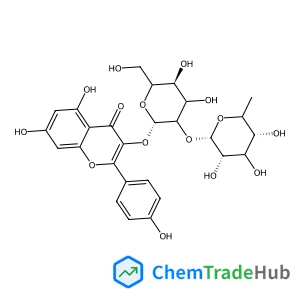
5,7-Dihydroxy-2-(4-hydroxyphenyl)-4-oxo-4H-chromen-3-yl 2-O-(6-deoxy-alpha-L-mannopyranosyl)-beta-D-glucopyranoside
CAS Number:
32602-81-6
Molecular Formula:
C27H30O15
Recommended Suppliers





Disclaimer
This page provides academic journal information for reference and research purposes only. We are not affiliated with any journal publishers and do not handle publication submissions. For publication-related inquiries, please contact the respective journal publishers directly.
If you notice any inaccuracies in the information displayed, please contact us at support@chemtradehub.com. We will promptly review and address your concerns.