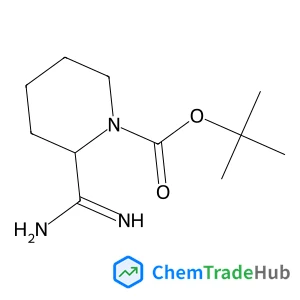
2-Methyl-2-propanyl 2-carbamimidoyl-1-piperidinecarboxylate
CAS Number:
1258640-98-0
Molecular Formula:
C11H21N3O2
Oliver L. G. Alderman, Dinu Iuga, Andrew P. Howes, Diane Holland, Ray Dupree
High-resolution, solid-state 11B NMR spectra have been obtained at high magnetic fields for a range of polycrystalline borates using double-rotation (DOR), multiple-quantum magic angle spinning and isotopic dilution. DOR linewidths can be less than 0.2 ppm in isotopically diluted samples, allowing highly accurate values for the isotropic chemical shift, δiso, and electric field gradient to be obtained. The experimental values are used as a test of density functional calculations using both projector augmented wave based CASTEP and WIEN2k. The CASTEP calculations of δiso are generally in very good agreement with experiment, having r.m.s. deviation 0.40 ppm. WIEN2k calculations of electric field gradient magnitude, CQ, and asymmetry, η, are also in excellent agreement with experiment, with r.m.s. deviations 0.038 MHz and 0.042 respectively. However, whilst CASTEP gives a similar deviation for η (0.043) it overestimates CQ by ∼15%. After scaling of the calculated electric field gradient by 0.842 the deviation in CQ is practically identical to that of the WIEN2k calculations. The spectral assignments that follow from the experimental and computational results allow identification of correlations between δiso and (a) the average B–O–B bond angle, θ, for both three and four coordinated boron, giving δiso(BIII) = (185.1 − θ)/3.42 ppm and δiso(BIV) = (130.2 − θ)/5.31 ppm; and (b) the ring-site T3 unit trigonal planar angular deviation, Stri, giving δiso(T3(ring)) = (1.642 × 10⁻² − Stri)/(8.339 × 10−4) ppm.
Juan Ouyang, Lihe Sun, Fang Zeng, Shuizhu Wu
DOI: 10.1039/D1AN02183D
Zhenyu Gu, Jianguo Zhang, Dan Zhang, Han Zhang, Zhigang Yang, Junle Qu
DOI: 10.1039/D1TB00410G
Huiyi Yang, Qiyi He, Junkang Pan, Ding Shen, Huanxin Xiao, Xiping Cui, Suqing Zhao
DOI: 10.1039/D0AN02293D
DOI: 10.1039/C8TB90176G
Dipankar Das, Rabiul Alam
DOI: 10.1039/D1AN01788H
D. Hosseini, Q. Imtiaz, P. M. Abdala, S. Yoon, A. M. Kierzkowska, A. Weidenkaff, C. R. Müller
DOI: 10.1039/C5TA01088H
Asta Žukauskaitė, Ivan Petřík, Aleš Pěnčík, Martin Hönig, Jiří Grúz, Jitka Široká, Ondřej Novák
DOI: 10.1039/D0AN02118K
N-(4-Methoxybenzyl)-2-pyridinamine (CAS: 52818-63-0) is increasingly being used ...
When handling Ethyl 4-(2-chlorophenyl)-1,3-thiazole-2-carboxylate, appropriate p...
Diethyldiselane (CAS: 628-39-7) is classified under the Globally Harmonized Syst...
The market for oxocopper (CAS: 12053-18-8) is primarily driven by its use in cat...
The market for 5-{[(2-Methyl-2-propanyl)oxy]carbonyl}-5-azaspiro[2.4]heptane-7-c...
2-(1-Pyrrolidinyl)-4-pyridinamine is a chemical compound with the CAS number 359...
2-(3-Pyridinyl)-1-azabicyclo[2.2.2]octane (CAS: 91556-75-1) is a crystalline sol...
(S)-Alpha-allyl-proline hydrochloride is usually synthesized via a Wittig reacti...
3-Methyl-1,2-oxazole-5-carboxylic acid (CAS: 4857-42-5) is an organic compound w...
Lys-SMCC-DM1 is synthesized via a multi-step process involving the coupling of S...

Physical Chemistry Chemical Physics (PCCP) is an international journal co-owned by 19 physical chemistry and physics societies from around the world. This journal publishes original, cutting-edge research in physical chemistry, chemical physics and biophysical chemistry. To be suitable for publication in PCCP, articles must include significant innovation and/or insight into physical chemistry; this is the most important criterion that reviewers and Editors will judge against when evaluating submissions. The journal has a broad scope and welcomes contributions spanning experiment, theory, computation and data science. Topical coverage includes spectroscopy, dynamics, kinetics, statistical mechanics, thermodynamics, electrochemistry, catalysis, surface science, quantum mechanics, quantum computing and machine learning. Interdisciplinary research areas such as polymers and soft matter, materials, nanoscience, energy, surfaces/interfaces, and biophysical chemistry are welcomed if they demonstrate significant innovation and/or insight into physical chemistry. Joined experimental/theoretical studies are particularly appreciated when complementary and based on up-to-date approaches.
![1-[6-(1H-Imidazol-1-yl)-3-pyridinyl]methanamine structure](https://static.chemtradehub.com/structs/914/914637-08-4-8825.webp "1-[6-(1H-Imidazol-1-yl)-3-pyridinyl]methanamine structure")
![1-{3-[4-Amino-3-(4-phenoxyphenyl)-1H-pyrazolo[3,4-d]pyrimidin-1-yl]-1-piperidinyl}-2,3-dihydroxy-1-propanone structure](https://static.chemtradehub.com/structs/122/1226872-27-0-e037.webp "1-{3-[4-Amino-3-(4-phenoxyphenyl)-1H-pyrazolo[3,4-d]pyrimidin-1-yl]-1-piperidinyl}-2,3-dihydroxy-1-propanone structure")