












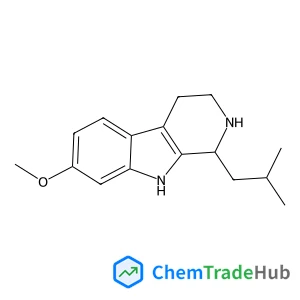
1-Isobutyl-7-methoxy-2,3,4,9-tetrahydro-1H-beta-carboline
CAS Number:
175975-76-5
Molecular Formula:
C16H22N2O
Jing-Hua Guo, Yoshiyuki Miyamoto
Applying density functional theory (DFT) calculations, we have designed fullerenes (C20, C24, C26, C28, C30, C36, C60 and C70) intercalated phthalocyanine covalent organic frameworks (Cn-Pc-PBBA COFs). First principles molecular dynamics (MD) simulations showed that the structures of Cn-Pc-PBBA COFs are stable at room temperature and even at higher temperature (500 K). The interlayer distance of Pc-PBBA COF has been expanded to 7.48–13.25 Å by the intercalated fullerenes, and the pore volume and surface area were enlarged by 2.3–3.1 and 2.0–2.6 times, respectively. The grand canonical Monte Carlo (GCMC) simulations show that our designed Cn-Pc-PBBA COFs exhibit a superior hydrogen storage capability: at 77 K and P = 100 bar, the hydrogen gravimetric and volumetric uptakes reach 9.4–12 wt% and 48.1–52.2 g L−1, respectively. To meet the requirement for practical application in hydrogen storage, we use the Li-doping method to modify the hydrogen storage performance of Cn-Pc-PBBA COFs. Our results show that the Li atoms can stably locate on the surface of C30-, C36, C60 and C70-Pc-PBBA COFs. At T = 298 K and P = 100 bar, for these four Li-doped Cn-Pc-PBBA COFs, the gravimetric and volumetric uptakes of H2 reach 4.2 wt% and 18.2 g L−1, respectively.
Fan Huang, Kersti Karu, Luiza C. Campos
DOI: 10.1039/D0AN02335C
Jian Wang, Ting Ting Wang, Peng Fei Gao, Cheng Zhi Huang
DOI: 10.1039/C4TB01263A
Jianwen Hou, Runhai Chen, Zhirong Xin, Hengchong Shi, Shing-Chung Wong, Jinghua Yin, Qiang Shi
DOI: 10.1039/C6TB03385G
Fang Li, Xiuming Wu, Mengmeng Gu, Guang-Li Wang
DOI: 10.1039/D0AN02438D
Farnoosh Attari, Habibullah Hazim, Ashkan Zandi, Zeinab Mazarei, Hasan Rafati
DOI: 10.1039/D0AN02013C
Mustafa Nigde, Ismail Agir, Rıdvan Yıldırım, Ibrahim Isildak
DOI: 10.1039/D1AN01754C
Tuanwei Liu, Jingjing Hu, Xiaoye Ma, Bing Kong, Jilan Wang, Zhide Zhang, Dian-Shun Guo, Xinlin Yang
DOI: 10.1039/C7TB01715D
DOI: 10.1039/JA9860100287
Hao Wan, Ying Liu, Haiyan Zhang, Linghua Zeng, Jiale Qu, Ben-Qing Wu, Xinhong Wan
DOI: 10.1039/D1AN90111G
Shan Huang, Yuexin Song, Zhimei He, Jian-Rong Zhang, Jun-Jie Zhu
DOI: 10.1039/D1AN00077B
N-(4-Methoxybenzyl)-2-pyridinamine (CAS: 52818-63-0) is increasingly being used ...
When handling Ethyl 4-(2-chlorophenyl)-1,3-thiazole-2-carboxylate, appropriate p...
Diethyldiselane (CAS: 628-39-7) is classified under the Globally Harmonized Syst...
The market for oxocopper (CAS: 12053-18-8) is primarily driven by its use in cat...
The market for 5-{[(2-Methyl-2-propanyl)oxy]carbonyl}-5-azaspiro[2.4]heptane-7-c...
2-(1-Pyrrolidinyl)-4-pyridinamine is a chemical compound with the CAS number 359...
2-(3-Pyridinyl)-1-azabicyclo[2.2.2]octane (CAS: 91556-75-1) is a crystalline sol...
(S)-Alpha-allyl-proline hydrochloride is usually synthesized via a Wittig reacti...
3-Methyl-1,2-oxazole-5-carboxylic acid (CAS: 4857-42-5) is an organic compound w...
Lys-SMCC-DM1 is synthesized via a multi-step process involving the coupling of S...

Physical Chemistry Chemical Physics (PCCP) is an international journal co-owned by 19 physical chemistry and physics societies from around the world. This journal publishes original, cutting-edge research in physical chemistry, chemical physics and biophysical chemistry. To be suitable for publication in PCCP, articles must include significant innovation and/or insight into physical chemistry; this is the most important criterion that reviewers and Editors will judge against when evaluating submissions. The journal has a broad scope and welcomes contributions spanning experiment, theory, computation and data science. Topical coverage includes spectroscopy, dynamics, kinetics, statistical mechanics, thermodynamics, electrochemistry, catalysis, surface science, quantum mechanics, quantum computing and machine learning. Interdisciplinary research areas such as polymers and soft matter, materials, nanoscience, energy, surfaces/interfaces, and biophysical chemistry are welcomed if they demonstrate significant innovation and/or insight into physical chemistry. Joined experimental/theoretical studies are particularly appreciated when complementary and based on up-to-date approaches.
![N-{15-[(2,5-Dioxo-1-pyrrolidinyl)oxy]-15-oxo-3,6,9,12-tetraoxapentadec-1-yl}-2-(2-propyn-1-yloxy)acetamide structure](https://static.chemtradehub.com/structs/210/2101206-92-0-2eb5.webp "N-{15-[(2,5-Dioxo-1-pyrrolidinyl)oxy]-15-oxo-3,6,9,12-tetraoxapentadec-1-yl}-2-(2-propyn-1-yloxy)acetamide structure")
![1-(1-Benzyl-1,2,3,6-tetrahydropyridin-4-yl)-1H-benzo[d]imidazol-2(3H)-one structure](https://static.chemtradehub.com/structs/603/60373-71-9-7dfb.webp "1-(1-Benzyl-1,2,3,6-tetrahydropyridin-4-yl)-1H-benzo[d]imidazol-2(3H)-one structure")
![N-{[(2-Methyl-2-propanyl)oxy]carbonyl}-L-methionylglycine structure](https://static.chemtradehub.com/structs/234/23446-03-9-e1e5.webp "N-{[(2-Methyl-2-propanyl)oxy]carbonyl}-L-methionylglycine structure")




