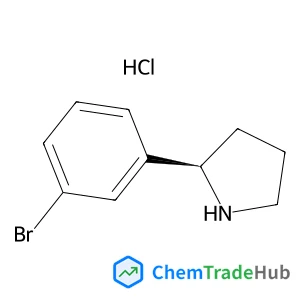
(2R)-2-(3-Bromophenyl)pyrrolidine hydrochloride (1:1)
CAS Number:
1391550-13-2
Molecular Formula:
C10H13BrClN
Damien Thompson, Mateusz Sikora, Piotr Szymczak, Marek Cieplak
Atomistic and meso scale computer simulations of nanoparticle aggregation are combined to describe the self-assembly of supraparticles in bulk and on surfaces under vacuum conditions. At the nano scale, atomic resolution molecular dynamics simulations provide the structures of 30 nm-diameter nanoparticles bound to each other and to coated hydrophobic surfaces, through the physical contacting of their alkyl coats. This “molecular velcro” has been recently exploited in experiments to direct the aggregation of coated nanoparticles into stable assemblies on electronics platforms. Interaction potentials are extracted from the nano scale simulations and transferred to coarse grained Brownian dynamics simulations that describe multi-nanoparticle aggregation and surface deposition. The simulation results show that the large interaction area between 30 nm nanoparticles provides a strong driving force for assembly of strongly-welded, porous supraparticles under vacuum conditions. Interaction forces are significantly larger than those found in earlier simulations of the aggregation of smaller nanoparticles, indicating that supraparticle assembly using large 30 nm nanoparticles may be kinetically controlled. The porosity programmed into kinetic assembly may potentially benefit emerging applications of nanoparticle assemblies in medicine, in particular the development of nanostructured drug-eluting stent coatings. Future work will involve potential of mean force calculations in a variety of solvents to estimate the porosity obtainable for specific applications.
Ke Xiao, Jianyong Yu, Jianmao Yang
DOI: 10.1039/C5TA00856E
Ming-Lee Chu, Jung-Lee Lin
DOI: 10.1039/D0AN02478C
Tuanwei Liu, Jingjing Hu, Xiaoye Ma, Bing Kong, Jilan Wang, Zhide Zhang, Dian-Shun Guo, Xinlin Yang
DOI: 10.1039/C7TB01715D
Zhi-Gang Gu, Salma Mirza, Shu-Hua Zhang, Jian Zhang
DOI: 10.1039/C8TA01034J
Shipeng Gong, Changlai Wang, Peng Jiang, Kang Yang, Jian Lu, Minxue Huang, Shi Chen, Junzheng Wang
DOI: 10.1039/C9TA04361F
Qing-Yun Zhou, Rong-Na Ma, Chao-Long Hu, Fei Sun, Li-Ping Jia, Wei Zhang, Lei Shang, Qing-Wang Xue, Wen-Li Jia, Huai-Sheng Wang
DOI: 10.1039/D1AN00204J
Andrew J. Wilson, Katherine A. Willets
DOI: 10.1039/C6AN01266C
Virginia Chu, João Gonçalves
DOI: 10.1039/D1AN01810H
Arif Ul Alam, Dennis Clyne
DOI: 10.1039/D1AN00038A
N-(4-Methoxybenzyl)-2-pyridinamine (CAS: 52818-63-0) is increasingly being used ...
When handling Ethyl 4-(2-chlorophenyl)-1,3-thiazole-2-carboxylate, appropriate p...
Diethyldiselane (CAS: 628-39-7) is classified under the Globally Harmonized Syst...
The market for oxocopper (CAS: 12053-18-8) is primarily driven by its use in cat...
The market for 5-{[(2-Methyl-2-propanyl)oxy]carbonyl}-5-azaspiro[2.4]heptane-7-c...
2-(1-Pyrrolidinyl)-4-pyridinamine is a chemical compound with the CAS number 359...
2-(3-Pyridinyl)-1-azabicyclo[2.2.2]octane (CAS: 91556-75-1) is a crystalline sol...
(S)-Alpha-allyl-proline hydrochloride is usually synthesized via a Wittig reacti...
3-Methyl-1,2-oxazole-5-carboxylic acid (CAS: 4857-42-5) is an organic compound w...
Lys-SMCC-DM1 is synthesized via a multi-step process involving the coupling of S...

Physical Chemistry Chemical Physics (PCCP) is an international journal co-owned by 19 physical chemistry and physics societies from around the world. This journal publishes original, cutting-edge research in physical chemistry, chemical physics and biophysical chemistry. To be suitable for publication in PCCP, articles must include significant innovation and/or insight into physical chemistry; this is the most important criterion that reviewers and Editors will judge against when evaluating submissions. The journal has a broad scope and welcomes contributions spanning experiment, theory, computation and data science. Topical coverage includes spectroscopy, dynamics, kinetics, statistical mechanics, thermodynamics, electrochemistry, catalysis, surface science, quantum mechanics, quantum computing and machine learning. Interdisciplinary research areas such as polymers and soft matter, materials, nanoscience, energy, surfaces/interfaces, and biophysical chemistry are welcomed if they demonstrate significant innovation and/or insight into physical chemistry. Joined experimental/theoretical studies are particularly appreciated when complementary and based on up-to-date approaches.