












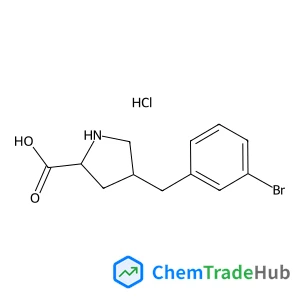
(2S,4R)-4-(3-Bromobenzyl)pyrrolidine-2-carboxylic acid hydrochloride
CAS Number:
1049734-10-2
Molecular Formula:
C12H15BrClNO2
Shengsheng Yu, Rong-Xin Zhu, Kai-Kai Niu, Ning Han, Hui Liu, Ling-Bao Xing
The competitive nature of type II photosensitizers in the transfer of excitation energy for the generation of singlet oxygen (1O2) presents significant challenges in the design of type I photosensitizers to produce the superoxide anion radical (O2˙−). In this study, we present an efficient method for the direct transformation of type II photosensitizers into type I photosensitizers through the implementation of an artificial light-harvesting system (ALHSs) involving a two-step sequential energy transfer process. The designed supramolecular complex (DNPY-SBE-β-CD) not only has the ability to generate 1O2 as type II photosensitizers, but also demonstrates remarkable fluorescence properties in aqueous solution, which renders it an efficient energy donor for the development of type I photosensitizers ALHSs, thereby enabling the efficient generation of O2˙−. Meanwhile, to ascertain the capability and practicality of this method, two organic reactions were conducted, namely the photooxidation reaction of thioanisole and oxidative hydroxylation of arylboronic acids, both of which display a high level of efficiency and exhibit significant catalytic performance. This work provides an efficient method for turning type II photosensitizers into type I photosensitizers by a two-step sequential energy transfer procedure.
Qiang Shao, Zhijian Xu, Jinan Wang, Jiye Shi, Weiliang Zhu
DOI: 10.1039/C6CP06624K
Maria-Astrid Schröter, Harald Seitz, Hans-Jörg Kunte, Tihomir Solomun
DOI: 10.1039/C6CP07707B
Damayanti Bagchi, Tuhin Kumar Maji, Samim Sardar, Chinmoy Bhattacharya, Debjani Karmakar, Samir Kumar Pal
DOI: 10.1039/C6CP08016B
Hongqin Li, Haijun Ye, Zheng Xu, Chuanyi Wang, Jiao Yin
DOI: 10.1039/C6CP07569J
D. Houdoux, J. Houplin, L. Amiaud, A. Lafosse, C. Dablemont
DOI: 10.1039/C6CP03328H
Qiang Sun
DOI: 10.1039/C6CP07589D
Facundo C. Herrera, Martín Mizrahi, Cristina Navío, Ramón Bernardo-Gavito, Daniel Granados, Félix G. Requejo
DOI: 10.1039/C6CP06982G
Antonina N. Arkhipova, Yuri V. Fedorov, Marina A. Zakharko, Dmitry E. Arkhipov, Gediminas Jonusauskas
DOI: 10.1039/C6CP07255K
Roberto Russo, Lorenzo Cupellini, Benedetta Mennucci
DOI: 10.1039/C6CP07458H
Martin Dračínský, Jan Storch, Vladimír Církva, Ivana Císařová, Jan Sýkora
DOI: 10.1039/C6CP07552E
2-(2-Chloroacetamido)-3-phenylpropanoic acid (CAS: 7765-11-9) is generally consi...
2-(Benzyloxy)-5-bromobenzoic acid can be handled safely if appropriate precautio...
(4-Methyl-1,2,5-oxadiazol-3-yl)methanamine hydrochloride is a chemical compound ...
2-(5-Hexylthiophen-2-yl)-4,4,5,5-tetramethyl-1,3,2-dioxaborolane (CAS: 917985-54...
While 4-(8-Methyl-9H-1,3-dioxolo[4,5-h][2,3]benzodiazepin-5-yl)benzenamine (CAS:...
The market for tert-butyl 3-hydroxy-4,5,7,8-tetrahydro-2H-pyrazolo[3,4-d]azepine...
Waste containing 3,5-Diamino-1H-pyrazole-4-carbonitrile (CAS: 6844-58-2) should ...
(6-Fluoro-3-pyridinyl)boronic acid can be synthesized through the reaction of 6-...
Dibenzyl carbonimidoylbiscarbamate (CAS: 10065-79-9) finds applications in vario...
The market for (beta,beta,2,3,4,5,6-~2~H_7_)Phenylalanine (CAS: 74228-83-4) is g...
Our journal has a wide-ranging scope which covers the full breadth of the chemical sciences. The research we publish contains the sorts of novel ideas, challenging questions and progressive thinking that bring undiscovered breakthroughs within reach. Your paper could focus on a single area, or cross many. It could be beyond the accepted bounds of the chemical sciences. It might address an immediate challenge, contribute to a future breakthrough or be wholly conceptual. We’re a team from every field of the chemical sciences, and know from experience that breakthroughs that drive the solutions to global challenges can come from anywhere, at any time. You could even start an entirely new area of research. Too bold? Too progressive? No such thing
![19-[Chloro(dideuterio)methyl]-19-deuterio-20,20-dideuteriooxyoctatriacontane-18,21-dione structure](https://static.chemtradehub.com/structs/124/1246818-85-8-6244.webp "19-[Chloro(dideuterio)methyl]-19-deuterio-20,20-dideuteriooxyoctatriacontane-18,21-dione structure")




