












Direct electron irradiation of DNA in a fully aqueous environment. Damage determination in combination with Monte Carlo simulations
Literature Information
Publication Date
2016-12-14
DOI
10.1039/C6CP07707B
Impact Factor
3.676
Authors
Maria-Astrid Schröter, Harald Seitz, Hans-Jörg Kunte, Tihomir Solomun
View Original
Abstract
We report on a study in which plasmid DNA in water was irradiated with 30 keV electrons generated by a scanning electron microscope and passed through a 100 nm thick Si3N4 membrane. The corresponding Monte Carlo simulations suggest that the kinetic energy spectrum of the electrons throughout the water is dominated by low energy electrons (<100 eV). The DNA radiation damage, single-strand breaks (SSBs) and double-strand breaks (DSBs), was determined by gel electrophoresis. The median lethal dose of D1/2 = 1.7 ± 0.3 Gy was found to be much smaller as compared to partially or fully hydrated DNA irradiated under vacuum conditions. The ratio of the DSBs to SSBs was found to be 1 : 12 as compared to 1 : 88 found for hydrated DNA. Our method enables quantitative measurements of radiation damage to biomolecules (DNA, proteins) in solutions under varying conditions (pH, salinity, co-solutes) for an electron energy range which is difficult to probe by standard methods.
Related Literature
A heterojunction photocatalyst composed of zinc rhodium oxide, single crystal-derived bismuth vanadium oxide, and silver for overall pure-water splitting under visible light up to 740 nm
Ryoya Kobayashi, Toshihiro Takashima, Satoshi Tanigawa, Shugo Takeuchi, Bunsho Ohtani
2016-06-30
Paper
DOI: 10.1039/C6CP02903E
Exploring the substrate specificity and catalytic mechanism of imidazolonepropionase (HutI) from Bacillus subtilis
Hao Su, Xiang Sheng, Yongjun Liu
2016-09-16
Paper
DOI: 10.1039/C6CP04918D
Coacervation of α-elastin studied by ultrafast nonlinear infrared spectroscopy
Francesca Palombo, Ellen Green, C. Peter Winlove
2016-09-21
Paper
DOI: 10.1039/C6CP04049G
Two-dimensional exciton properties in monolayer semiconducting phosphorus allotropes
A. S. Rodin, Alexandra Carvalho, A. R. Rocha
2016-09-13
Paper
DOI: 10.1039/C6CP05566D
Understanding of the formation of shallow level defects from the intrinsic defects of lead tri-halide perovskites
Jongseob Kim, Choong-Heui Chung, Ki-Ha Hong
2016-09-02
Paper
DOI: 10.1039/C6CP02886A
Impact electrochemistry on screen-printed electrodes for the detection of monodispersed silver nanoparticles of sizes 10–107 nm
Muhammad Zafir Mohamad Nasir, Martin Pumera
2016-10-03
Paper
DOI: 10.1039/C6CP05463C
Aggregates of quadrupolar dyes for two-photon absorption: the role of intermolecular interactions
S. Sanyal, A. Painelli, S. K. Pati, F. Terenziani, C. Sissa
2016-09-14
Paper
DOI: 10.1039/C6CP05153G
Charge-transfer and isomerization reactions of trans-4-(N-arylamino)stilbenes
Hsuan-Hsiao Yao, Hsu-Hsiang Cheng, Chao-Han Cheng, Cheng-Kai Lin, Jye-Shane Yang, I-Chia Chen
2016-09-21
Paper
DOI: 10.1039/C6CP05514A
A detailed Raman and X-ray study of UO2+x oxides and related structure transitions
J. M. Elorrieta, L. J. Bonales, N. Rodríguez-Villagra, V. G. Baonza, J. Cobos
2016-10-03
Paper
DOI: 10.1039/C6CP03800J
How photon pump fluence changes the charge carrier relaxation mechanism in an organic–inorganic hybrid lead triiodide perovskite
Piotr Piatkowski, Boiko Cohen, Samrana Kazim, Shahzada Ahmad, Abderrazzak Douhal
2016-06-10
Paper
DOI: 10.1039/C6CP02682F
You might also like
Compound Q&A
Is 2-(2-chloroacetamido)-3-phenylpropanoic acid (CAS: 7765-11-9) safe?
2-(2-Chloroacetamido)-3-phenylpropanoic acid (CAS: 7765-11-9) is generally consi...
7765-11-92-(2-chloroacetamido...
Compound Q&A
Is 2-(Benzyloxy)-5-bromobenzoic acid (CAS: 62176-31-2) safe?
2-(Benzyloxy)-5-bromobenzoic acid can be handled safely if appropriate precautio...
62176-31-22-(Benzyloxy)-5-brom...
Compound Q&A
What is (4-Methyl-1,2,5-oxadiazol-3-yl)methanamine hydrochloride (CAS: 1159825-48-5)?
(4-Methyl-1,2,5-oxadiazol-3-yl)methanamine hydrochloride is a chemical compound ...
1159825-48-5(4-Methyl-1,2,5-oxad...
Compound Q&A
What is 2-(5-Hexylthiophen-2-yl)-4,4,5,5-tetramethyl-1,3,2-dioxaborolane (CAS: 917985-54-7)?
2-(5-Hexylthiophen-2-yl)-4,4,5,5-tetramethyl-1,3,2-dioxaborolane (CAS: 917985-54...
917985-54-72-(5-Hexylthiophen-2...
Compound Q&A
Are there alternatives to 4-(8-Methyl-9H-1,3-dioxolo[4,5-h][2,3]benzodiazepin-5-yl)benzenamine (CAS: 102771-26-6) in synthesis?
While 4-(8-Methyl-9H-1,3-dioxolo[4,5-h][2,3]benzodiazepin-5-yl)benzenamine (CAS:...
102771-26-64-(8-Methyl-9H-1,3-d...
Compound Q&A
What is the market or research trend for tert-butyl 3-hydroxy-4,5,7,8-tetrahydro-2H-pyrazolo[3,4-d]azepine-6-carboxylate (CAS: 851376-80-2)?
The market for tert-butyl 3-hydroxy-4,5,7,8-tetrahydro-2H-pyrazolo[3,4-d]azepine...
851376-80-2tert-butyl 3-hydroxy...
Compound Q&A
How should waste containing 3,5-Diamino-1H-pyrazole-4-carbonitrile (CAS: 6844-58-2) be handled?
Waste containing 3,5-Diamino-1H-pyrazole-4-carbonitrile (CAS: 6844-58-2) should ...
6844-58-23,5-Diamino-1H-pyraz...
Compound Q&A
How is (6-Fluoro-3-pyridinyl)boronic acid (CAS: 351019-18-6) typically synthesized?
(6-Fluoro-3-pyridinyl)boronic acid can be synthesized through the reaction of 6-...
351019-18-6(6-Fluoro-3-pyridiny...
Compound Q&A
What industries use Dibenzyl carbonimidoylbiscarbamate (CAS: 10065-79-9)?
Dibenzyl carbonimidoylbiscarbamate (CAS: 10065-79-9) finds applications in vario...
10065-79-9Dibenzyl carbonimido...
Compound Q&A
What is the market or research trend for (beta,beta,2,3,4,5,6-~2~H_7_)Phenylalanine (CAS: 74228-83-4)?
The market for (beta,beta,2,3,4,5,6-~2~H_7_)Phenylalanine (CAS: 74228-83-4) is g...
74228-83-4(beta,beta,2,3,4,5,6...
Source Journal
Physical Chemistry Chemical Physics

CiteScore:
5.5
Self-citation Rate:
10.3%
Articles per Year:
3036
Physical Chemistry Chemical Physics (PCCP) is an international journal co-owned by 19 physical chemistry and physics societies from around the world. This journal publishes original, cutting-edge research in physical chemistry, chemical physics and biophysical chemistry. To be suitable for publication in PCCP, articles must include significant innovation and/or insight into physical chemistry; this is the most important criterion that reviewers and Editors will judge against when evaluating submissions. The journal has a broad scope and welcomes contributions spanning experiment, theory, computation and data science. Topical coverage includes spectroscopy, dynamics, kinetics, statistical mechanics, thermodynamics, electrochemistry, catalysis, surface science, quantum mechanics, quantum computing and machine learning. Interdisciplinary research areas such as polymers and soft matter, materials, nanoscience, energy, surfaces/interfaces, and biophysical chemistry are welcomed if they demonstrate significant innovation and/or insight into physical chemistry. Joined experimental/theoretical studies are particularly appreciated when complementary and based on up-to-date approaches.
Recommended Compounds
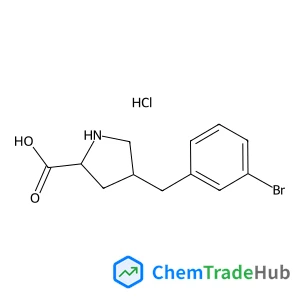
(2S,4R)-4-(3-Bromobenzyl)pyrrolidine-2-carboxylic acid hydrochloride
CAS Number:
1049734-10-2
Molecular Formula:
C12H15BrClNO2
![3,7-Di(1,1':3',1''-terphenyl-5'-yl)-10,11,12,13-tetrahydrodiindeno[7,1-de:1',7'-fg][1,3,2]dioxaphosphocin-5-ol 5-oxide structure](https://static.chemtradehub.com/structs/135/1352810-38-8-3f10.webp "3,7-Di(1,1':3',1''-terphenyl-5'-yl)-10,11,12,13-tetrahydrodiindeno[7,1-de:1',7'-fg][1,3,2]dioxaphosphocin-5-ol 5-oxide structure")
3,7-Di(1,1':3',1''-terphenyl-5'-yl)-10,11,12,13-tetrahydrodiindeno[7,1-de:1',7'-fg][1,3,2]dioxaphosphocin-5-ol 5-oxide
CAS Number:
1352810-38-8
Molecular Formula:
C53H39O4P
![Ethyl ({[(2-methyl-2-propanyl)oxy]carbonyl}amino)(2-pyridinyl)acetate structure](https://static.chemtradehub.com/structs/313/313490-90-3-dd15.webp "Ethyl ({[(2-methyl-2-propanyl)oxy]carbonyl}amino)(2-pyridinyl)acetate structure")
Ethyl ({[(2-methyl-2-propanyl)oxy]carbonyl}amino)(2-pyridinyl)acetate
CAS Number:
313490-90-3
Molecular Formula:
C14H20N2O4
Recommended Suppliers




Disclaimer
This page provides academic journal information for reference and research purposes only. We are not affiliated with any journal publishers and do not handle publication submissions. For publication-related inquiries, please contact the respective journal publishers directly.
If you notice any inaccuracies in the information displayed, please contact us at support@chemtradehub.com. We will promptly review and address your concerns.