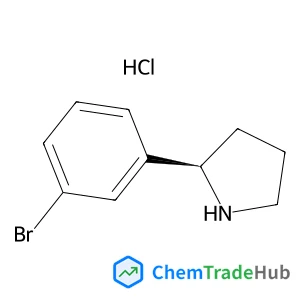
(2R)-2-(3-Bromophenyl)pyrrolidine hydrochloride (1:1)
CAS Number:
1391550-13-2
Molecular Formula:
C10H13BrClN
César Ray, Edurne Avellanal-Zaballa, Jessica Colligan, Florencio Moreno, Gilles Muller, Jorge Bañuelos, Beatriz L. Maroto, Santiago de la Moya
We report a workable and easy approach for the direct post-multifunctionalization of common BODIPYs (F-BODIPYs) with minimal interference to the starting photophysical behavior. It entails the easy transformation of an F-BODIPY into the corresponding N-BODIPY by using a dissimilarly-N,N′-disubstituted bis(sulfonamide), which is easily obtained from ethane-1,2-diamine. This approach is exemplified by the rapid synthesis of a selected battery of unprecedented dissimilar-at-boron N-BODIPYs, which are rationally designed to act as efficient multichromophoric arrays for light harvesting by excitation energy transfer, as specific bioprobes for fluorescent imaging, or as efficient chiroptical dyes exhibiting visible circular dichroism and circularly polarized luminescence. Noticeably, this approach has led to the synthesis of the first CPL-bright chiral-at-boron BODIPYs, a significant novelty in BODIPY chemistry and CPL emitters.
Haichao Huang, Hailong Wang, Chao Gong, Zhenjing Zhuang, Wenmin Feng, Si-Hai Wu, Lianhui Wang
DOI: 10.1039/D1QO01478A
Peter Mai, Georg Zocher, Thilo Stehle, Shu-Ming Li
DOI: 10.1039/C8OB02037J
Lin Su, Zheng Yu, Peiling Ren, Zhi Luo, Wei Hou, Hongtao Xu
DOI: 10.1039/C8OB02071J
Yuping Zhu, Tianqi Liu, Bingxin Liu, Houguang Shi, Qitao Tan
DOI: 10.1039/D1QO01574E
Mingsheng Wu, Xianghu Zhao, Yisen Liu, Song Cao
DOI: 10.1039/C8OB02117A
Madhu Ramesh, Pandeeswar Makam, Chandrashekhar Voshavar, Harshavardhan Khare, Kolla Rajasekhar, Suryanarayanarao Ramakumar, Thimmaiah Govindaraju
DOI: 10.1039/C8OB01691G
Girish Singh Bisht, Akanksha M. Pandey, Moreshwar B. Chaudhari, Sandip G. Agalave, Abhishek Kanyal, Krishanpal Karmodiya, Boopathy Gnanaprakasam
DOI: 10.1039/C8OB01852A
Fangyi Li, Changfu Qiu, Guangwei Yin, Chunhua Wang, Zheng Li
DOI: 10.1039/C8OB01941J
N-(4-Methoxybenzyl)-2-pyridinamine (CAS: 52818-63-0) is increasingly being used ...
When handling Ethyl 4-(2-chlorophenyl)-1,3-thiazole-2-carboxylate, appropriate p...
Diethyldiselane (CAS: 628-39-7) is classified under the Globally Harmonized Syst...
The market for oxocopper (CAS: 12053-18-8) is primarily driven by its use in cat...
The market for 5-{[(2-Methyl-2-propanyl)oxy]carbonyl}-5-azaspiro[2.4]heptane-7-c...
2-(1-Pyrrolidinyl)-4-pyridinamine is a chemical compound with the CAS number 359...
2-(3-Pyridinyl)-1-azabicyclo[2.2.2]octane (CAS: 91556-75-1) is a crystalline sol...
(S)-Alpha-allyl-proline hydrochloride is usually synthesized via a Wittig reacti...
3-Methyl-1,2-oxazole-5-carboxylic acid (CAS: 4857-42-5) is an organic compound w...
Lys-SMCC-DM1 is synthesized via a multi-step process involving the coupling of S...

Organic Chemistry Frontiers publishes high-quality research from across organic chemistry. Emphases are placed on studies that make significant contributions to the field of organic chemistry by reporting either new or significantly improved protocols or methodologies. Topics include, but are not limited to the following: Organic synthesis Development of synthetic methodologies Catalysis Natural products Functional organic materials Supramolecular and macromolecular chemistry Physical and computational organic chemistry
![1,10-bis(3,5-dimethylphenyl)-12-hydroxy-4,5,6,7-tetrahydroiindeno[7,1-de:1',7'-fg][1,3,2]dioxaphosphocine 12-oxide structure](https://static.chemtradehub.com/structs/141/1412439-82-7-b9a9.webp "1,10-bis(3,5-dimethylphenyl)-12-hydroxy-4,5,6,7-tetrahydroiindeno[7,1-de:1',7'-fg][1,3,2]dioxaphosphocine 12-oxide structure")