












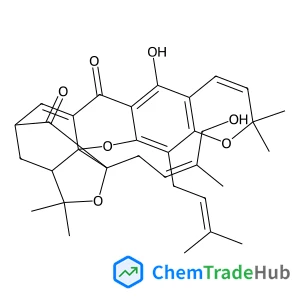
Structure-based protein engineering enables prenyl donor switching of a fungal aromatic prenyltransferase
Literature Information
Publication Date
2018-09-21
DOI
10.1039/C8OB02037J
Impact Factor
3.876
Authors
Peter Mai, Georg Zocher, Thilo Stehle, Shu-Ming Li
View Original
Abstract
Microorganisms provide valuable enzyme machinery to assemble complex molecules. Fungal prenyltransferases (PTs) typically catalyse highly regiospecific prenylation reactions that are of significant pharmaceutical interest. While the majority of PTs accepts dimethylallyl diphosphate (DMAPP), very few such enzymes can use geranyl diphosphate (GPP) or farnesyl diphosphate (FPP) as donors. This catalytic gap prohibits the wide application of PTs for structural diversification. Structure-guided molecular modelling and site-directed mutagenesis of FgaPT2 from Aspergillus fumigatus led to the identification of the gatekeeping residue Met328 responsible for the prenyl selectivity and sets the basis for creation of GPP- and FPP-accepting enzymes. Site-saturation mutagenesis of the gatekeeping residue at position 328 in FgaPT2 revealed that the size of this side chain is the determining factor for prenyl selectivity, while its hydrophobicity is crucial for allowing DMAPP and GPP to bind.
Related Literature
Macromolecular complexation of poly(methylenephosphine) to gold(i): a facile route to highly metallated polymers
Bronwyn H. Gillon, Brian O. Patrick, Derek P. Gates
2008-03-28
Communication
DOI: 10.1039/B719199E
One-step solid-state thermolysis of a metal–organic framework: a simple and facile route to large-scale of multiwalled carbon nanotubes
Linyun Chen, Junfeng Bai, Chunzhao Wang, Yi Pan, Manfred Scheer, Xiaozeng You
2008-01-31
Communication
DOI: 10.1039/B718476J
Photoinduced CO release, cellular uptake and cytotoxicity of a tris(pyrazolyl)methane (tpm) manganese tricarbonyl complex
Johanna Niesel, Antonio Pinto, Harmel W. Peindy N'Dongo, Klaus Merz, Ingo Ott, Ronald Gust, Ulrich Schatzschneider
2008-02-08
Communication
DOI: 10.1039/B719075A
Highly luminescent mono- and multilayers of immobilized CdTe nanocrystals: controlling optical properties through post chemical surface modification
Takaaki Tsuruoka, Rena Takahashi, Toshihiro Nakamura, Minoru Fujii, Kensuke Akamatsu, Hidemi Nawafune
2008-01-29
Communication
DOI: 10.1039/B717732A
Amplified nitric oxide photorelease in DNA proximity
Fiorella L. Callari, Salvatore Sortino
2008-03-20
Communication
DOI: 10.1039/B800132D
Inhibition and dispersion of proteobacterial biofilms
Justin J. Richards, Robert W. Huigens III, T. Eric Ballard, Anne Basso, John Cavanagh, Christian Melander
2008-02-08
Communication
DOI: 10.1039/B719802G
Central-ring functionalization and application of the rigid, aromatic, and H-shaped pentiptycene scaffold
Jye-Shane Yang, Jyu-Lun Yan
2008-02-14
Feature Article
DOI: 10.1039/B713428M
A simple method for the containment and purification of filled open-ended single wall carbon nanotubes using C60 molecules
Lidong Shao, Tsung-Wu Lin, Gerard Tobias, Malcolm L. H. Green
2008-03-05
Communication
DOI: 10.1039/B800881G
You might also like
Compound Q&A
What is the market or research trend for N-(4-Methoxybenzyl)-2-pyridinamine (CAS: 52818-63-0)?
N-(4-Methoxybenzyl)-2-pyridinamine (CAS: 52818-63-0) is increasingly being used ...
52818-63-0N-(4-Methoxybenzyl)-...
Compound Q&A
What precautions should be taken when handling Ethyl 4-(2-chlorophenyl)-1,3-thiazole-2-carboxylate (CAS: 1050507-06-6)?
When handling Ethyl 4-(2-chlorophenyl)-1,3-thiazole-2-carboxylate, appropriate p...
1050507-06-6Ethyl 4-(2-chlorophe...
Compound Q&A
What regulatory guidelines apply to diethyldiselane (CAS: 628-39-7)?
Diethyldiselane (CAS: 628-39-7) is classified under the Globally Harmonized Syst...
628-39-7Diethyldiselane
Compound Q&A
What is the market or research trend for oxocopper (CAS: 12053-18-8)?
The market for oxocopper (CAS: 12053-18-8) is primarily driven by its use in cat...
12053-18-8oxocopper; oxo-(oxoc...
Compound Q&A
What is the market or research trend for 5-{[(2-Methyl-2-propanyl)oxy]carbonyl}-5-azaspiro[2.4]heptane-7-carboxylic acid?
The market for 5-{[(2-Methyl-2-propanyl)oxy]carbonyl}-5-azaspiro[2.4]heptane-7-c...
1268519-54-55-{[(2-Methyl-2-prop...
Compound Q&A
What is 2-(1-Pyrrolidinyl)-4-pyridinamine (CAS: 35981-63-6)?
2-(1-Pyrrolidinyl)-4-pyridinamine is a chemical compound with the CAS number 359...
35981-63-62-(1-Pyrrolidinyl)-4...
Compound Q&A
What are the physical and chemical properties of 2-(3-Pyridinyl)-1-azabicyclo[2.2.2]octane (CAS: 91556-75-1)?
2-(3-Pyridinyl)-1-azabicyclo[2.2.2]octane (CAS: 91556-75-1) is a crystalline sol...
91556-75-12-(3-Pyridinyl)-1-az...
Compound Q&A
How is (S)-Alpha-allyl-proline hydrochloride (CAS: 129704-91-2) typically synthesized?
(S)-Alpha-allyl-proline hydrochloride is usually synthesized via a Wittig reacti...
129704-91-2(S)-Alpha-allyl-prol...
Compound Q&A
What is 3-Methyl-1,2-oxazole-5-carboxylic acid (CAS: 4857-42-5)?
3-Methyl-1,2-oxazole-5-carboxylic acid (CAS: 4857-42-5) is an organic compound w...
4857-42-53-Methyl-1,2-oxazole...
Compound Q&A
How is Lys-SMCC-DM1 (CAS: 1281816-04-3) typically synthesized?
Lys-SMCC-DM1 is synthesized via a multi-step process involving the coupling of S...
1281816-04-3Lys-SMCC-DM1
Source Journal
Organic & Biomolecular Chemistry

CiteScore:
3.4
Self-citation Rate:
10.3%
Articles per Year:
1041
Organic & Biomolecular Chemistry (OBC) publishes original and high impact research and reviews in organic chemistry. We welcome research that shows new or significantly improved protocols or methodologies in total synthesis, synthetic methodology or physical and theoretical organic chemistry as well as research that shows a significant advance in the organic chemistry or molecular design aspects of chemical biology, catalysis, supramolecular and macromolecular chemistry, theoretical chemistry, mechanism-oriented physical organic chemistry, medicinal chemistry or natural products. Articles published in the journal should report new work which makes a highly-significant impact in the field. Routine and incremental work is generally not suitable for publication in the journal. More details about key areas of our scope are below. In all cases authors should include in their article clear rationale for why their research has been carried out.
Recommended Compounds
![(2R,6S)-6-[(Benzyloxy)methyl]-4-{[(2-methyl-2-propanyl)oxy]carbonyl}-2-morpholinecarboxylic acid structure](https://static.chemtradehub.com/structs/109/1093085-91-6-3382.webp "(2R,6S)-6-[(Benzyloxy)methyl]-4-{[(2-methyl-2-propanyl)oxy]carbonyl}-2-morpholinecarboxylic acid structure")
(2R,6S)-6-[(Benzyloxy)methyl]-4-{[(2-methyl-2-propanyl)oxy]carbonyl}-2-morpholinecarboxylic acid
CAS Number:
1093085-91-6
Molecular Formula:
C18H25NO6
Recommended Suppliers




Disclaimer
This page provides academic journal information for reference and research purposes only. We are not affiliated with any journal publishers and do not handle publication submissions. For publication-related inquiries, please contact the respective journal publishers directly.
If you notice any inaccuracies in the information displayed, please contact us at support@chemtradehub.com. We will promptly review and address your concerns.