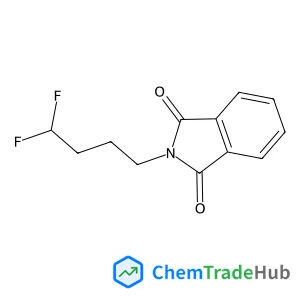
2-(4,4-Difluorobutyl)-1H-isoindole-1,3(2H)-dione
CAS Number:
1265341-14-7
Molecular Formula:
C12H11F2NO2
Seon-Mi Jin, Jun Ho Hwang, Jaehyeong Park, Du Hyeon Ryu, BongSoo Kim, Chang Eun Song, Eunji Lee
Achieving precise control over the 3D morphology of the active layer in all-polymer solar cells (APSCs) is crucial for improving power conversion efficiency and stability. The ideal configuration involves a vertically aligned p–n nanoheterojunction with a 10–20 nm exciton diffusion length, but the inherent freedom of polymer chains poses challenges due to their stochastic nature. Extensive exploration of spatial analytical techniques, from molecular to macroscale levels, is also needed to reveal the polymer behavior governing the active layers. Meanwhile, halogenated solvents are used for high-efficiency APSC fabrication due to their favorable solubility with each polymer component. However, recent efforts aim to harness non-halogenated solvents, mitigating toxicity and environmental hazards. Here, we explore the generation of uniform thin film morphologies based on solution-processable crystallization-driven polymer assemblies. Pre-assembled n-type crystalline nanowires (NWs) via heating and cooling solutions of non-halogenated 1,2,4-trimethylbenzene formed very well-aligned, uniform thin film structures with well-dissolved noncrystalline p-type polymers and showed efficiency comparable to the performance of thin films prepared with chlorobenzene (CB) halogenated solvent. X-ray scattering and transmission electron microtomography confirm organized, long-range aligned one-dimensional NWs with closely interfaced p–n nanoheterojunctions through strong intra- and inter-polymeric π-stacking interactions. Notably, the resulting thin film morphology resembles that of blended film casting with CB. Significantly, the long-term stability of the crystalline NWs-based thin film morphology under light exposure surpasses that of blend films due to robust intermolecular packing in the NWs.

Science Progress

Journal of Medicinal Chemistry

Helvetica Chimica Acta

Organic Preparations and Procedures International

Proceedings of the National Academy of Sciences of the United States of America

Journal of Organometallic Chemistry

Molecular Pharmacology

European Journal of Wood and Wood Products

Russian Chemical Reviews

Pharmacological Reviews
Jonathon Duay, Eleanor Gillette, Junkai Hu
DOI: 10.1039/C3CP50724F
Ling Chen, Wan Guo, Yuxin Yang, Ang Zhang, Shengqu Zhang, Yihang Guo, Yingna Guo
DOI: 10.1039/C3CP00084B
Jan Rongé, Dorien Nijs, Stef Kerkhofs, Kasper Masschaele, Johan A. Martens
DOI: 10.1039/C3CP50890K
Reshma Sultana, Naser Reza, Helena Woodvine, Jonathan G. Terry, Anthony J. Walton, Charlotte L. Brady, Ilka Schmueser, Andrew R. Mount
DOI: 10.1039/C3CP50759A
S. Sasanka Kumar, Manoj Komath, Manoj Raama Varma, M. K. Jayaraj, K. Rajeev Kumar
DOI: 10.1039/C3CP42648C
Zhiguo Wang, Qiulei Su, Huiqiu Deng
DOI: 10.1039/C3CP51167G
Chunhui Li, Lei Yang, Junyan Xiao, Yih-Chyng Wu, Martin Søndergaard, Yanhong Luo, Dongmei Li, Qingbo Meng, Bo Brummerstedt Iversen
DOI: 10.1039/C3CP50365H
Oliver L. G. Alderman, Dinu Iuga, Andrew P. Howes, Diane Holland, Ray Dupree
DOI: 10.1039/C3CP50772F
Javier Catalán
DOI: 10.1039/C3CP44627A
N-(4-Methoxybenzyl)-2-pyridinamine (CAS: 52818-63-0) is increasingly being used ...
When handling Ethyl 4-(2-chlorophenyl)-1,3-thiazole-2-carboxylate, appropriate p...
Diethyldiselane (CAS: 628-39-7) is classified under the Globally Harmonized Syst...
The market for oxocopper (CAS: 12053-18-8) is primarily driven by its use in cat...
The market for 5-{[(2-Methyl-2-propanyl)oxy]carbonyl}-5-azaspiro[2.4]heptane-7-c...
2-(1-Pyrrolidinyl)-4-pyridinamine is a chemical compound with the CAS number 359...
2-(3-Pyridinyl)-1-azabicyclo[2.2.2]octane (CAS: 91556-75-1) is a crystalline sol...
(S)-Alpha-allyl-proline hydrochloride is usually synthesized via a Wittig reacti...
3-Methyl-1,2-oxazole-5-carboxylic acid (CAS: 4857-42-5) is an organic compound w...
Lys-SMCC-DM1 is synthesized via a multi-step process involving the coupling of S...

Polymer Chemistry welcomes submissions in all areas of polymer science that have a strong focus on macromolecular chemistry. Manuscripts may cover a broad range of fields, yet no direct application focus is required.
![1-(1-Benzyl-1,2,3,6-tetrahydropyridin-4-yl)-1H-benzo[d]imidazol-2(3H)-one structure](https://static.chemtradehub.com/structs/603/60373-71-9-7dfb.webp "1-(1-Benzyl-1,2,3,6-tetrahydropyridin-4-yl)-1H-benzo[d]imidazol-2(3H)-one structure")