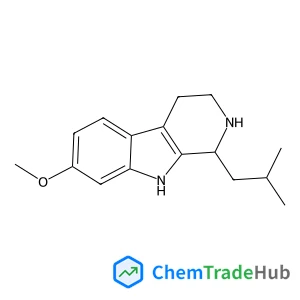
1-Isobutyl-7-methoxy-2,3,4,9-tetrahydro-1H-beta-carboline
CAS Number:
175975-76-5
Molecular Formula:
C16H22N2O
Jan Rongé, Dorien Nijs, Stef Kerkhofs, Kasper Masschaele, Johan A. Martens
Water splitting was performed in a photoelectrochemical cell (PEC) with water oxidation and hydrogen formation reactions in two separate compartments. A photoanode consisting of carbon paper loaded with TiO2 and a cathode made of Pt dispersed on carbon black spread also on carbon paper were fixed on both sides of a Nafion® membrane and electrically coupled via an external circuit. Anode and cathode compartments with serpentine flow field were operated either in the liquid or vapour phase. Electrical current was monitored with chronoamperometry and D2 formation from deuterated water using mass spectrometry. Mapping the photocurrent under a variety of reaction conditions enabled identification of the limiting factors related to proton and photocarrier transport and reaction product evacuation. This comprehensive research approach to the operation of a PEC will assist future optimisation of cell design and development of membrane electrode assemblies.

European Journal of Wood and Wood Products

Kinetics and Catalysis

Organic Preparations and Procedures International

Planta Medica

Nature

Molecular Pharmacology

Proceedings of the National Academy of Sciences of the United States of America

Journal of Organometallic Chemistry

Pure and Applied Chemistry

Helvetica Chimica Acta
H. Schulze, G. Henihan, A. Hardie, I. Ciani, G. Giraud, J. G. Terry, A. J. Walton, R. Pethig, P. Ghazal, K. E. Templeton, A. R. Mount, T. T. Bachmann
DOI: 10.1039/C3AN01319G
Jialu Wang, Martha Sibrian-Vazquez, Jorge O. Escobedo, Mark Lowry, Lei Wang, Yu-Hsuan Chu, Richard G. Moore, Robert M. Strongin
DOI: 10.1039/C3AN01168B
Jiyuan Li, Xijiao Ren, Jiaxing Zhao, Xinhui Lou
DOI: 10.1039/D1AN00182E
Renan Cunha, Lucas Lafeta, Marco A. Romano-Silva, Rafael Vieira, Leandro M. Malard
DOI: 10.1039/D1AN00074H
Ping-hua Ling, Xiao-na Zang, Cai-hua Qian, Feng Gao
DOI: 10.1039/D1AN00142F
Hui-Jun Zhang, Jin Zhu, Ning Bao, Shou-Nian Ding
DOI: 10.1039/D0AN02437F
B. Turner, J. Mizukado, S. G. Kazarian
DOI: 10.1039/C7AN00337D
Wei Zhang, Saiyu Bu, Qinghong Yuan, Ming Hu
DOI: 10.1039/C8TA09817D
Zhiling Luo, Changhong Liu, Shoushan Fan, Enchong Liu
DOI: 10.1039/C9TA04105B
N-(4-Methoxybenzyl)-2-pyridinamine (CAS: 52818-63-0) is increasingly being used ...
When handling Ethyl 4-(2-chlorophenyl)-1,3-thiazole-2-carboxylate, appropriate p...
Diethyldiselane (CAS: 628-39-7) is classified under the Globally Harmonized Syst...
The market for oxocopper (CAS: 12053-18-8) is primarily driven by its use in cat...
The market for 5-{[(2-Methyl-2-propanyl)oxy]carbonyl}-5-azaspiro[2.4]heptane-7-c...
2-(1-Pyrrolidinyl)-4-pyridinamine is a chemical compound with the CAS number 359...
2-(3-Pyridinyl)-1-azabicyclo[2.2.2]octane (CAS: 91556-75-1) is a crystalline sol...
(S)-Alpha-allyl-proline hydrochloride is usually synthesized via a Wittig reacti...
3-Methyl-1,2-oxazole-5-carboxylic acid (CAS: 4857-42-5) is an organic compound w...
Lys-SMCC-DM1 is synthesized via a multi-step process involving the coupling of S...

Physical Chemistry Chemical Physics (PCCP) is an international journal co-owned by 19 physical chemistry and physics societies from around the world. This journal publishes original, cutting-edge research in physical chemistry, chemical physics and biophysical chemistry. To be suitable for publication in PCCP, articles must include significant innovation and/or insight into physical chemistry; this is the most important criterion that reviewers and Editors will judge against when evaluating submissions. The journal has a broad scope and welcomes contributions spanning experiment, theory, computation and data science. Topical coverage includes spectroscopy, dynamics, kinetics, statistical mechanics, thermodynamics, electrochemistry, catalysis, surface science, quantum mechanics, quantum computing and machine learning. Interdisciplinary research areas such as polymers and soft matter, materials, nanoscience, energy, surfaces/interfaces, and biophysical chemistry are welcomed if they demonstrate significant innovation and/or insight into physical chemistry. Joined experimental/theoretical studies are particularly appreciated when complementary and based on up-to-date approaches.
![1-{3-[4-Amino-3-(4-phenoxyphenyl)-1H-pyrazolo[3,4-d]pyrimidin-1-yl]-1-piperidinyl}-2,3-dihydroxy-1-propanone structure](https://static.chemtradehub.com/structs/122/1226872-27-0-e037.webp "1-{3-[4-Amino-3-(4-phenoxyphenyl)-1H-pyrazolo[3,4-d]pyrimidin-1-yl]-1-piperidinyl}-2,3-dihydroxy-1-propanone structure")
![5'-Fluoro-[2,3'-biindolinylidene]-2',3-dione structure](https://static.chemtradehub.com/structs/251/251903-00-1-9cb1.webp "5'-Fluoro-[2,3'-biindolinylidene]-2',3-dione structure")