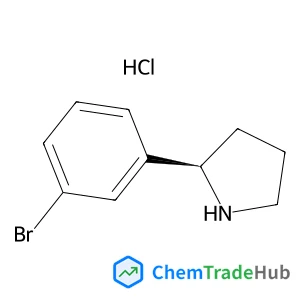
(2R)-2-(3-Bromophenyl)pyrrolidine hydrochloride (1:1)
CAS Number:
1391550-13-2
Molecular Formula:
C10H13BrClN
S. Sasanka Kumar, Manoj Komath, Manoj Raama Varma, M. K. Jayaraj, K. Rajeev Kumar
The poor solubility, poor biocompatibility and disposal issues make fluorescent quantum dots such as CdSe, CdS, ZnS, InP, InAs, etc. impractical for imaging tissues or intercellular structures. As calcium phosphate is the main inorganic component of human bone and teeth, hydroxyapatite (Ca10(PO4)6(OH)2, HAp) is highly biocompatible and bioactive. Since HAp nanoparticles are not luminescent, a novel inorganic biocompatible fluorescent probe was suggested by doping HAp with lanthanides. Here we report the growth of chemically pure fluorescent HAp nanoparticles synthesized by a new methodology, liquid phase pulsed laser ablation using third harmonics (355 nm) of Nd-YAG laser. Europium doped HAp nanoparticles show emission with prominent peaks at 531 nm, 572 nm, 601 nm and 627 nm upon excitation at a wavelength of 325 nm. The red luminescence could also be observed under visible excitation at 459 nm and is suitable for living cell applications.
Dipankar Das, Rabiul Alam
DOI: 10.1039/D1AN01788H
Kawin Khachornsakkul, Kuen-Hau Hung, Jung-Jung Chang, Wijitar Dungchai, Chih-Hsin Chen
DOI: 10.1039/D1AN00032B
Virginia Chu, João Gonçalves
DOI: 10.1039/D1AN01810H
Juan Ouyang, Lihe Sun, Fang Zeng, Shuizhu Wu
DOI: 10.1039/D1AN02183D
Bernadette Byrne, Sergei G. Kazarian
DOI: 10.1039/D1AN00087J
DOI: 10.1039/JA9860100293
Xudong Zheng, Chun Wang, Jiangdong Dai, Weidong Shi, Yongsheng Yan
DOI: 10.1039/C4TA06860B
DOI: 10.1039/JA9860100281
T. L. Palama, I. Canard, G. J. P. Rautureau, C. Mirande, S. Chatellier, B. Elena-Herrmann
DOI: 10.1039/C6AN00393A
Fang Li, Xiuming Wu, Mengmeng Gu, Guang-Li Wang
DOI: 10.1039/D0AN02438D
N-(4-Methoxybenzyl)-2-pyridinamine (CAS: 52818-63-0) is increasingly being used ...
When handling Ethyl 4-(2-chlorophenyl)-1,3-thiazole-2-carboxylate, appropriate p...
Diethyldiselane (CAS: 628-39-7) is classified under the Globally Harmonized Syst...
The market for oxocopper (CAS: 12053-18-8) is primarily driven by its use in cat...
The market for 5-{[(2-Methyl-2-propanyl)oxy]carbonyl}-5-azaspiro[2.4]heptane-7-c...
2-(1-Pyrrolidinyl)-4-pyridinamine is a chemical compound with the CAS number 359...
2-(3-Pyridinyl)-1-azabicyclo[2.2.2]octane (CAS: 91556-75-1) is a crystalline sol...
(S)-Alpha-allyl-proline hydrochloride is usually synthesized via a Wittig reacti...
3-Methyl-1,2-oxazole-5-carboxylic acid (CAS: 4857-42-5) is an organic compound w...
Lys-SMCC-DM1 is synthesized via a multi-step process involving the coupling of S...

Physical Chemistry Chemical Physics (PCCP) is an international journal co-owned by 19 physical chemistry and physics societies from around the world. This journal publishes original, cutting-edge research in physical chemistry, chemical physics and biophysical chemistry. To be suitable for publication in PCCP, articles must include significant innovation and/or insight into physical chemistry; this is the most important criterion that reviewers and Editors will judge against when evaluating submissions. The journal has a broad scope and welcomes contributions spanning experiment, theory, computation and data science. Topical coverage includes spectroscopy, dynamics, kinetics, statistical mechanics, thermodynamics, electrochemistry, catalysis, surface science, quantum mechanics, quantum computing and machine learning. Interdisciplinary research areas such as polymers and soft matter, materials, nanoscience, energy, surfaces/interfaces, and biophysical chemistry are welcomed if they demonstrate significant innovation and/or insight into physical chemistry. Joined experimental/theoretical studies are particularly appreciated when complementary and based on up-to-date approaches.
![N-{15-[(2,5-Dioxo-1-pyrrolidinyl)oxy]-15-oxo-3,6,9,12-tetraoxapentadec-1-yl}-2-(2-propyn-1-yloxy)acetamide structure](https://static.chemtradehub.com/structs/210/2101206-92-0-2eb5.webp "N-{15-[(2,5-Dioxo-1-pyrrolidinyl)oxy]-15-oxo-3,6,9,12-tetraoxapentadec-1-yl}-2-(2-propyn-1-yloxy)acetamide structure")